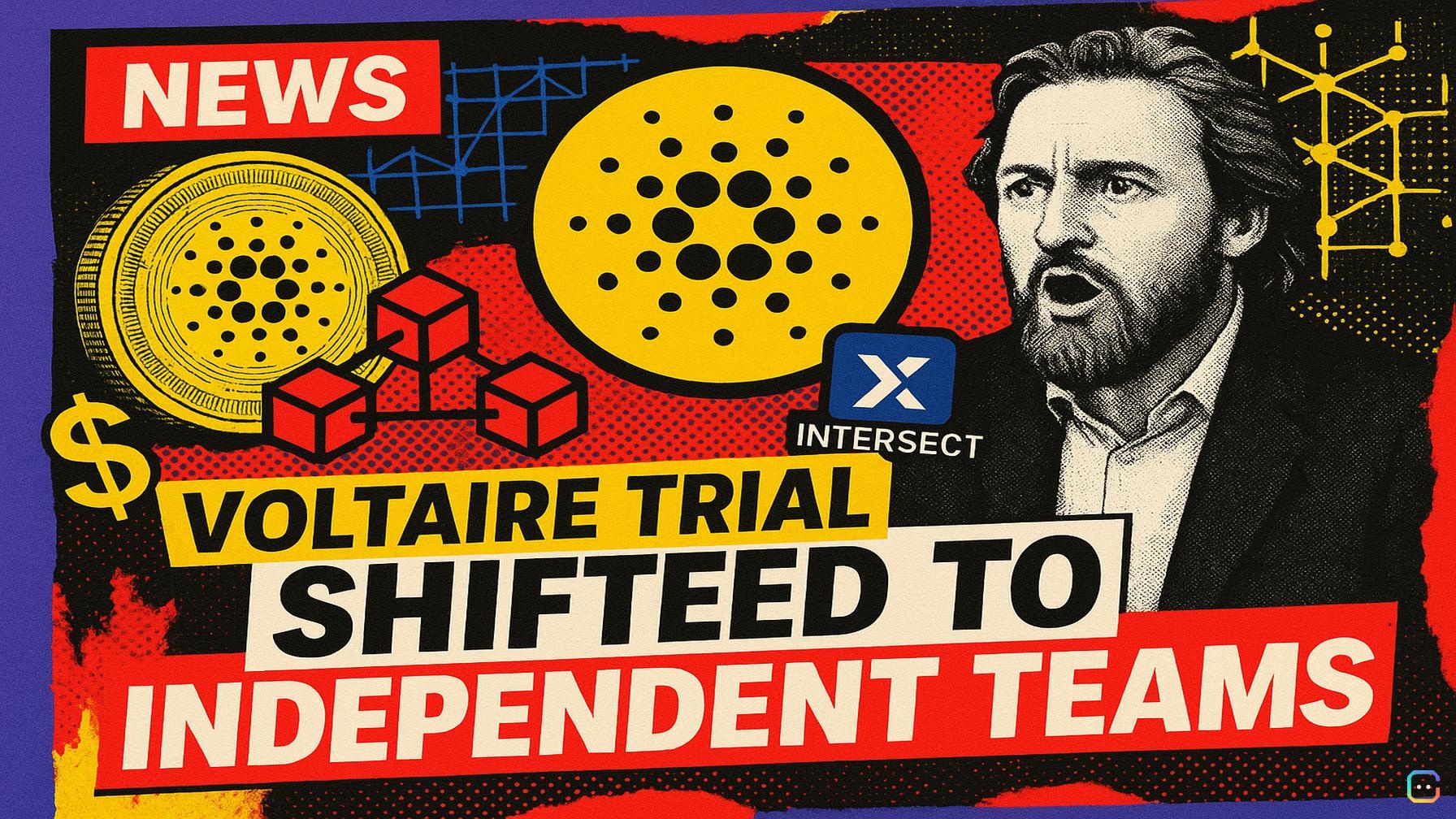
Headline: Cardano to Hand Core Infrastructure to Independent Teams — A Real-World Test of Voltaire
Cardano is preparing a major operational shift that will move core infrastructure responsibilities away from Input Output Global (IOG) and into the hands of independent ecosystem teams — with Intersect providing oversight. The transition, slated to begin in August, covers critical components including the Haskell node, the Plutus smart contract platform, the Daedalus wallet, and Hydra scaling tools.
Why this matters
- This isn’t a cosmetic governance change: it moves decentralization from policy and token-voting theory into day-to-day engineering and maintenance.
- Cardano has long promoted decentralization as a core identity trait, and the Voltaire era is designed to give community institutions and ecosystem teams real operational power. The handover will test whether that ideal can work in practice without degrading coordination, code quality, or development momentum.
What’s changing
- Responsibility for core pieces of Cardano’s stack will shift from IOG to multiple independent teams.
- Intersect is expected to act as the coordination hub: prioritizing work, communicating with the community, and helping prevent critical tasks from slipping through the cracks.
- The affected components include the Haskell node, Plutus, Daedalus, and Hydra — all central to developer and user experience.
Opportunities and risks
- If successful, the move would materially strengthen Cardano’s decentralization credentials: the network would be less dependent on a single founding company and more resilient to organizational change.
- If coordination breaks down, the process could become fragmented or slow, reinforcing critiques that Cardano’s governance-first approach sacrifices execution speed for ideals.
- Practical challenges include aligning priorities across teams, funding and governance becoming politicized, preserving technical standards, and maintaining rigorous security and release processes.
Market implications
- Traders and the broader market rarely price governance changes in isolation. They will look for concrete outcomes: increased development activity, better tooling, stronger DeFi growth, and visible momentum among builders.
- In a competitive layer-1 landscape — with Ethereum, Solana and others vying for developers and liquidity — governance uniqueness helps Cardano’s positioning only if it produces measurable progress.
Intersect’s role
- Intersect is intended to provide structure for decentralized development rather than to become another central operator. The aim is an accountable ecosystem where responsibilities are distributed but coordinated.
- That balance is difficult: open-source ecosystems can be powerful but also messy. How Intersect manages priorities, communications, and quality assurance will be critical.
The takeaway
This handover is a structural milestone, not a short-term PR event. For Cardano’s long-term supporters, it’s a sign the network is “growing up” and building independent institutions necessary for longevity. But the next phase must deliver: reliable infrastructure, improving developer tooling, and ecosystem growth. The market will judge the shift by results, not intent.
Sources: Materials released by Intersect (Intersect MBO) and Input Output Global.
Written by the News Desk; edited by Samuel Rae.
Read more AI-generated news on: undefined/news