Your AI just executed several tiny payments while you read that headline — you didn’t approve them, and Visa didn’t process them. If some of crypto’s loudest voices are right, that moment points to the future of the internet economy.
Coinbase founder Brian Armstrong recently suggested that AI agents will soon outnumber humans in making online transactions. Binance founder Changpeng Zhao went further, predicting agents could drive a million times more payments than people — and that most of those payments will be in crypto. Their posts, shared the same day last week, crystallize a structural argument about how agents and money will interact.
Two constraints make crypto attractive to autonomous agents. First, banks require identity verification that software agents can’t provide; opening an account typically means KYC and compliance gates. Second, a crypto wallet needs only a private key to operate. That friction asymmetry — identity-heavy fiat rails vs. key-based crypto wallets — is central to the argument Armstrong made.
But the technical story is only half the picture. The other half is economics. AI agents don’t shop like humans. When an agent completes a task (researching, coordinating logistics, compiling reports), it often calls dozens of specialized APIs in one session. Each call might cost fractions of a cent to cover GPU compute, real-time data, web scraping, or hiring a specialist sub-agent. Those microtransactions are tiny — and they’re not what Visa or Mastercard were built to process.
To illustrate: imagine this article was produced by an agent working for a CoinDesk “chief” agent. It might verify Armstrong’s tweet ($0.002), query on-chain volume ($0.004), check press releases ($0.001), and consult a finance model for payments protocol details ($0.003), then pay an AI writing tool to assemble the text. Six transactions, total cost under two cents, according to protocols like x402. Running the same six micropayments over a card network would be absurdly expensive — Stripe’s minimum processing fee on a single transaction is around $0.30, so card rails could cost more than 100x the underlying value.
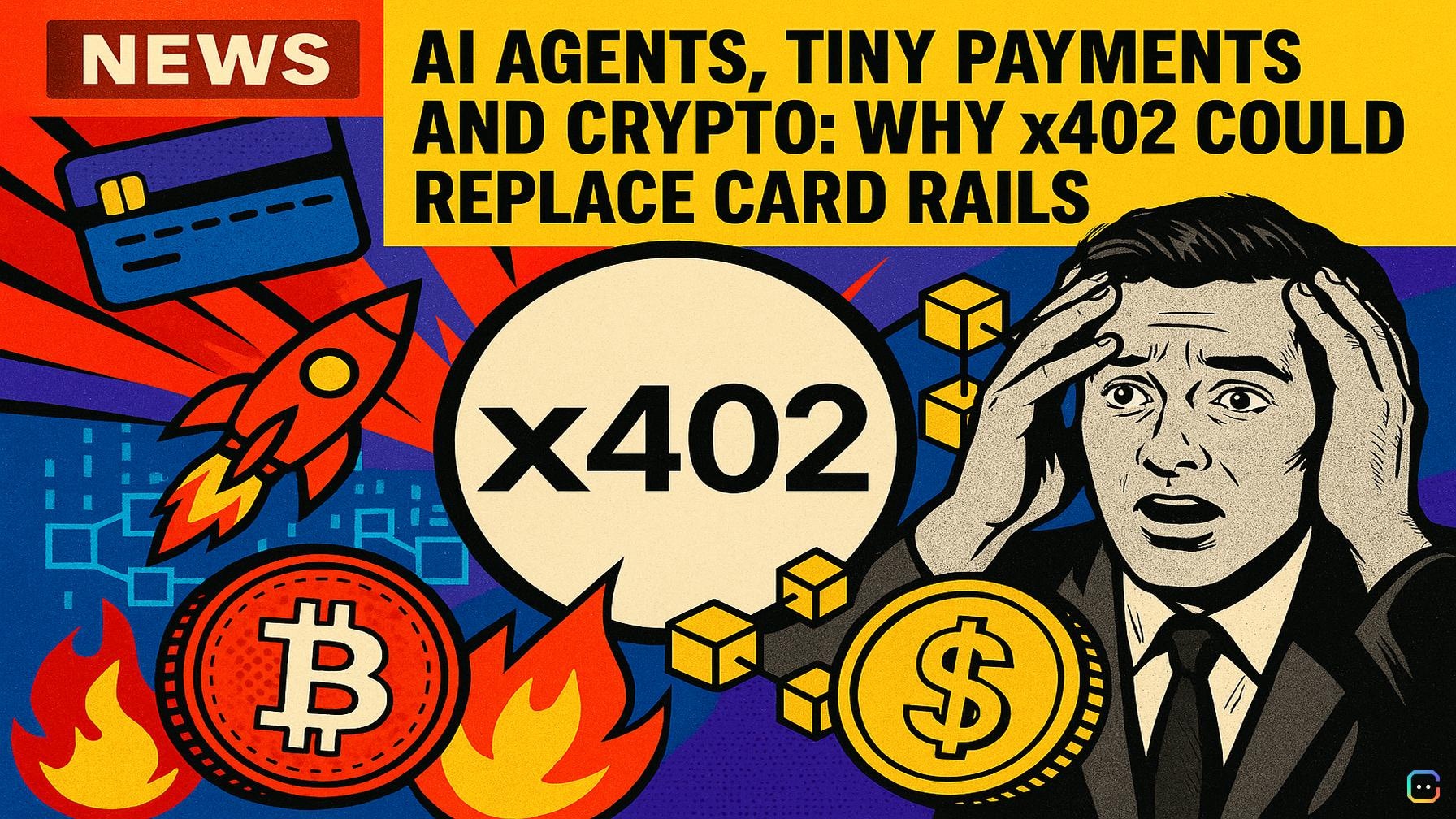
That economic mismatch is the idea behind x402, Coinbase’s open payment protocol that embeds stablecoin payments into HTTP requests so an agent can hit a paywall, pay in USDC, and continue its task in a single interaction. Cloudflare, Circle, AWS, and Stripe are among the backers, and Google’s open agent payments standard includes x402 as a settlement layer.
Where could this matter most? Industries with high-frequency, low-value data exchange are prime candidates:
- Healthcare: an agent managing an insurance claim pays per document retrieved from a medical-records API.
- Logistics: procurement agents bid and settle freight slots in real time across carriers.
- Media: crawlers pay per article indexed instead of negotiating bulk licenses.
- Finance: trading agents pay specialist models fractions of a cent for risk signals.
Reality, however, is catching up with theory. CoinDesk reports x402 currently processes roughly $28,000 in daily volume, but analytics firm Artemis flags about half of observed transactions as artificial activity rather than real commerce. The kinds of merchants x402 targets are still relatively rare.
Meanwhile, traditional finance is adapting. Visa launched its Trusted Agent Protocol last October, and Mastercard recently completed Europe’s first live AI-agent bank payment inside Santander’s regulated infrastructure — both operating on card rails but with cryptographic verification layered on.
The most plausible near-term outcome is a bifurcated payments landscape: regulated commerce and consumer-facing transactions remain on card rails, while high-frequency, machine-to-machine payments — agents hiring agents, paying for API calls, buying compute — migrate to stablecoins because the economics demand it. The open question is which side eventually dominates.
Read more AI-generated news on: undefined/news