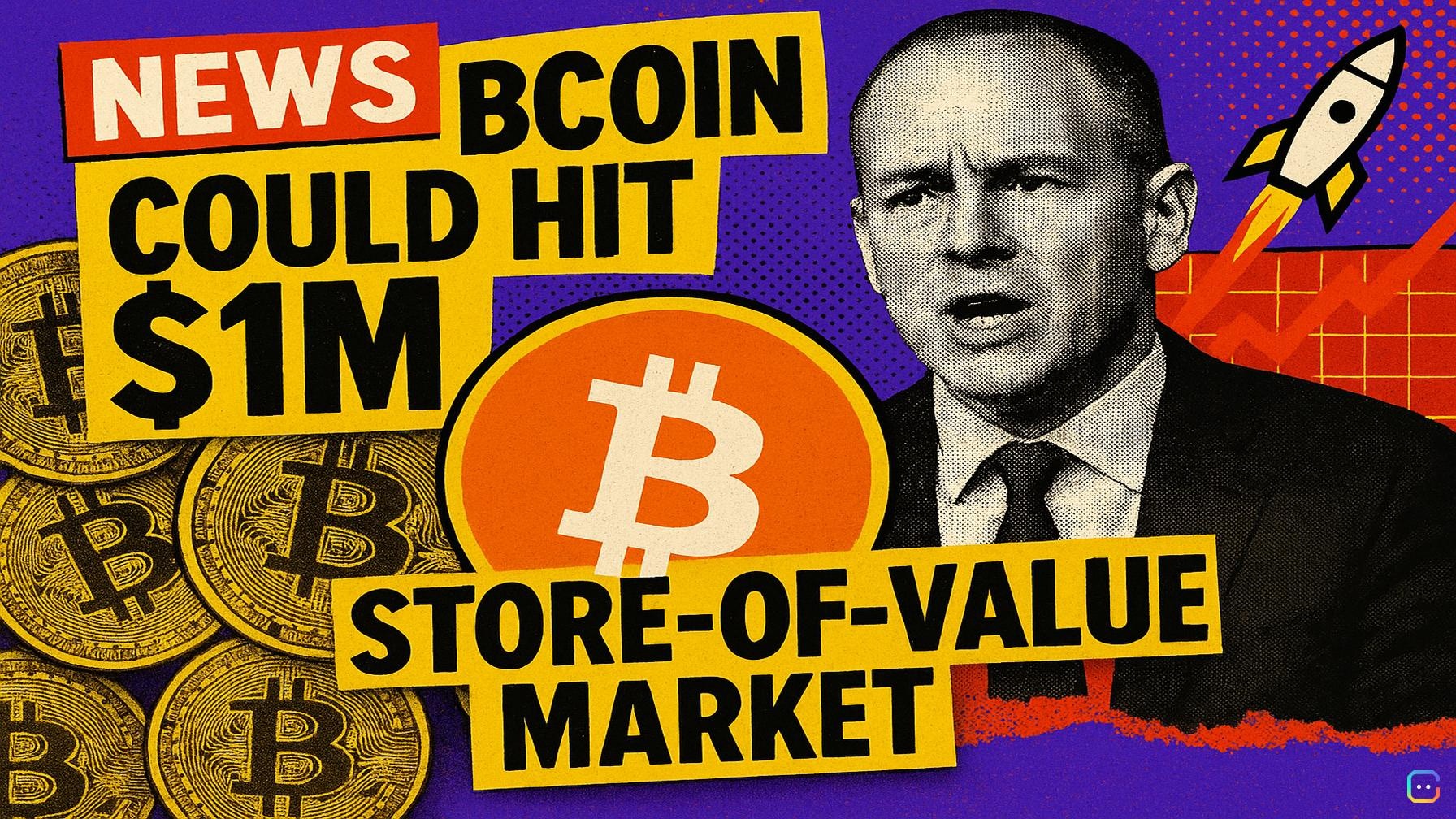
Bitwise CIO Matt Hougan is once again making headlines with a bold, but analytically grounded claim: bitcoin could reach $1 million a coin if it captures a substantially larger slice of the global store-of-value market now dominated by gold, government bonds and other defensive assets.
In a recent report Hougan argued the crypto’s long-term upside hinges less on short-term market cycles and more on market-share gains within the worldwide wealth-preservation sector. He pointed out the sector’s dramatic expansion—from roughly $2.5 trillion in 2004 to nearly $40 trillion today—and noted that bitcoin currently represents only about 4% of that market by value. “One million sounds crazy,” Hougan admitted. “It implies bitcoin will rise 14x from today’s price.” But under his math, if bitcoin were to capture roughly half of today’s store-of-value market, its price could approach $1 million within about a decade. If the broader market keeps growing, bitcoin would need an even smaller share to hit that mark.
That $1 million figure has become a recurring touchstone across the crypto industry. High-profile supporters and bullish forecasts include Eric Trump doubling down on the call, Coinbase CEO Brian Armstrong suggesting bitcoin could hit $1M by 2030, Jack Dorsey saying it could happen in five years, Arthur Hayes eyeing as soon as 2028, Ark Invest projecting $3.8M by decade’s end, and Bernstein forecasting $1M by 2033. The repeated citation of the round number has generated both excitement and scrutiny.
Analysts told CoinDesk the headline number functions as shorthand for a bigger idea: bitcoin as a credible rival to gold for long-term value storage. “It’s a clean headline and shorthand for the idea that Bitcoin could rival gold as a store of value. The exact number matters less than the share of global wealth Bitcoin captures,” said Mati Greenspan, founder of Quantum Economics.
Jason Fernandes, co-founder of AdLunam, echoed that the milestone is as much psychological and narrative-driven as it is a precise forecast. Round numbers travel well in marketing and align with holder incentives, he said, but the underlying thesis isn’t pure hype. Fernandes warned of a common error—valuing bitcoin against today’s store-of-value market instead of a much larger future one—and reframed the question: not if $1M is theoretically possible, but whether institutional adoption compounds long enough to make it reasonable. He also offered a concrete alternative math point: bitcoin would need roughly 17% of a projected $121 trillion store-of-value market over the next decade to justify a $1M price.
Most analysts who commented called Hougan’s view plausible over the long term but emphasized timing is the crux. Greenspan said geopolitical tension and macro uncertainty bolster bitcoin’s appeal as a “neutral” store of value alongside gold, but that reaching such a valuation would likely take years—if not a decade or more—of sustained institutional adoption and regulatory clarity. Nima Beni, founder of Bitlease, added that the timeline could compress if confidence in traditional safe assets erodes, citing potential sovereign debt crises or disruptions in gold markets as accelerants.
Hougan’s case rests in part on bitcoin’s characteristics: a fixed supply capped at 21 million coins and a decentralized network, which he and others argue give it attributes similar to traditional stores of value. But analysts stress the outcome rests less on price speculation and more on adoption dynamics and macroeconomic conditions—how much of the global wealth-preservation market investors ultimately allocate to bitcoin over time.
Bottom line: the $1 million bitcoin narrative persists because it captures a simple market-share story—bitcoin doesn’t need to replace gold, it only needs to claim a meaningful portion of a much bigger future store-of-value market. Whether that happens in five years, a decade, or longer remains the subject of vigorous debate.
Read more AI-generated news on: undefined/news