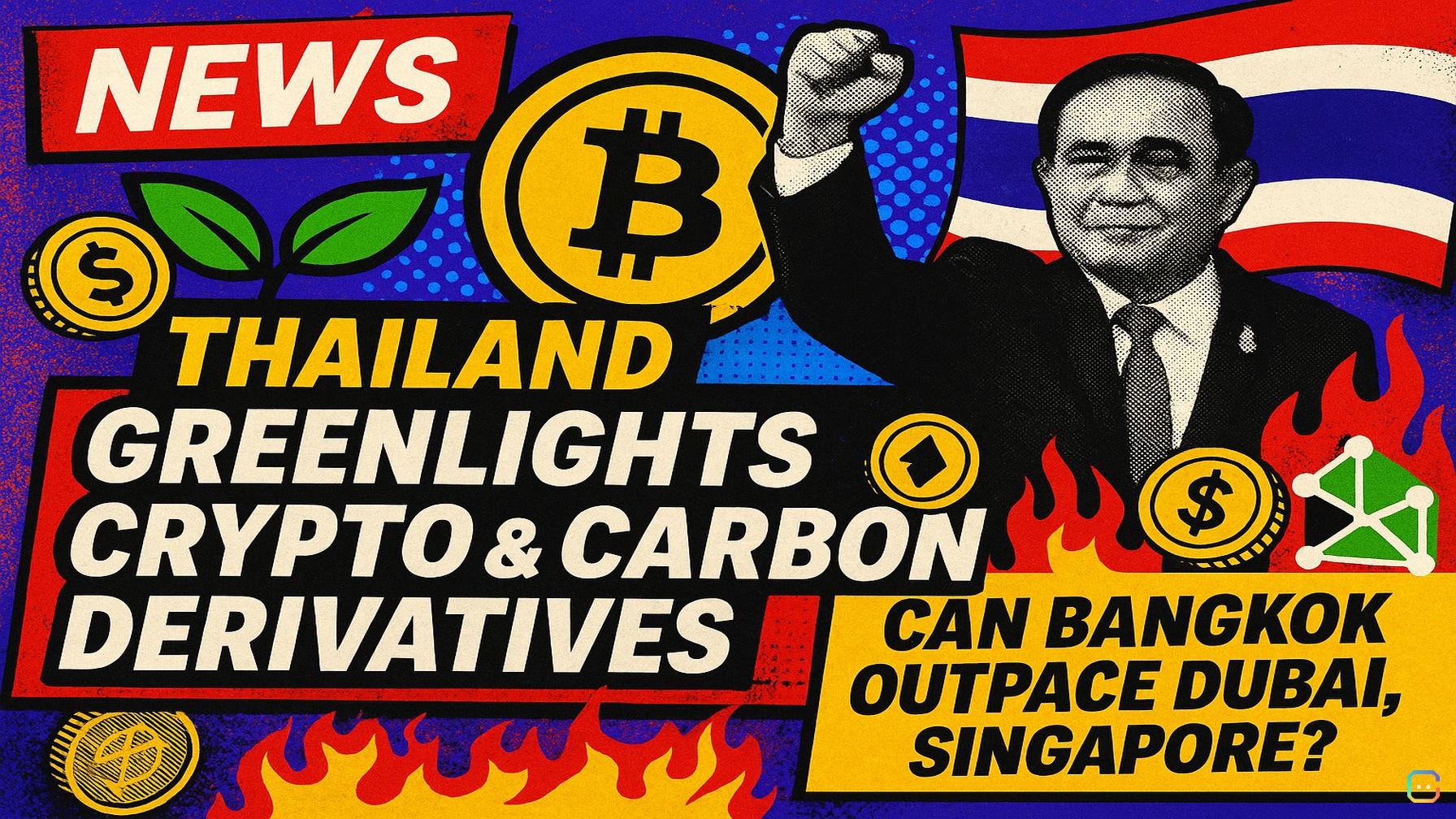
Is Bangkok positioning itself to rival Dubai and Singapore in the race for digital-asset primacy? Thailand’s government has just taken a major step that suggests it might be gearing up to do exactly that.
What changed
- The government has officially added digital assets and carbon credits as allowable reference products under the Derivatives Trading Act.
- That means cryptocurrencies and carbon credits can now serve as underlying assets for futures and options traded on the Thailand Futures Exchange (TFEX).
- Practically, institutional and large investors can trade crypto derivatives with the same market structure used for traditional commodities like gold or oil.
Why it matters
- This shifts crypto’s status in Thailand away from being treated largely as speculative retail assets toward a regulated asset class integrated into capital markets.
- Investors gain new risk-management tools—Bitcoin futures and options can help hedge against volatility and allow more sophisticated portfolio strategies. Regulators have signaled portfolio allocations of up to 5% for crypto in diversified strategies.
- The move empowers the SEC to better connect traditional finance with the digital economy and paves the way for larger institutional participation.
Regulatory guardrails
- The expansion comes with stricter rules: crypto firms (including Binance TH) must meet higher licensing standards, and brokers will face tighter supervision to limit market instability.
- These safeguards are designed to support growth while protecting investors and system stability.
Industry reaction
- Nirun Fuwattananukul, CEO of Binance TH, called the change “a watershed moment” for Thailand’s capital markets, saying it signals the country’s ambition to be a forward-looking leader in Southeast Asia’s digital economy. He and others have suggested the regulatory evolution could set the stage for Bitcoin ETFs and other institutional products as soon as 2026.
How Thailand got here — a quick timeline
- 2018: Thailand introduced the first licensing rules for crypto exchanges.
- 2021: Crypto trading surged in popularity; some consumers were even using Bitcoin for luxury purchases.
- March 2022: Bank of Thailand banned crypto as a means of payment to protect financial stability.
- Post-2022: Authorities adopted a “balanced” approach—restricting crypto as everyday money but encouraging it as an investable asset class.
- 2024: Regulatory sandbox launched to test new products and models.
- 2025: Banks entered the market; Kasikorn Bank received a crypto custodian license and began offering digital services. Local token projects (KUB, JFIN, BAND) also helped revive activity.
Incentives and next steps
- A capital gains tax exemption for trades executed on approved platforms runs through December 31, 2029, providing a fiscal sweetener for market participants.
- Market watchers and industry leaders expect the next milestones to include Bitcoin ETFs and carbon credit futures by 2026—developments that would further integrate Thailand into the global digital-asset ecosystem.
Bottom line
Thailand’s regulatory pivot is measured but significant: it creates structured pathways for institutional crypto trading, strengthens oversight, and uses targeted incentives to attract capital and innovation. Whether Bangkok can overtake or even closely rival established hubs like Dubai and Singapore will depend on how smoothly products are launched, how rules are enforced, and how fast institutional demand materializes.
Disclaimer: AMBCrypto's content is informational and not investment advice. Cryptocurrency trading is high-risk; do your own research before making financial decisions. © 2026 AMBCrypto
Read more AI-generated news on: undefined/news