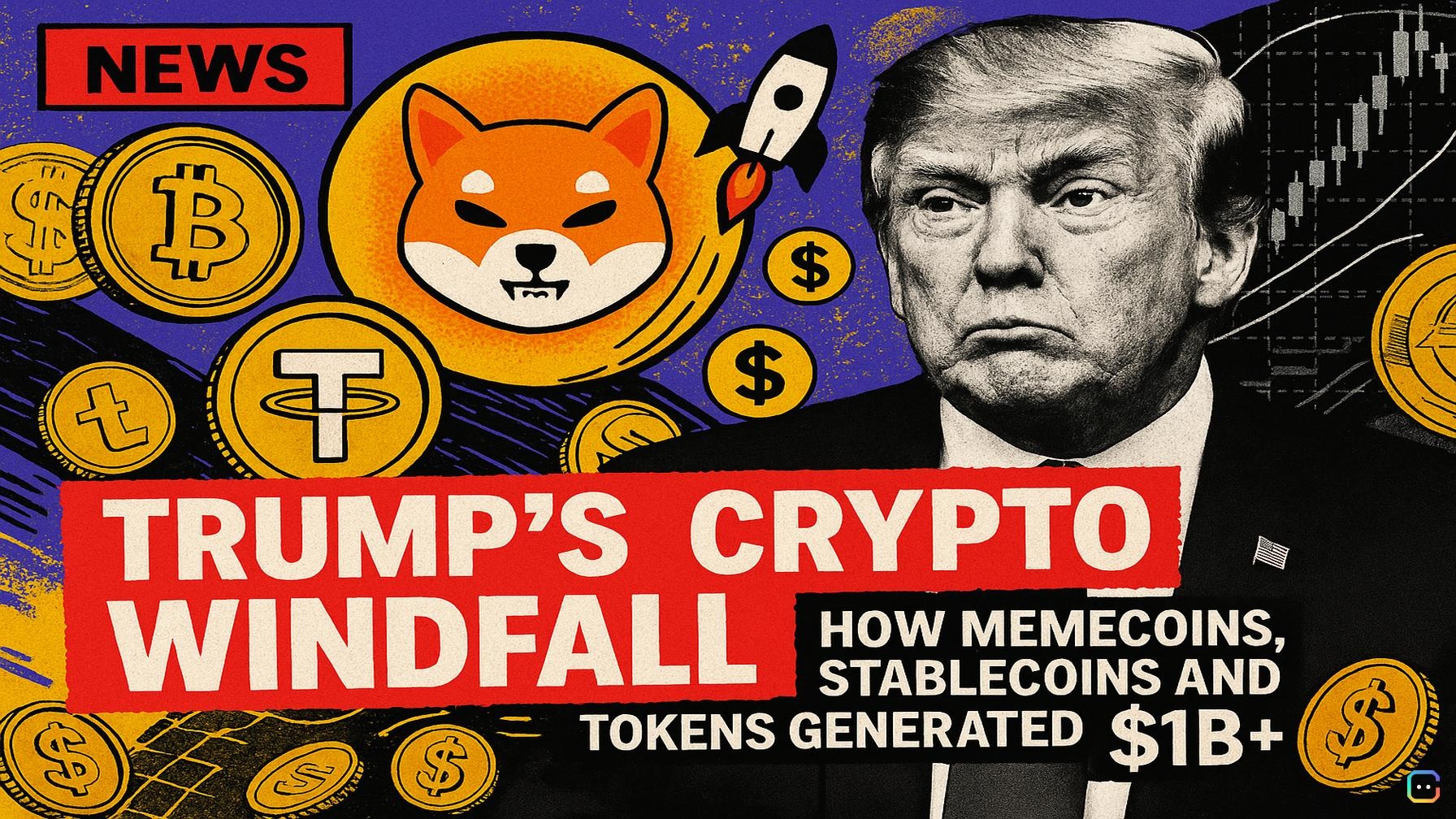
Headline: From “scam” to cash cow — How Trump’s crypto holdings generated more than $1 billion last year
Donald Trump once dismissed cryptocurrency as a “scam.” According to his newly released financial disclosure, crypto went on to become a major revenue source for him: the report shows he took in more than $1 billion from crypto in the last year. That figure — and the mechanics behind it — have prompted intense scrutiny from critics and investigators, and raised fresh questions about conflicts of interest and the integrity of U.S. crypto policy.
What the filings and investigations say
- Trump’s disclosure attributes roughly $500 million-plus to World Liberty Financial (WLFI and USD1) and more than $600 million to the $TRUMP memecoin business, together exceeding $1 billion in revenue.
- Forbes has revised its estimate of Trump’s net worth to about $6 billion, up from $2.3 billion in 2024.
- Reuters found the Trump family’s four main crypto ventures (World Liberty, the memecoin business, American Bitcoin and AI Financial Corp) have generated roughly $2.3 billion for the family since Trump returned to office — nearly matching reported losses by more than a million investors.
- Journalistic probes by outlets including the Wall Street Journal, Reuters and Forbes underpin many of the timeline and ownership details below.
Three crypto products tied to Trump
Trump and his businesses are connected to three distinct types of digital assets:
1) $TRUMP (memecoin)
- Launched three days before Trump’s January 2025 inauguration.
- Memecoins have no underlying business model; their value is driven by attention and speculation.
- About 80% of $TRUMP’s supply is held by Trump-affiliated entities, which also collect a fee on trades. Revenues reportedly exceeded $600 million.
- The token’s price crashed after initial hype and now trades about 98% below its peak. Some buyers reportedly spent $148 million worth of the token to secure seats at a Trump dinner.
- Legal experts warn anonymous purchases of memecoins can function as untraceable gifts to public officials.
2) USD1 (stablecoin)
- USD1 is designed to maintain a 1:1 peg to the U.S. dollar by backing issued coins with cash and short-term U.S. Treasury securities.
- Stablecoin issuers collect customer fiat, buy interest-bearing Treasuries, and keep interest income. Larger reserve balances mean larger yield revenue — the basic revenue engine here.
- Binance reportedly wrote the code for USD1 and promoted it on its exchange. Binance holds about 87% of the USD1 supply.
- In May 2025, MGX — an Abu Dhabi state fund chaired by Sheikh Tahnoon bin Zayed Al Nahyan — invested $2 billion into Binance using USD1. That created roughly $2 billion of interest-earning reserves for the Trump-linked venture, producing an estimated $80 million a year in yield.
- The SEC dropped a major lawsuit against Binance just days after Binance listed USD1. In October 2025, Trump pardoned Binance founder Changpeng Zhao.
3) WLFI (governance token) and World Liberty Financial
- WLFI is a governance token issued by World Liberty Financial, a company cofounded in 2024 by Trump family members and business partners.
- Governance tokens give holders voting rights over projects but do not confer ownership or profit claims.
- A Trump-affiliated business reportedly owns about 60% of World Liberty and is contractually entitled to 75% of net proceeds from token sales. World Liberty brought Trump more than $500 million last year, per his disclosure.
- The Wall Street Journal reported that Sheikh Tahnoon secretly acquired a 49% stake in World Liberty for about $500 million four days before the January 2025 inauguration.
How the money was made — the economics in plain terms
- Stablecoin model: Take in dollars, issue coins, invest the dollars in short-term Treasuries, keep the interest. The larger the reserves, the larger the interest income.
- Memecoin model: Issue a token that sparks trading activity; collect fees on every trade and retain large reserves of the token to benefit as volume peaks.
- Token-sale model: Owning large equity and entitlement stakes in token-issuing companies converts primary token sales and reserve flows into direct revenues.
Political fallout and legal concerns
- Illinois lieutenant governor and Democratic Senate candidate Juliana Stratton criticized the arrangement as using “public office to make billions while American families struggle,” calling it “disgusting.” The White House, via deputy press secretary Anna Kelly, has denied conflicts of interest, saying administration actions are taken in the public interest.
- Critics and legal experts argue the structure creates an unprecedented intersection of presidential influence and private crypto profit, potentially allowing anyone to buy access to the president by purchasing his coin.
- Some regulations introduced under Trump — such as the GENIUS Act, which clarifies some industry rules — are seen as positive by parts of the industry. But those regulatory gains risk being overshadowed by allegations of special favors, revolving-door decision-making, and opaque foreign investments into Trump-linked crypto ventures.
- The combination of high-profile investments, rapid regulatory moves, dropped litigation, and a presidential pardon has intensified concerns about the rule of law and regulatory capture.
Why this matters for crypto markets
- The episode underscores how token economics can funnel large amounts of yield and fees to insiders if they control issuance, reserves, and trading flows.
- It highlights counterparty and concentration risks (e.g., a single exchange holding a dominant share of a stablecoin).
- It raises new compliance, transparency and governance questions for an industry already grappling with investor protection, money-laundering risks, and geopolitical capital flows.
Bottom line
The disclosure that Trump earned more than $1 billion from crypto last year is a dramatic example of how digital-asset structures — stablecoins, governance tokens and memecoins — can generate rapid and substantial revenue. The details revealed by filings and investigative reporting have intensified scrutiny of the governance, transparency and political implications of crypto business models, and could shape how regulators and lawmakers respond going forward.
Read more AI-generated news on: undefined/news