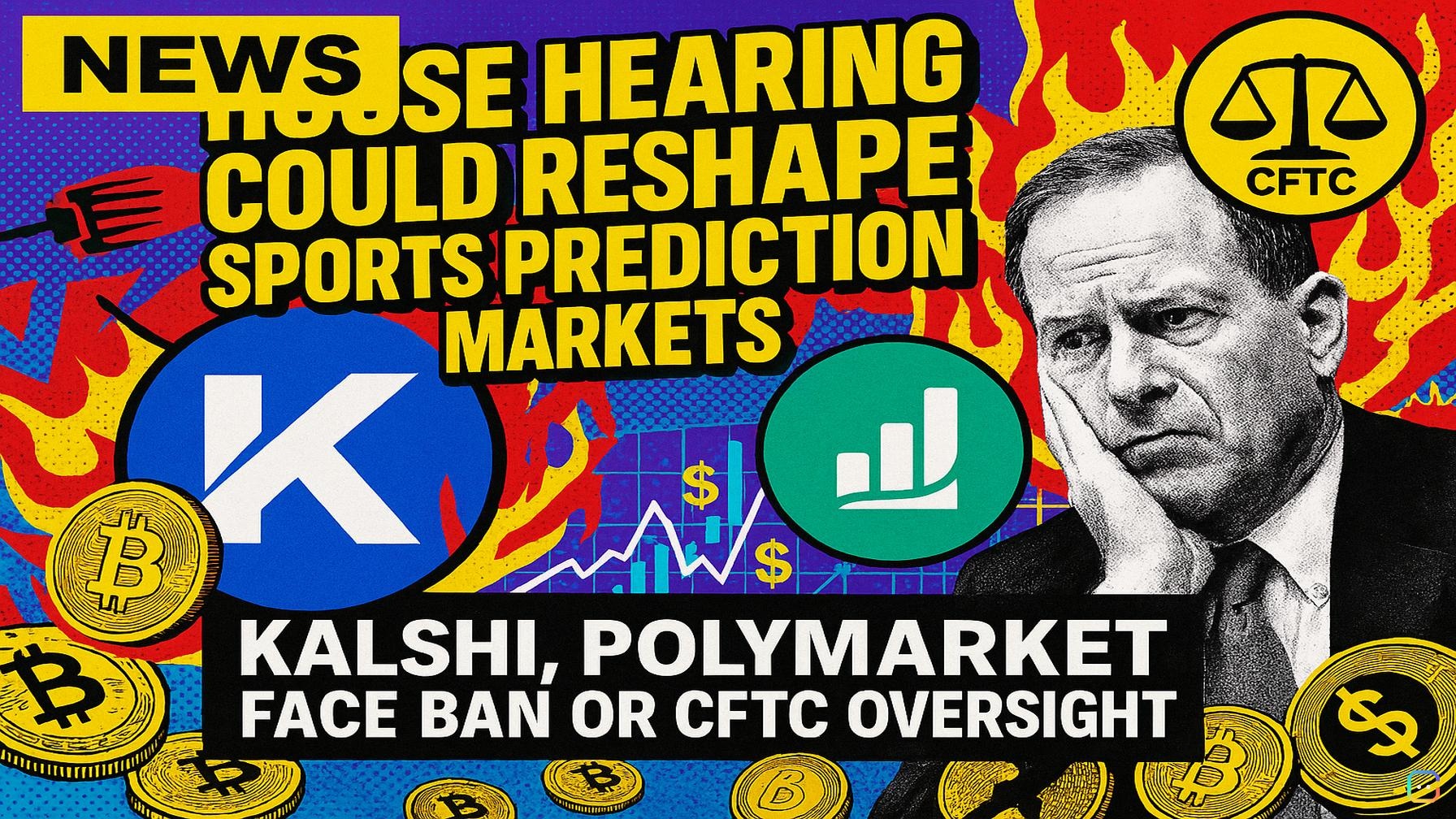
The U.S. House is taking a close look at sports prediction markets — and the outcome could reshape how platforms such as Kalshi and Polymarket operate.
What’s happening
- The House Agriculture Committee’s Subcommittee on Commodity Markets, Digital Assets, and Rural Development has scheduled a hearing focused on prediction markets tied to sporting events. Lawmakers say the session will probe customer protections and market integrity across these platforms.
- Expected witnesses include legal experts and executives from the American Gaming Association (AGA) and the Indian Gaming Association (IGA), both of which are urging Congress to ban sports contracts on regulated exchanges.
Why this matters
- Regulators and courts have already started to press platforms that offer sports-linked contracts, questioning whether those products are federally regulated derivatives or unlicensed gambling. Kalshi and Polymarket — two high-profile prediction-market venues — have been accused by some authorities of operating like traditional sportsbooks, despite marketing themselves as event markets.
- At the federal level, backers of prediction markets argue the Commodity Futures Trading Commission (CFTC) already has authority to oversee these event contracts and to block problematic listings. Legal observers reviewing testimony say proponents are asking Congress not to create new laws clarifying that power; instead they want the CFTC to use existing statutory authority to police the markets.
The competing arguments
- Supporters point to the CFTC’s existing tools — including authority under Dodd-Frank — to prohibit exchanges from listing contracts that conflict with the public interest. Robert Schwartz, a witness supporting prediction markets, said the agency can decide which event contracts exchanges may list without new congressional powers.
- Gaming-industry witnesses counter that the economic reality of these products mirrors conventional sports wagers and that exchanges are effectively sidestepping state gambling rules. David Bean of the Indian Gaming Association warns that allowing sports contracts on federally regulated exchanges risks turning them into nationwide online gambling platforms. As a result, the AGA and IGA are lobbying lawmakers to impose a ban on sports contracts rather than leave decisions to case-by-case CFTC review.
State and international pressure
- The issue has already seen action outside Congress. France’s gaming regulator blocked access to Polymarket, accusing the platform of offering illegal gambling services and treating the violation as a criminal offense subject to fines.
- In the U.S., a federal court decision by Judge Analisa Torres ruled that New York’s gambling laws apply to Kalshi’s sports-related event contracts. That judgment undercuts arguments that federal commodities oversight automatically preempts state gambling regulation and raises the prospect that states can continue to apply their own laws to these markets. While the ruling concerned Kalshi directly, observers say it could have spillover effects for Polymarket and others.
What’s at stake for crypto and DeFi markets
- The House hearing will present these conflicting legal theories to lawmakers: one side defending the CFTC’s ability to reject harmful contracts under current law, the other pressing Congress to bar sports-linked products entirely from regulated exchanges.
- Meanwhile, decentralized platforms are moving forward with their own technical solutions. Hyperliquid announced plans for HIP-4, a system to let users create outcome markets permissionlessly. Under the proposal, validators would approve standardized market templates and enforce their rules on-chain; third parties could then deploy markets using those approved templates without seeking individual validator votes for each listing. Validators would still create a small number of “canonical markets” themselves.
Bottom line
- The House hearing could determine whether the U.S. preserves a federal, regulator-led framework for policing event contracts or moves toward a statutory ban on sports-linked products. Either outcome will have major implications for centralized prediction exchanges and decentralized market builders alike — even as projects like Hyperliquid continue to develop permissionless tooling that doesn’t resolve the underlying legal dispute.
Read more AI-generated news on: undefined/news