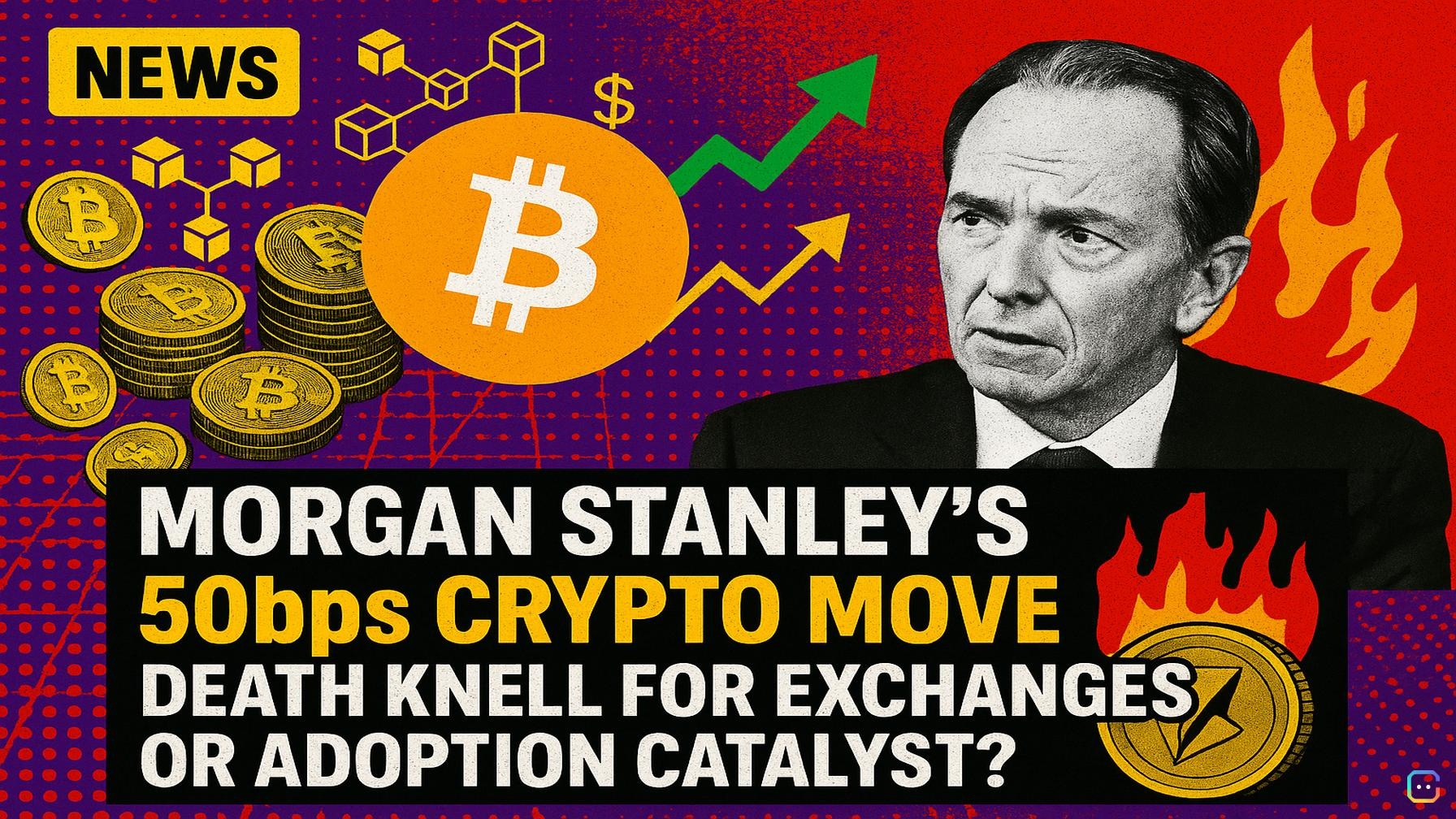
Morgan Stanley’s surprise move to roll out crypto trading on E*Trade at just 50 basis points has reignited a fierce debate about whether Wall Street’s entry will be the death knell for native crypto exchanges—or simply the next stage in the market’s evolution.
The reaction was immediate. Bloomberg analyst Eric Balchunas called it “SHOTS FIRED,” warning on X that Morgan Stanley’s price point undercuts Schwab (75 bps) and, by implication, other incumbents such as Coinbase and Robinhood. Some observers went further, saying Morgan Stanley “isn’t entering crypto to complement Coinbase—it’s entering to replace it.”
The pricing play echoes the 2024 spot‑ETF fee war, when providers initially launched with fees around 50 bps before Morgan Stanley dramatically cut rates to 14 bps. The likely short‑term outcome: trading costs fall—good news for retail traders but bad news for exchange margins. Coinbase, which recently cited financial pressure when announcing a 14% workforce reduction, is the poster child for platforms that could face squeezed revenue as competition intensifies.
Morgan Stanley frames the move as more than a price cut. Jed Finn, head of wealth management, said the initiative is “much bigger than trading crypto at a cheaper rate,” arguing the strategy is about “disintermediating the disintermediators.” Finn added that the push is designed to keep Morgan Stanley’s 8.6 million clients inside its ecosystem as crypto demand grows, predicting a highly competitive environment over the next few years.
Balchunas predicted copycat moves from rivals: based on how Schwab reacts, he suggested “it will likely won't let this stand. Others will probably undercut too,” and that “by the time the dust settles it'll be pretty dirt cheap to trade crypto everywhere.” His bottom line: TradFi is serious competition and native exchanges “should be scared.”
But crypto‑native leaders caution against a U.S.‑centric, doomsday reading. Kevin Lee, chief business officer at Gate (ranked seventh on CoinGecko with roughly $2 billion in 24‑hour volume), told CoinDesk Balchunas’ take “feels somewhat localized to the U.S. market and oversimplified.” He argued the fee cuts are part of a familiar pattern—competition compresses commissions—and noted that successful crypto platforms have long diversified beyond trading fees into staking, structured products, institutional services and broader ecosystem plays.
Other industry voices see a silver lining. Georgii Verbitskii, founder of non‑custodial DeFi protocol TYMIO, called Morgan Stanley’s move “clearly positive for crypto adoption overall,” adding that bringing crypto trading to millions of brokerage users helps normalize digital assets even if the 50 bps rate “is not especially competitive.” Echoing a middle path, crypto market analyst Keneabasi Umoren told CoinDesk he doesn’t believe TradFi will “kill exchanges,” but said it will “squeeze U.S. spot‑trading and custody revenue and push exchanges further into derivatives, DeFi and global markets.”
Bottom line: Morgan Stanley’s low fee is a catalytic moment, not necessarily a knockout blow. Expect trading costs to trend lower and pressure on margin-heavy business models, while exchanges pivot toward diversified revenue streams and non‑spot markets. At the same time, the move accelerates mainstream access to crypto—an adoption boost that could reshape where, how and by whom digital assets are traded.
Read more AI-generated news on: undefined/news