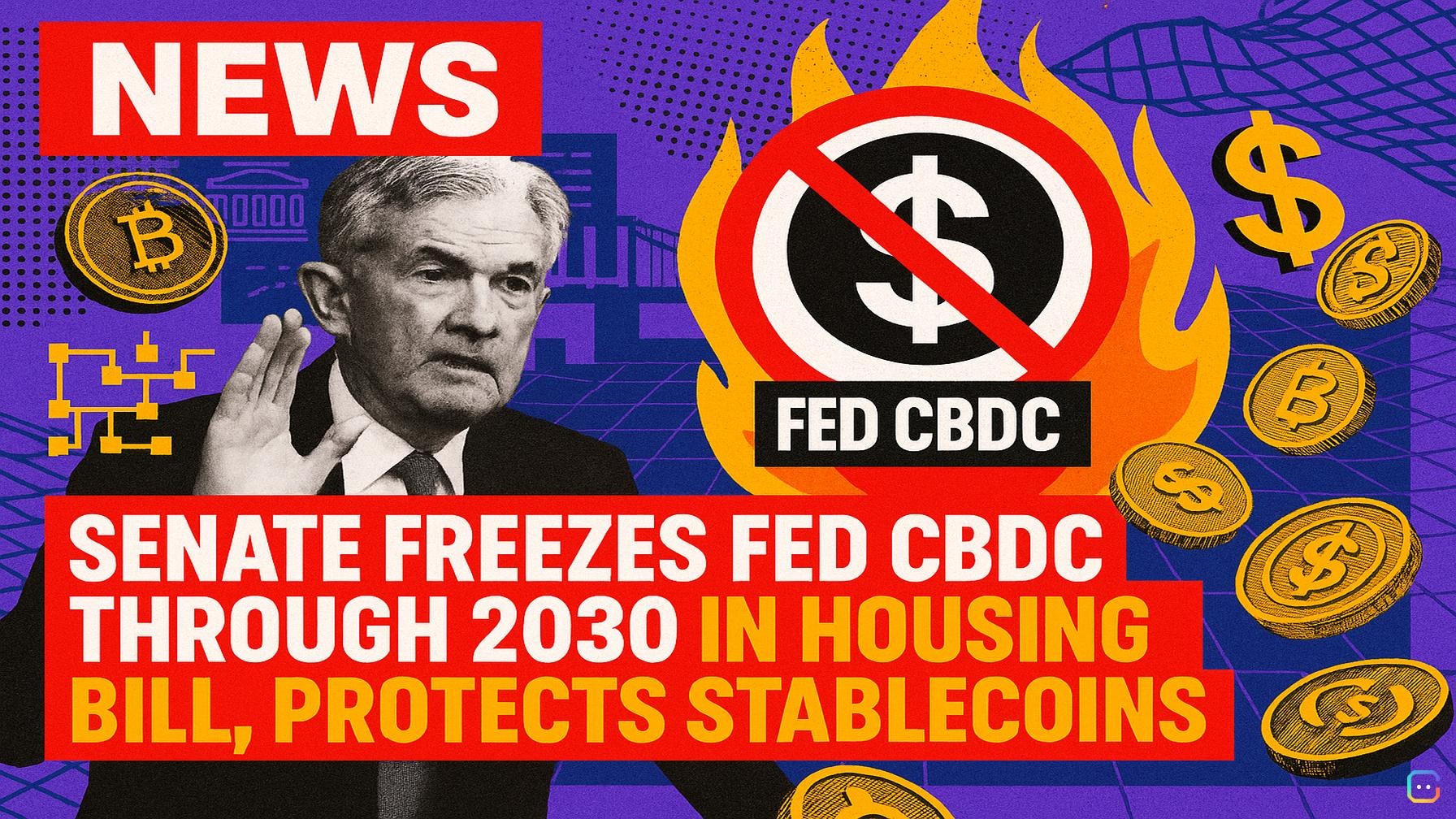
The U.S. Senate on Monday vaulted a surprising crypto policy change into lawmaking purview by passing a major housing bill that also freezes a Federal Reserve digital dollar for four years.
What happened
- The 21st Century ROAD to Housing Act cleared the Senate 85-5. The bill is primarily a bipartisan push to boost housing supply and curb large investors buying single-family homes.
- Hidden in the text is a provision barring the Federal Reserve from issuing a central bank digital currency (CBDC) through the end of 2030. The language prevents the Fed from issuing “a central bank digital currency or any digital asset that is substantially similar” either directly or indirectly through financial institutions or intermediaries.
- Even after 2030, the Fed would need explicit congressional authorization to pursue a digital dollar.
What it means for crypto and stablecoins
- The measure explicitly exempts private stablecoins — defined in the bill as “dollar‑denominated currency that is open, permissionless, and private.” Major issuers such as Circle and Tether are left untouched; the article notes they are governed by last year’s GENIUS Act.
- In practice, the ban locks out a government-run digital dollar for the near term, preserving the existing private stablecoin ecosystem and removing a potential competitive entrant into digital payments for the next several years.
Political context and process
- Lawmakers framed the package as a bipartisan win on housing. Banking Committee Chair Tim Scott (R-SC) and Ranking Member Elizabeth Warren (D-MA) jointly authored the bill; Scott said housing supply and prices are acute problems, while Warren called the package the most significant housing legislation in three decades. Senate Minority Leader Chuck Schumer also praised the effort.
- The CBDC freeze was attached as a political rider to help secure House Republican support and speed passage. The Senate first approved a version including the freeze in March (89-10), and negotiators reached reconciled text last week after months of talks with the House.
- Some House conservatives want a permanent ban; Rep. Anna Paulina Luna (R-FL) argued CBDCs are “bad for everyone.” House leaders are expected to take up the bill quickly, possibly as soon as Tuesday, before it heads to the White House.
Background on U.S. CBDC efforts
- The article says the Fed had not moved past research on a digital dollar. It also notes public opposition from both Fed Chair Kevin Warsh and President Donald Trump, who signed an executive order in January 2025 directing his administration not to pursue a CBDC.
- In short: there was no active federal CBDC rollout underway, and this bill would make that official policy for at least the next four years.
Global contrast
- The U.S. move contrasts with global momentum on CBDCs. The European Central Bank is preparing a digital euro with a pilot expected next year and a possible launch targeted for 2029. China continues expanding cross-border use of its e-CNY, recently onboarding dozens of financial institutions. According to the Atlantic Council, three countries have launched CBDCs and many more are piloting or developing them.
What to watch
- The House vote and any amendments, then the White House signing. If signed, the four-year freeze reshapes the near-term digital currency landscape in the U.S., protecting private stablecoin activity but leaving the long-term question of a U.S. CBDC open and squarely in Congress’s hands after 2030.
Read more AI-generated news on: undefined/news