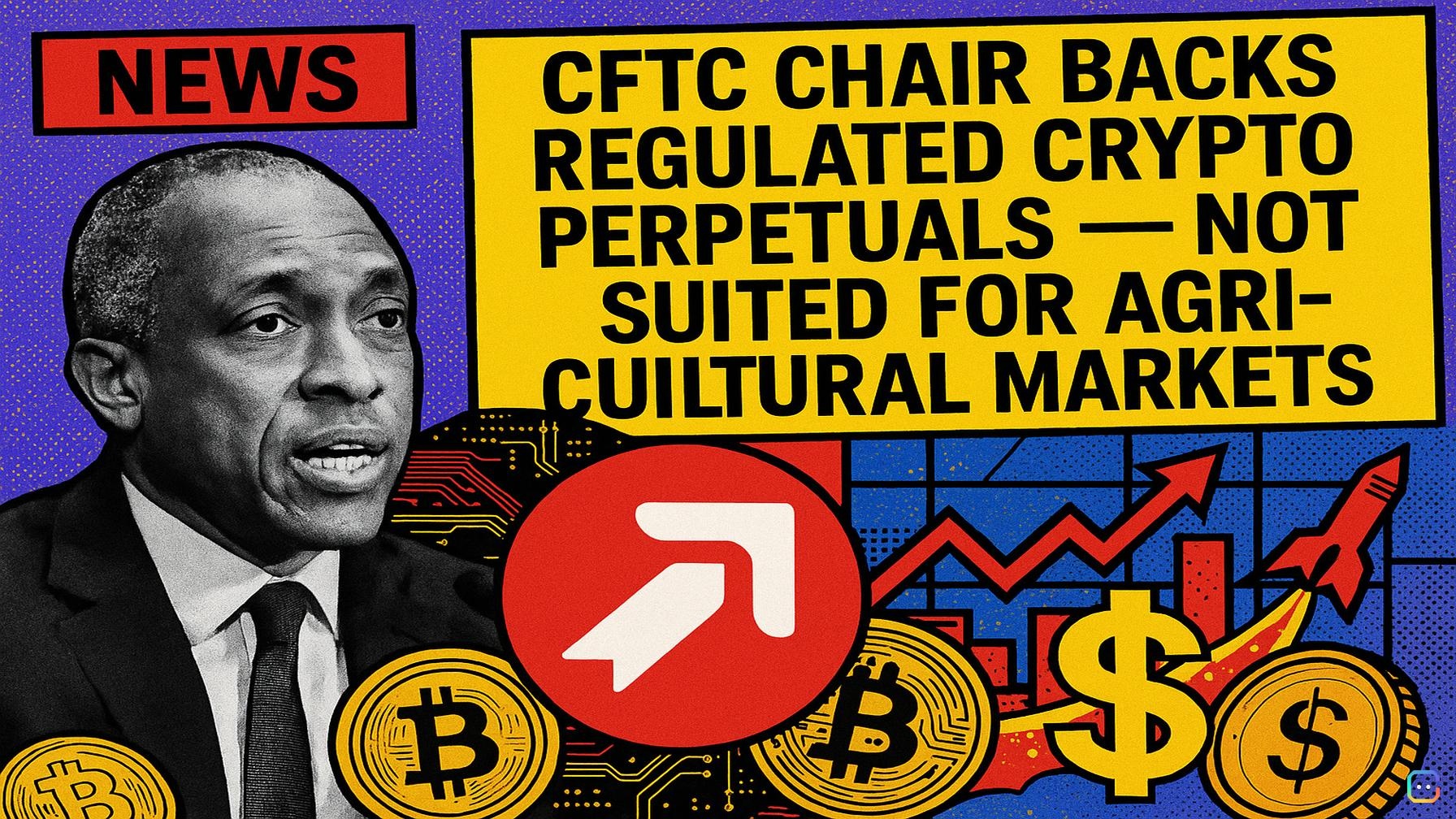
CFTC chair Michael Selig has defended the emergence of regulated crypto perpetual futures — while drawing a clear line that those instruments aren’t a fit for traditional agricultural markets.
Speaking Tuesday at the American Cotton Shippers Association Annual Convention, Selig noted the practical differences between 24/7, cash-settled perpetual contracts and commodity markets that rely on physical delivery and operate in limited hours. “Perpetual structures and round-the-clock trading are not well suited to agricultural markets,” he told attendees, stressing the agency’s long history overseeing products from corn to livestock even as it adapts to digital assets.
Why the distinction matters
Perpetual futures, popular in crypto markets, never expire — a structural difference from classic futures contracts that typically have set delivery or settlement dates. That mismatch is particularly acute for agricultural commodities, where contracts often connect directly to physical delivery, seasonal cycles, and discrete trading windows.
Regulatory momentum — and contention
Selig’s comments come amid a fast-moving shift toward regulated crypto perpetuals in the U.S. Over recent weeks the CFTC approved Bitcoin perpetual futures for prediction-market operator Kalshi, issued a no-action position enabling similar products on Coinbase, and saw crypto exchange Kraken launch perpetual trading for U.S. customers via its CFTC-regulated Bitnomial platform.
The surge in activity has attracted established exchanges’ attention: CBOE is reportedly evaluating whether its Bitcoin and Ether futures could be converted into perpetuals after Kalshi’s perpetuals generated more than $8.5 billion in trading volume within weeks of launch.
But the new approvals haven’t been free of controversy. CME Group has filed suit in U.S. District Court in D.C., alleging the CFTC’s approvals violated the Commodity Exchange Act — a legal challenge that could shape how regulators treat these products moving forward.
A broader rulebook review
The CFTC and the SEC have also launched a joint public consultation to reassess how Title VII of the Dodd‑Frank Act applies to swaps, security‑based swaps, mixed swaps, and related derivatives — including event contracts and prediction markets that blur lines between commodities and securities. The agencies say financial markets have evolved since Dodd‑Frank’s original implementation and are seeking public input on jurisdictional questions, swap exclusions, alternative compliance frameworks, and newly developed products. Comments will be accepted for 60 days after publication in the Federal Register.
Selig called the exercise a chance to resolve “longstanding ambiguities” in Dodd‑Frank. SEC Chair Paul Atkins similarly said additional regulatory clarity is overdue, particularly around event‑based products.
What’s at stake
A central regulatory question is whether crypto perpetuals should be treated as futures (subject to the Commodity Exchange Act and CFTC rules) or as swaps — a classification that would trigger different requirements for execution, reporting, clearing, and oversight. Kalshi’s Bitcoin perpetuals were allowed to remain listed under existing futures rules, but a reclassification could force platforms to adopt a different compliance model.
Leadership and legislative uncertainty
Regulatory direction comes amid leadership gaps at the agency. Selig is currently the CFTC’s sole commissioner and chair after Caroline Pham’s departure in December 2025; President Donald Trump has not yet nominated additional commissioners. Meanwhile, the U.S. Senate is expected to consider the Digital Asset Market Clarity Act soon — legislation that industry participants say could redraw the line between CFTC and SEC responsibilities for digital assets.
Bottom line
Selig’s message was twofold: perpetuals can be an appropriate, regulated product in crypto markets, but they are not a one‑size‑fits‑all solution — especially not for physical commodities like cotton or grain. With market innovation accelerating, regulators, exchanges, and courts are now wrestling with where perpetuals fit in the U.S. regulatory framework.
Read more AI-generated news on: undefined/news