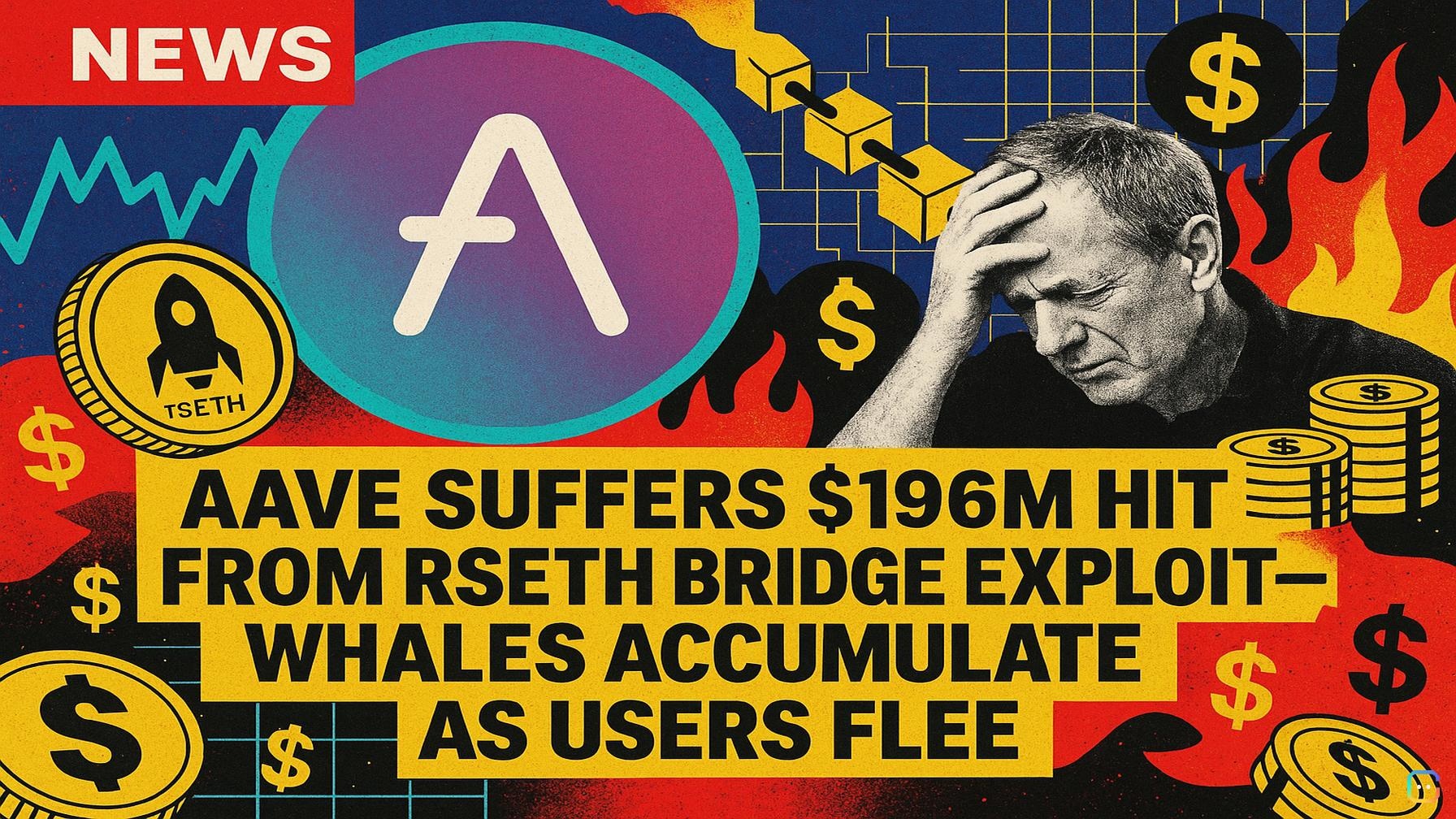
Aave is enduring one of the sharpest shocks in its history after an April 18 attack that exploited a vulnerability in KelpDAO’s rsETH bridge. Attackers moved the stolen rsETH onto Aave V3 as collateral and borrowed roughly $196 million in wrapped ether. Crucially, the shortfall wasn’t caused by a bug in Aave’s own code — but that technical distinction has done little to calm market panic.
Immediate fallout was severe. Over the next 48 hours, users pulled about $8.45 billion in deposits as they rushed to cut exposure. The AAVE token plunged 14–18% from pre-incident levels and is trading near $96 — a valuation last seen in the depths of the previous bear market. On the surface, the protocol faces a worst-case combination: a real liquidity event on top of a confidence crisis.
But beneath the fear, on-chain data is signaling something worth watching. CryptoQuant’s Spot Average Order Size metric, which divides total spot volume by trade count to estimate the average executed trade, is showing elevated readings in the “Big Whale Orders” category. In plain terms: large, patient buyers are active while the crowd is fleeing.
Why that matters: since late 2022, clusters of heightened whale spot orders in AAVE have consistently coincided with significant price bottoms — whether local lows or broader market pivots. These accumulation windows appeared during the 2022 bear-market troughs, mid-2023 consolidations, 2024 corrections, and early 2025 setups. None guaranteed immediate rebounds, but they marked moments when the risk-reward balance tilted in favor of buyers willing to hold through volatility.
Right now AAVE is trading in the $90–$100 band, fear metrics are spiking toward levels not seen since the 2022 bear market, and whale order size is flashing again. CryptoQuant annotates this cluster with a question mark — the outcome is open — but the structural similarity to prior accumulation phases is unmistakable. Historically, “smart money” has accumulated at precisely these inflection points, not because the immediate outlook was safe, but because it mirrored past setups that preceded recoveries.
What will decide whether history repeats? Two variables stand out:
- How quickly and cleanly Umbrella reserve coverage addresses the roughly $196 million deficit. A smooth resolution would go a long way toward restoring confidence.
- Whether large order sizes remain elevated as price probes the $85–$95 zone. A sustained cluster at those levels would closely mirror prior accumulation windows.
Technically, AAVE remains in a broader downtrend defined by lower highs and lower lows and a downward-sloping 200-day moving average. The token has shown some stabilization after the sell-off into the $85–$90 area, forming a short-term base and a volume-backed bounce toward about $110. That bounce and the subsequent pullback into the $90 area came with increased participation, suggesting both buyers and sellers are actively repositioning rather than stepping aside.
For a convincing trend change, AAVE would need to reclaim and hold the $110–$120 region. Until then, the market is in a fragile stabilization phase inside a larger bearish structure — one where exhaustion could give way to renewed selling or, if whale accumulation continues and reserves are resolved, the conditions for a meaningful recovery may be forming.
Bottom line: the immediate shock from the bridge exploit and resulting liquidity hit is real — but on-chain whale behavior and historical precedents offer a potentially constructive counter-narrative. The next few weeks, and how the Umbrella coverage and large buyers behave, will likely determine whether this becomes a lasting rout or a strategic buying opportunity.
Read more AI-generated news on: undefined/news