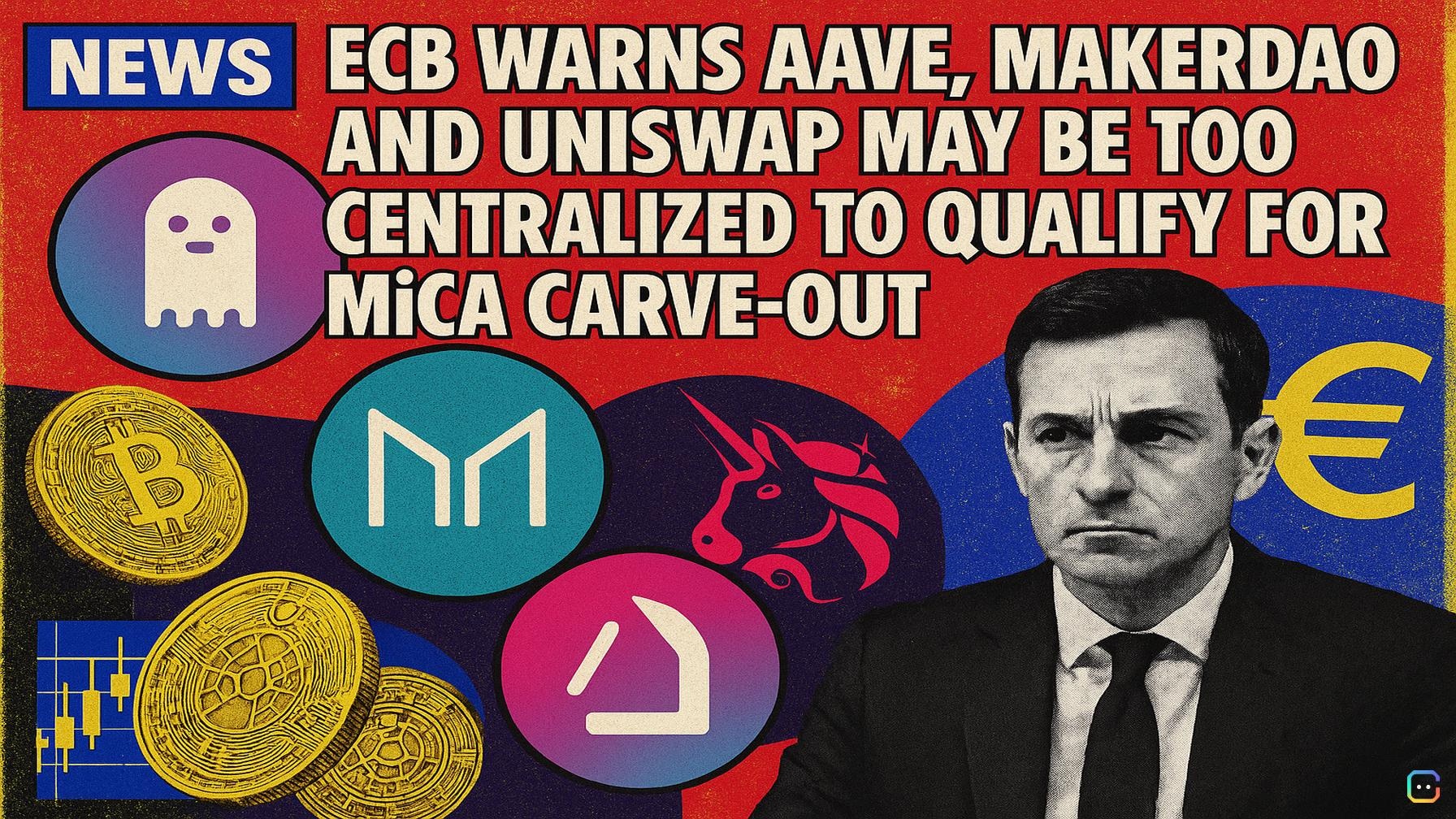
Headline: ECB paper warns major DeFi DAOs may be too centralized to qualify for MiCA’s decentralization carve-out
The European Central Bank has raised a blunt warning for DeFi: some of the sector’s flagship protocols may be far less decentralized than they claim — and that could cost them regulatory safe harbor under the EU’s upcoming Markets in Crypto‑Assets (MiCA) regime.
In a new working paper titled “Who to regulate? Identifying actors within DeFi’s governance,” ECB staff examine governance in Aave, MakerDAO (the Sky ecosystem), Uniswap and Ampleforth. Their findings paint a picture of concentrated power:
- The top 100 holders in each protocol control more than 80% of governance token supply.
- Around half or more of those holdings in some cases are linked to the protocols themselves or to centralized exchanges (the paper cites Binance as an example).
- Voting power is even more concentrated than token ownership. Many of the largest voters are delegates whose real‑world identities are unclear or unidentifiable.
- In Ampleforth, the top 20 voters account for roughly 96% of proxy voting rights — a structure the ECB describes as leaving control with a small, opaque elite.
The authors connect these patterns to prior academic warnings about “minority rule,” where a handful of large token holders or delegates can effectively decide protocol outcomes. They also stress that the concentration of governance power is stable over time — suggesting “decentralization” is often more branding than substance.
Why this matters under MiCA
MiCA’s regulatory carve-out applies to crypto services “provided in a fully decentralised manner without any intermediary.” The ECB’s analysis directly challenges claims that Aave, MakerDAO, Uniswap and Ampleforth meet that bar. If effective decision‑making is concentrated in identifiable anchors — founding teams, exchanges, or a few delegates — regulators will likely treat those DAOs as entities with accountable points of control rather than as fully decentralized systems.
Policy implications
The paper is explicit about intent: it aims to identify “regulatory anchor points” in ecosystems designed to avoid traditional issuers, boards or CEOs. Limited on‑chain transparency about who controls key delegates, the ECB notes, complicates accountability and strengthens calls from EU agencies and legal commentators to interpret MiCA’s decentralization exemption narrowly. In short, supervisors appear ready to apply forensic scrutiny to DeFi governance similar to the analysis they use for bank shareholder registers and control chains.
What’s next for DeFi?
If leading DAOs cannot demonstrate materially dispersed and accountable governance, they may be pushed into the same licensing, capital and compliance obligations that apply to centralized crypto‑asset service providers in the EU. For projects that rely on decentralization as a legal defense, the ECB paper signals that tokenomics and on‑chain governance will increasingly be assessed by regulators — not just marketing materials.
Read more AI-generated news on: undefined/news