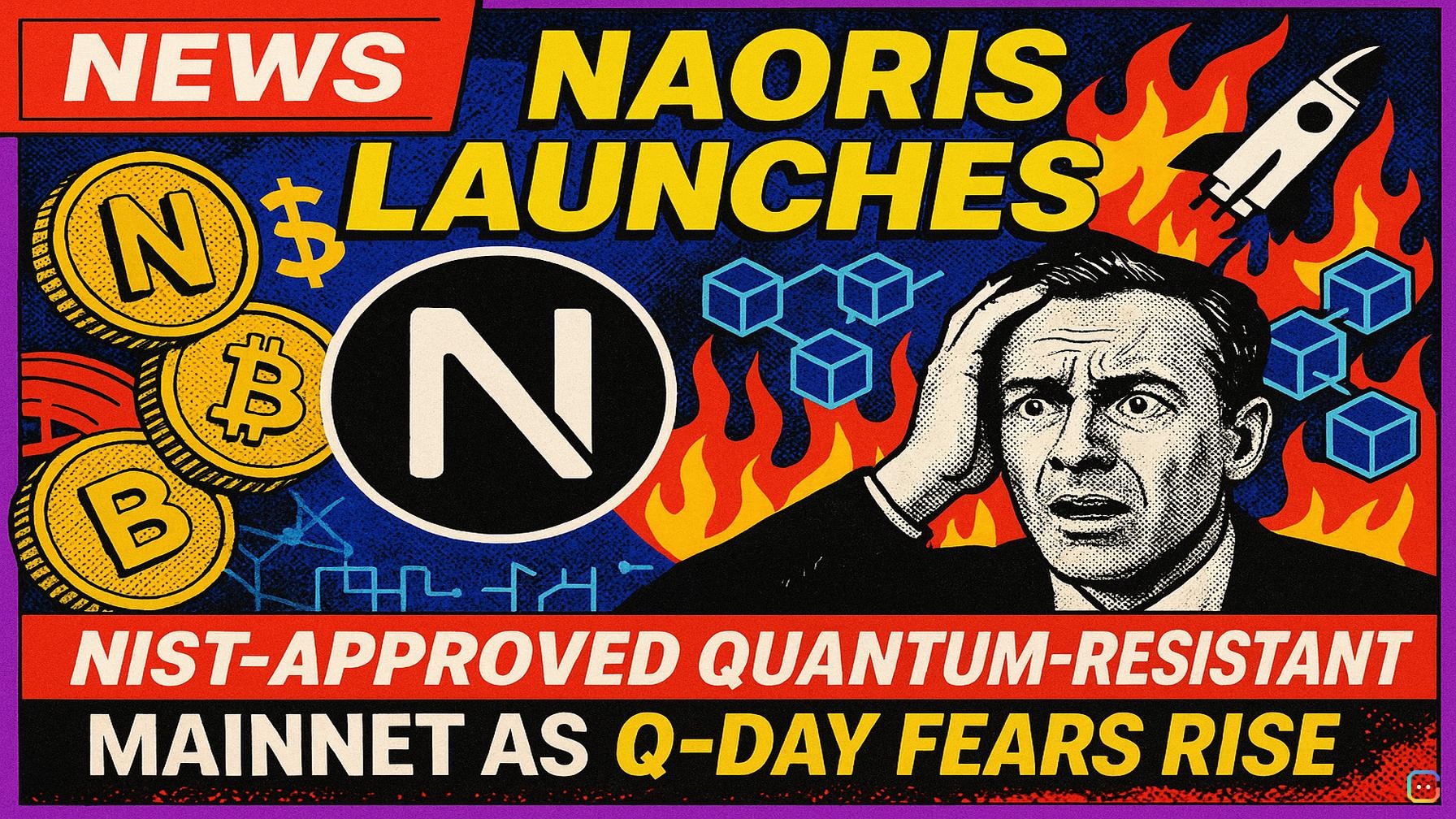
Naoris Protocol this week launched its long‑promised quantum‑resistant mainnet — a production blockchain built from the ground up to withstand the future arrival of powerful quantum computers that could break today’s cryptography.
“Mainnet represents the transition from proof‑of‑concept to production infrastructure. The network has already validated over 100 million transactions using post‑quantum cryptography. That is not a roadmap promise; it is measured, operational capacity,” Nathaniel Szerezla, Naoris’ chief growth officer, said in the company release.
The debut arrives as legacy chains face growing alarm about a so‑called “Q‑Day” — the moment a quantum machine becomes capable of cracking the public‑key cryptography that secures most blockchains. Concerns intensified this week after Google signaled that a sufficiently powerful quantum computer could break Bitcoin’s blockchain with fewer than 500,000 qubits, a substantially lower threshold than many earlier estimates. A separate analysis also warned of potential vulnerabilities in Ethereum that could put roughly $100 billion on the chain at risk. Because blockchain transactions are permanent, weaknesses today could be exploited by future quantum hardware that reverses or forges historical signatures.
Naoris’ response is technical and preventative: the network is built around post‑quantum cryptography and uses algorithms vetted and approved by the U.S. National Institute of Standards and Technology (NIST) to protect accounts, transactions and assets. A key feature is what the team calls an “irreversible security transition.” Once a user migrates to post‑quantum keys, the protocol requires quantum‑resistant signatures for subsequent transactions and will automatically block attempts that use classical, vulnerable cryptographic methods — helping ensure assets remain protected even if today’s standards are later broken.
Though quantum‑resistant protections are live only on Naoris’ own mainnet for now, the project is positioned for broader adoption: the architecture is designed with future support in mind for wallets, exchanges, Layer‑2 networks and DeFi platforms. The mainnet launch started with an invite‑only cohort of strategic participants operating the first validator nodes to establish an initial trust layer before wider decentralization.
Naoris points to an extensive testnet phase as proof of scale: during testing it says the network detected and mitigated more than 603 million threats, processed over 106 million post‑quantum transactions, created upwards of 3.3 million wallets and activated more than one million security nodes globally.
The protocol’s native token, NAORIS, underpins network operations — helping to secure transactions, enforce protocol rules and build economic trust among participants. At press time the token carried a market capitalization of about $36 million.
What this means for the broader crypto ecosystem is twofold: the industry must reckon with quantum risk sooner than many expected, and projects like Naoris aim to shift that calculus by offering architecture that treats quantum resistance as a baseline, not an afterthought. Whether legacy chains and major infrastructure providers will migrate or layer in post‑quantum protections remains a critical question as the quantum timeline accelerates.
Read more AI-generated news on: undefined/news