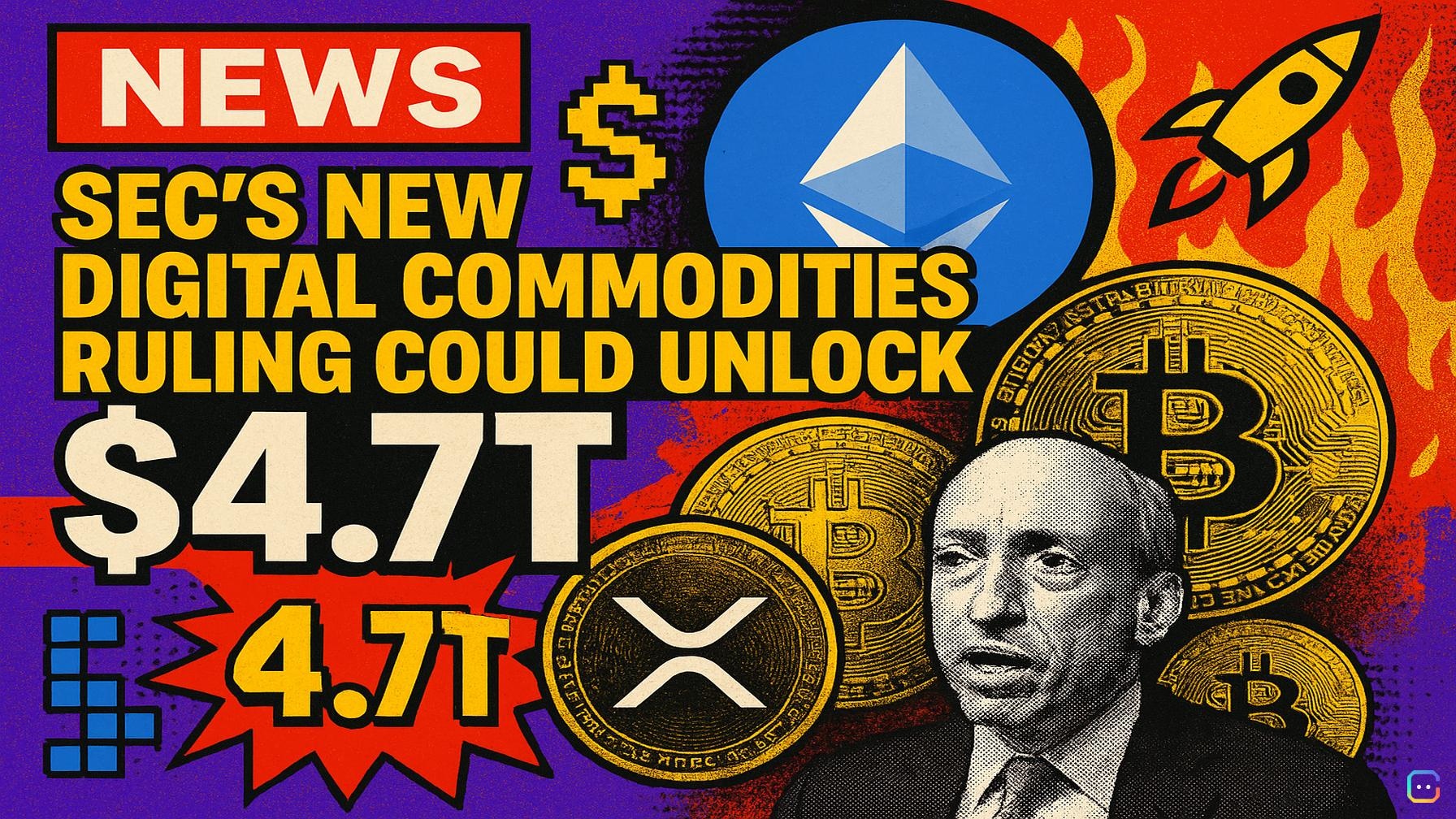
A fresh shift in Washington’s crypto playbook has thrust XRP and Ethereum into the spotlight — and an outspoken analyst says it could unlock as much as $4.7 trillion for the market.
What happened
- On March 18, 2026, crypto analyst @Noalphalimits posted a detailed breakdown after remarks from Paul Atkins of the SEC indicating that most crypto assets should not be treated as securities. That stance represents a sharp departure from earlier, enforcement-focused positions.
- The comments were reinforced by an official SEC document that introduces the term “digital commodities”: assets whose value is tied to the functional operation of decentralized systems rather than the managerial efforts of a central party.
Which tokens are affected
The SEC framework singled out 16 assets as digital commodities, including:
XRP, Ethereum, Solana, Cardano, Dogecoin, Avalanche, Aptos, Bitcoin Cash, Hedera, Algorand, Litecoin, Polkadot, Shiba Inu, Stellar, Tezos, and Chainlink.
New taxonomy and non-securities guidance
The SEC’s document also establishes a five-category taxonomy for crypto: digital commodities, digital collectibles, digital tools, stablecoins, and digital securities. Importantly, it clarifies that activities like staking, airdrops, and mining are not treated as securities offerings under this framework.
How the $4.7 trillion figure was reached
The analyst combined two data points:
- The combined market capitalization of the 16 identified assets, estimated at roughly $1.8 trillion.
- An estimated $2.9 trillion in institutional capital that had remained on the sidelines due to regulatory uncertainty.
He argues that reclassification removes a key barrier, effectively “unlocking” that $2.9 trillion in institutional dry powder and bringing the total to about $4.7 trillion.
Potential market effects (as outlined by the analyst)
1. Legal pressure eases: Ongoing SEC lawsuits that alleged unregistered securities offerings — notably cases involving exchanges such as Coinbase and Kraken and the long-running Ripple (XRP) litigation — could lose momentum under the new classification.
2. ETF acceleration: Treating these tokens as commodities could clear a path for spot ETFs beyond Bitcoin and Ether, increasing the likelihood of filings and approvals for assets such as XRP, Solana, Cardano, and Avalanche. Major asset managers (BlackRock, Fidelity, Grayscale) are expected to be key players if that window opens.
3. Institutional access and infrastructure: U.S. exchanges might expand listings, improving liquidity and tightening spreads. Banks and brokerages — including Goldman Sachs, JPMorgan, and Morgan Stanley — could find clearer regulatory footing to offer custody, trading, and other services. Staking products could also return to U.S. platforms.
A note of caution
This is, for now, an SEC interpretation rather than settled law. Legislative efforts remain in play — the article notes a draft bill referenced by Senator Tim Scott — so the regulatory landscape could change. The analyst warns the market may be operating inside a potentially brief window of clarity.
Bottom line
The SEC’s evolving stance, coupled with its new taxonomy for crypto, could materially change how large swaths of the market are regulated and accessed by institutions. If sustained, it would not only reshape litigation risk but also open clearer paths for ETFs, exchange listings, and institutional custody — potentially putting trillions of dollars of capital into play. But investors should watch for legal and legislative developments that could alter the picture.
Read more AI-generated news on: undefined/news