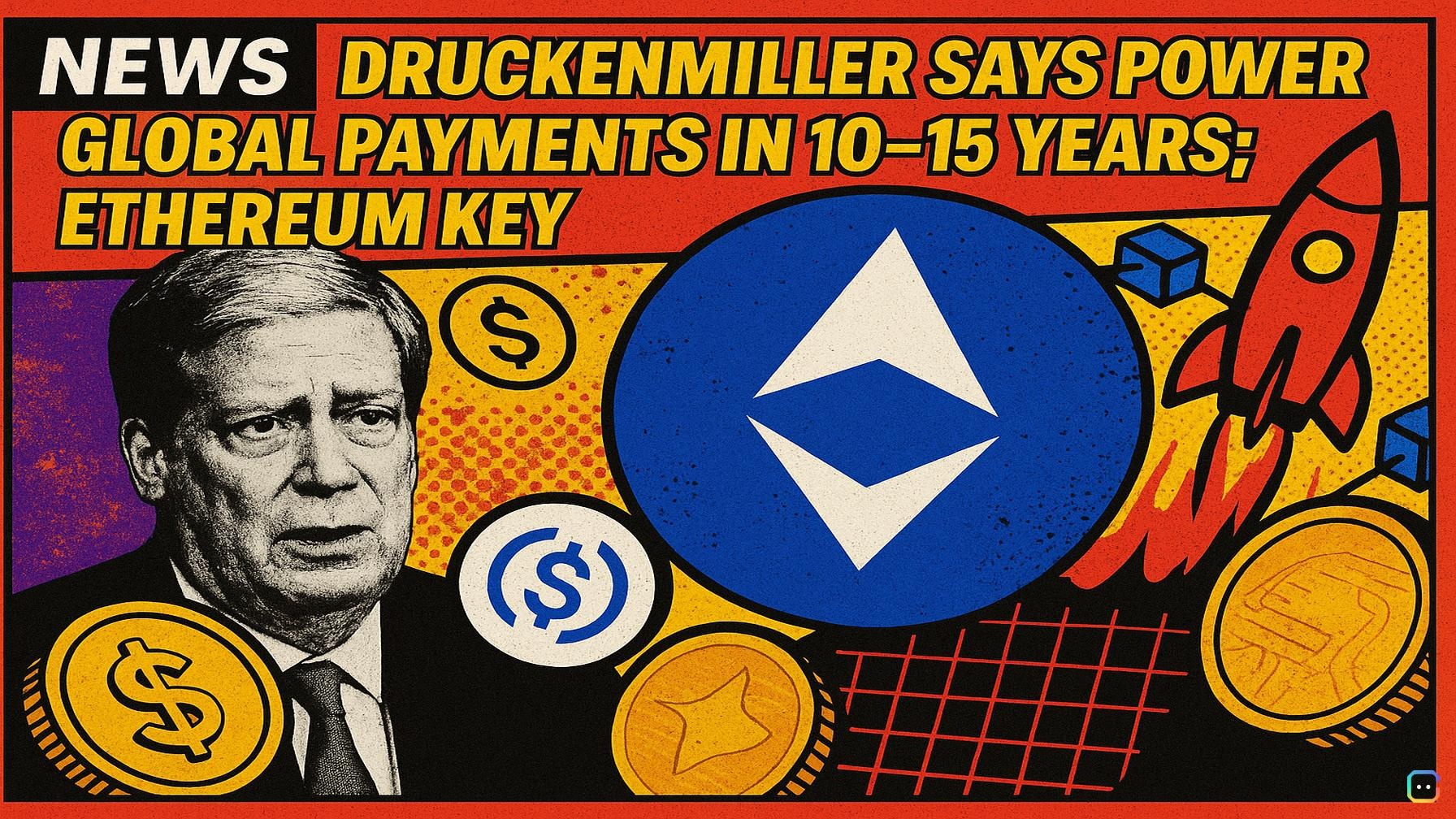
Veteran investor Stanley Druckenmiller has staked a bold claim on the future of money: stablecoins could power the global payments system within the next 10 to 15 years. In a post shared by Etherealize on X, Druckenmiller argued that blockchain-based money offers clear advantages—faster settlement, greater efficiency and much lower costs—that could make stablecoins a practical backbone for payments worldwide.
Druckenmiller’s comments align with his increasing exposure to the Ethereum ecosystem. He’s named among backers of BitMine (BMNR), an Ethereum-focused treasury firm chaired by Tom Lee that reportedly holds more than $10 billion in ETH. Other notable supporters of the project include ARK Invest and Bill Miller. Druckenmiller has framed stablecoins and blockchain rails not just as speculative assets but as productivity-enhancing tools for investors and institutions.
Institutional debate: open vs. proprietary rails
A recent announcement from Cari has intensified a debate over how institutional blockchain infrastructure should be built. Analyst “Alex” pushed back on the idea that architecture is the only issue, saying the bigger question is business model: proprietary networks versus open standards.
Proprietary systems such as Canton or Tempo, Alex notes, can end up controlled by a small group that holds disproportionate voting power. While technically permissionless, these networks may use opaque admission processes that allow the most influential participants to later set terms of access and pricing—a dynamic that mirrors how legacy payment networks like SWIFT and Visa consolidated market power. Banks, he says, are happy to claim they want to build a “SWIFT-killer,” but reluctant to join someone else’s.
Why Ethereum matters
That’s where Ethereum, according to Alex and supporters like Druckenmiller, stands apart. They argue Ethereum functions as a neutral settlement layer immune to capture by a single coalition—no participant can credibly threaten to rewrite the rules to benefit themselves later. From a game-theory perspective, Alex contends, that neutrality makes ETH the only sustainable long-term equilibrium for a global institutional settlement layer.
Bottom line
Druckenmiller’s endorsement adds weight to a growing institutional narrative: stablecoins and blockchain rails could reshape payments, and the choice between proprietary networks and open platforms like Ethereum will determine who controls the future plumbing of finance.
Read more AI-generated news on: undefined/news