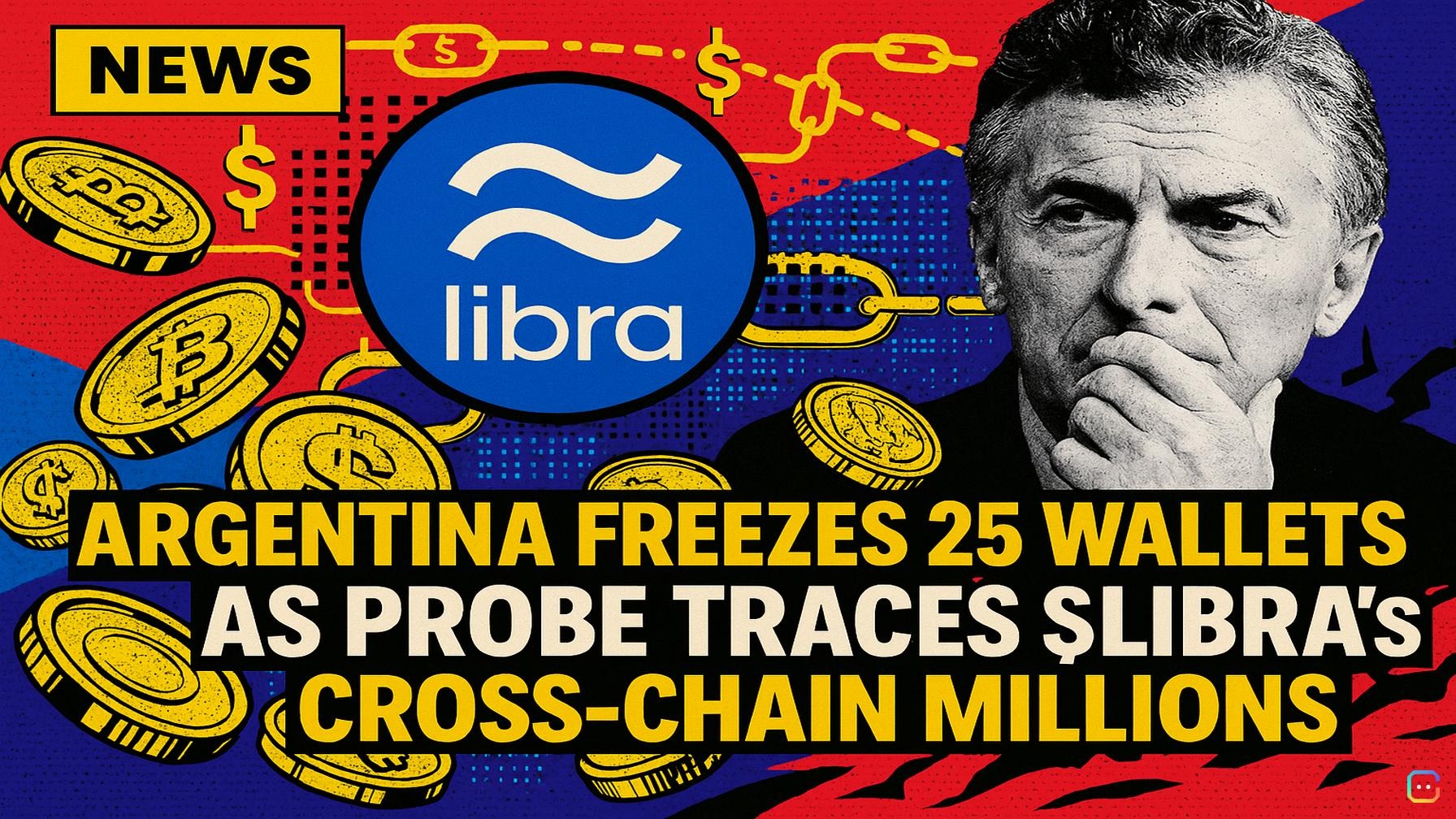
Headline: Argentine judge freezes 25 crypto wallets as probe into $LIBRA token traces millions across chains
Argentine authorities have moved to identify and freeze assets linked to the controversial $LIBRA token after a police reconstruction traced millions of dollars across multiple blockchains.
Federal Judge Marcelo Martínez de Giorgi ordered the identification of holders behind 25 cryptocurrency wallets and the freezing of assets tied to the $LIBRA investigation, according to Clarín. The directive follows a report from the Cybercrime Technical Department of the Argentine Federal Police that mapped the movement of crypto assets connected to the case from May onward. The court asked exchanges and service providers for account-holder identities, KYC records, IP addresses, transaction histories and other data that could reveal who was behind the transfers.
What investigators found
- The court action targets 25 wallets believed to hold funds that remained with creators of the $LIBRA token after its failed launch in February 2025. It is not yet clear whether those funds remain in the targeted wallets or have been moved elsewhere.
- Police documents reconstructed activity for eight wallets labeled the “Libra Team,” which investigators tie to the token’s creation and to withdrawals of investor funds that followed a brief price spike after Argentine President Javier Milei promoted the project on social media.
- Token creator Hayden Davis has previously said roughly $110 million stayed under his control after the launch. Investigators say four of the eight “Libra Team” wallets consolidated funds into a single wallet identified as “61yk.”
US freeze, then redistribution
- The police report notes wallet “61yk” had been frozen for nearly six months under an existing U.S. District Court (Southern District of New York) order tied to a separate case involving Davis. After the restriction was lifted, investigators allege the wallet redistributed funds using a so-called “digital smurfing” technique — breaking large balances into many smaller transfers to obfuscate the trail and aid conversion to fiat.
Cross-chain moves and exchange links
- A major movement on May 10 saw 498,539 USDT routed through a cross-chain interoperability protocol to a Tron-network wallet; that receiving wallet then split the amount into 17 separate transactions, another alleged attempt to hide provenance.
- Investigators traced at least 10 of those transfers through Binance. They also linked eight wallets to Bybit, two to OKX and two to Bitfinex. Because centralized exchanges generally collect KYC, those on-chain-to-exchange flows could help identify some individuals — although the report warns some platforms may not retain KYC for every account.
Amounts still active — and a proposed revival
- Independent crypto analyst Fernando Molina, who has tracked $LIBRA fund movements, estimated that about $8.2 million remained dormant before reactivating in May via wallets now under judicial scrutiny.
- Separate materials reviewed by Clarín indicate remaining funds are being managed through a trust set up by Davis, intended to distribute grants to Argentine companies as part of a proposed revival of the project later this year. The trust reportedly has already received 71 grant applications.
What’s next
Judicial requests for KYC, IP and transaction data could identify some wallet owners if exchanges cooperate. The freezing orders are meant to preserve assets while investigators piece together cross-chain movements that allegedly used fragmentation strategies to frustrate tracing. Authorities say the probe remains active and that key questions — including whether the funds targeted still sit in the identified wallets — are unresolved.
Read more AI-generated news on: undefined/news