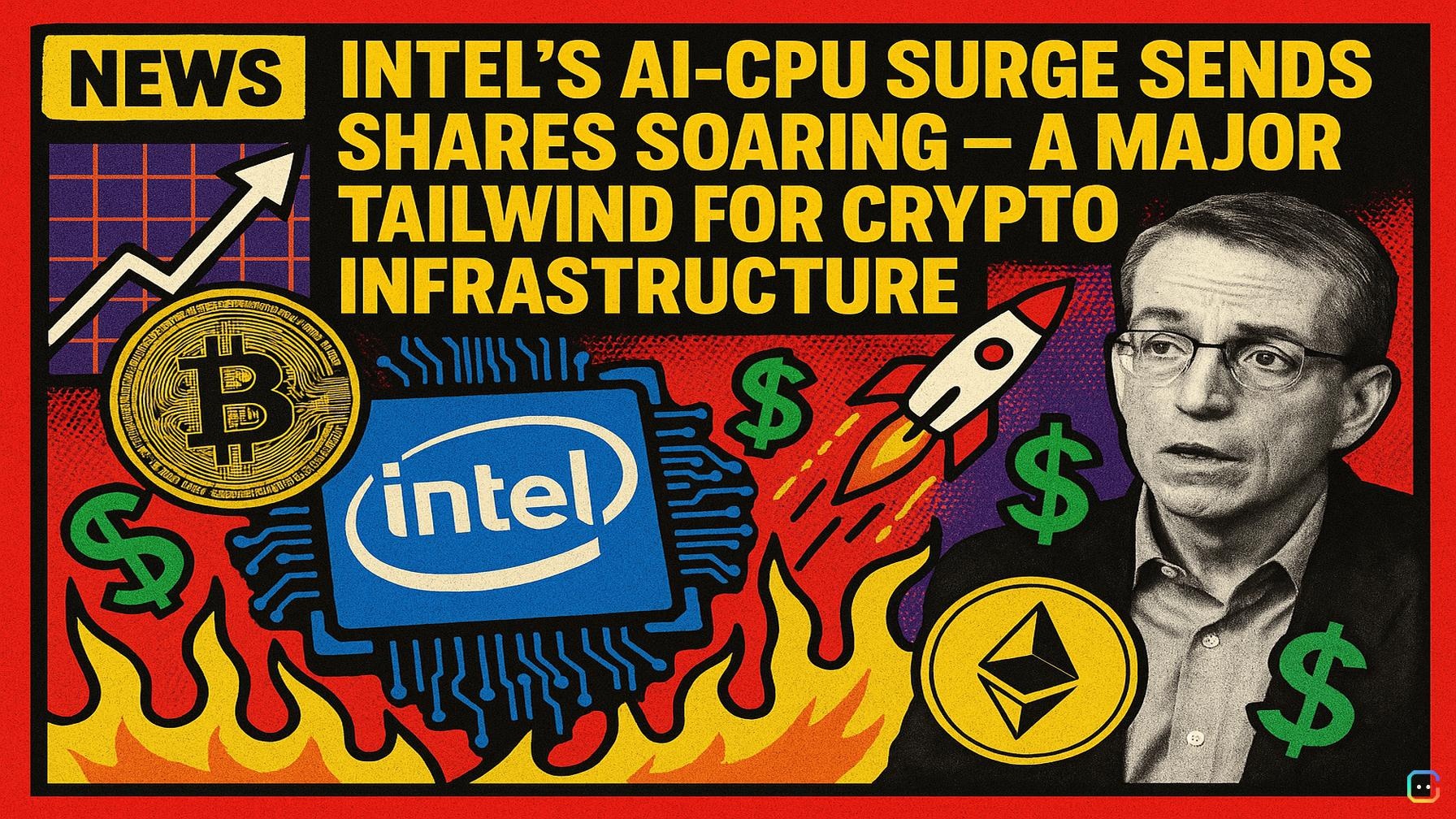
Headline: Intel smashes expectations as AI-driven CPU demand sends shares soaring — what it means for crypto infrastructure
Intel blew past Wall Street in Q1, posting adjusted EPS of $0.29 (vs. $0.01 expected) on $13.6 billion in revenue (consensus $12.36 billion). The surprise beat and an upbeat Q2 guide — revenue projected at $13.8–$14.8 billion versus analysts’ $13.03 billion forecast — sent the stock surging in after-hours trade on April 23, topping roughly $80 and jumping as much as ~20% (initially reported as a more than 16% rise). It’s also the sixth straight quarter Intel has exceeded its own expectations.
Data centers drive the upside
The standout was data center revenue: $5.1 billion, up 22% year-over-year and well ahead of the $4.41 billion estimate. Intel’s rebound in the data-center market is being powered not by the traditional GPU-driven wave, but by a fresh class of AI workloads — “AI agents.” These semi-autonomous bots handle tasks like browsing, querying and data processing, and those workloads are CPU-heavy. That trend has put Intel’s Xeon processors back in the spotlight for hyperscalers and cloud providers.
“The CPU is reinserting itself as the indispensable foundation of the AI era,” said CEO Lip-Bu Tan on the earnings call. In Intel’s press release he added that the next AI wave — moving from foundational models to inference to agentic systems — “is significantly increasing the need for Intel’s CPUs and wafer and advanced packaging offerings,” and pointed to deeper strategic partnerships as a result.
Supply constraints, but more capacity ahead
Demand is outpacing supply. CFO David Zinsner said revenue “would have been meaningfully higher, but demand continues to outpace our growing supply,” and Intel plans quarterly supply ramp-ups going forward. Zinsner framed the results as the product of strong CPU-led demand and disciplined execution to expand capacity.
Other business lines and deal-making
- Client Computing revenue also beat, at $7.7 billion versus estimates of $7.1 billion — notable given IDC’s projection of an 11.3% PC market decline in 2026.
- Strategic deals included a multiyear agreement with Google to supply Xeon CPUs for Google Cloud and a collaboration with Elon Musk on the AI-focused Terafab facility, which will produce chips for SpaceX, xAI and Tesla.
- Intel is also buying back a 49% stake in a fabrication facility it sold to Apollo in 2024 for $11.2 billion — this time repurchased for $14.2 billion.
Market reaction and outlook
Investors have already bid Intel’s shares up about 77% year-to-date, treating the Q1 beat and strong Q2 outlook as validation of the company’s reset under management. With AI chip demand continuing to grow and CPUs regaining relevance for emerging agent-driven workloads, Intel’s data-center business appears well positioned to keep benefiting.
Why crypto readers should care
- More CPU capacity and lower latency cloud compute helps AI-driven crypto tools — e.g., trading bots, on-chain analytics, and smart-agent interfaces that interact with protocols.
- Cloud and data-center agreements (Google Cloud, Terafab partnerships) expand the compute backbone many web3 and AI-native crypto projects rely on.
- This rally doesn’t directly change ASIC-driven mining economics, but broader silicon supply improvements and faster inference at the edge could accelerate developer tooling and services used across the crypto stack.
Bottom line: Intel’s quarter shows CPUs are back in demand as AI workloads diversify beyond GPUs. For crypto projects that depend on cloud compute, AI tooling or large-scale inference, a stronger Intel supply and renewed data-center momentum could be a meaningful tailwind.
Read more AI-generated news on: undefined/news