Mastercard just signaled where global payments are heading — and how urgently.
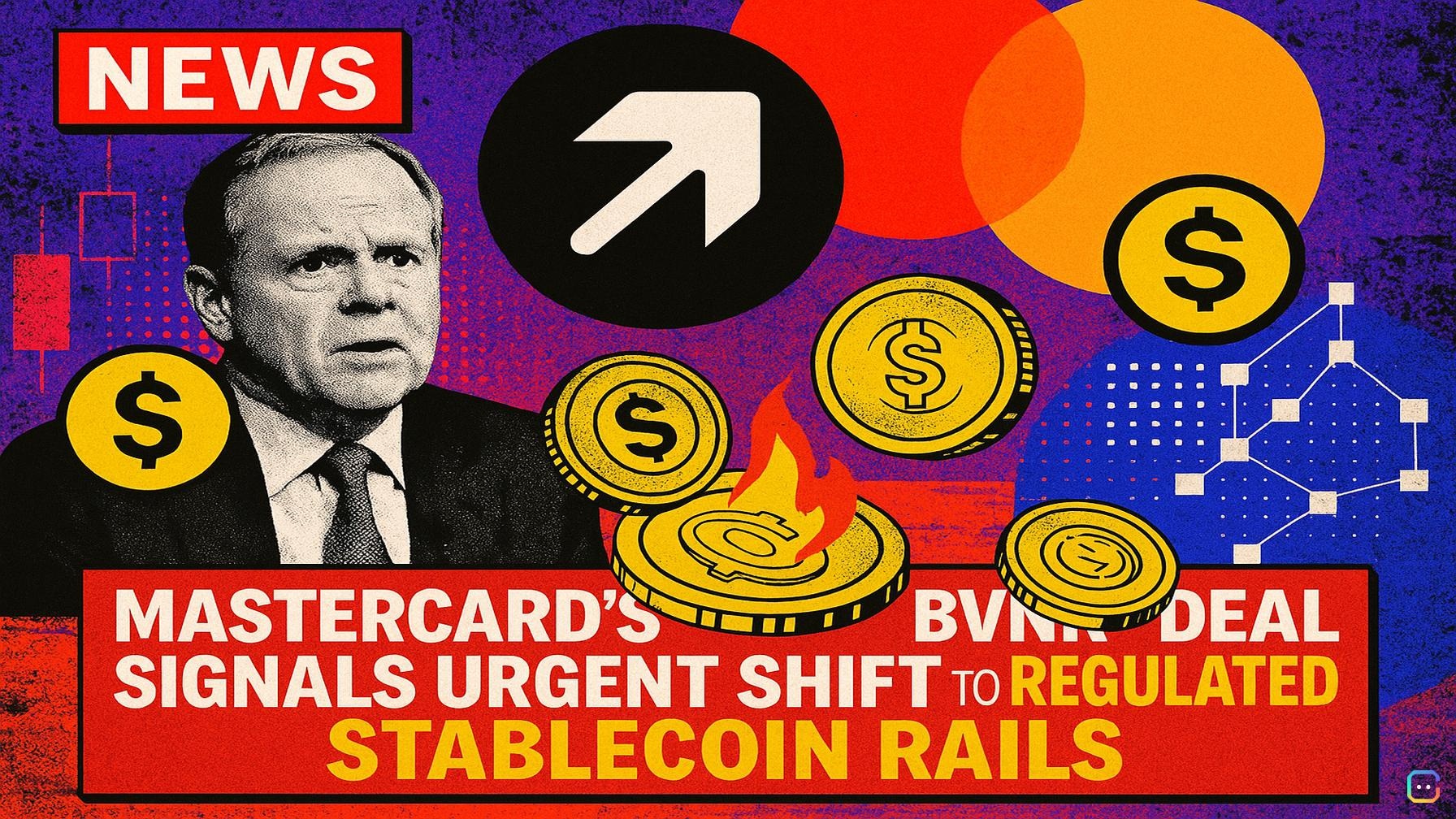
The card giant paid $1.8 billion for BVNK, more than double the startup’s $750 million Series B valuation from a little over a year ago. That 140% premium makes this the largest stablecoin infrastructure acquisition to date, outstripping Stripe’s $1.1 billion purchase of Bridge. On the surface, it’s a big-ticket buy. Look closer and it reveals what Mastercard — and the wider payments industry — now sees as the business-critical asset: regulated, multi-jurisdictional stablecoin rails.
Why buy instead of build?
Mastercard has the engineers to construct a settlement layer. But code is the easy part. BVNK’s real value is the years it spent securing licenses and regulatory approvals across roughly 130 jurisdictions. That kind of compliance footprint can take years of engagement with regulators — time a legacy network racing to modernize settlements cannot afford. In payments, the compliance framework is the product; everything else can be recreated. Mastercard didn’t pay for software alone — it paid for time, regulatory trust, and immediate market access.
What this means for cross-border payments
The legacy correspondent banking system still handles over $190 trillion in cross-border flows annually, but it’s slow, opaque and expensive — like relying on a fax machine to run modern business. Each intermediary in those chains adds cost and delay. That friction matters most in low-value remittance corridors: remittance fees average 6–8% in many routes serving Africa and Southeast Asia. For example, a worker in Dubai sending $500 to the Philippines typically loses $30–$40 per transfer to intermediaries. Across the roughly $685 billion that flows to low- and middle-income countries each year, that’s a massive transfer of value away from the people who can least afford it.
Stablecoin-native settlement changes that equation. By removing or drastically reducing correspondent layers, stablecoin rails can structurally lower settlement costs; flat fees of 1–2% become realistic rather than promotional. If Mastercard pairs BVNK’s compliant rails with its merchant network and reach in emerging markets, the acquisition could materially lower remittance costs and expand financial access for the estimated 1.3 billion adults still outside the formal banking system.
The competitive landscape is accelerating
Stripe’s acquisition of Bridge and Mastercard’s purchase of BVNK are clear signals. Reports say Visa is evaluating its own moves. Within 12–18 months it’s likely every major card network will have a stablecoin settlement strategy — or a public explanation for why it doesn’t.
The real contest is not “crypto vs. legacy finance”
That framing is increasingly outdated. The sharper competition is between regulated stablecoin infrastructure and unregulated alternatives that have flourished in corridors lacking compliant options. Unregulated rails can move faster because they skip licensing, but speed without regulatory legitimacy is fragile; the sector has been burned before by collapses and scandals. Every month that regulated solutions aren’t usable in a corridor is another month shadow systems entrench themselves.
Mastercard’s buy compresses that timeline. BVNK’s licensing reach plus Mastercard’s distribution narrows the gap between regulated capability and market demand — a crucial advantage for players committed to compliance. And that’s why Mastercard was willing to pay a premium: not for a piece of code, but for the years and relationships it would have taken to achieve this regulatory footprint.
Bottom line
This deal isn’t merely a card network hedging its bets on crypto. It’s a strategic purchase of time and regulatory access that accelerates the shift of stablecoin settlement from niche experiment to core payments infrastructure. The acquisition makes one thing clear: the window to build a compliant global stablecoin presence is closing fast, and the window to buy is getting more expensive by the quarter. The next big deal in this space will be treated as inevitable — not surprising — and that change in expectations may be the single clearest sign that stablecoin infrastructure has moved from the periphery to the center of global payments.
Read more AI-generated news on: undefined/news