Today's Cryptocurrency Prices by Market Caps
The global cryptocurrency market cap today i $2.35T
Market Cap
$2.35T
24h Trading Volume
$141.09B
BTC Dominance
56.47%
|
#
|
Name
|
Price
|
1h %
|
24h %
|
7d %
|
Market Cap
|
Volume (24h)
|
Chart (7d) |
|---|---|---|---|---|---|---|---|---|
|
|
—
|
|||||||
|
No cryptocurrencies found Try adjusting your search query |
||||||||
Latest Crypto News
View All News
XRP Retreats from 2025 Highs to $1.15 Support — Supply, Inflation Cloud Recovery
XRP has slipped in step with a broader crypto downturn that’s plagued markets for nearly eight months, leaving many investors nervous. After a blockbuster 2025 that saw XRP surge on the back of favorable legal news, the token has lost much of its shine — its market capitalization has slid to roughly $72 billion and price momentum remains fragile. A quick recap: XRP climbed to an all-time high of $3.65 in July 2025 following a run that began in late 2024 as signs mounted that the SEC vs. Ripple lawsuit was nearing resolution. Once the case closed in 2025, investor sentiment drove XRP’s market cap as high as about $226 billion. But the landscape has changed since, and recovery has been uneven. Supply dynamics add another layer of complexity. Coinbase’s current data shows XRP’s circulating supply at about 62 billion coins. At that supply level, XRP would need to trade near $3.22 for market cap to hit $200 billion — meaning reclaiming prior highs is not just a matter of price momentum but also supply behavior over time. Technically, XRP appears to be finding short-term support in the $1.15–$1.18 range. The token staged a brief bounce to $1.29 on June 16 but failed to sustain that move and reverted toward support. Macro forces likely contributed: the Federal Reserve held interest rates steady, while US inflation rose to 4.2% in May 2026 — a hotter print than many expected. Rising crude prices amid the US–Iran tensions were cited as a key factor pushing inflation higher. That geopolitical picture has shifted. The US and Iran reportedly reached a peace agreement, triggering a pullback in oil prices. If oil-driven inflation pressures ease, inflation readings could cool and tilt monetary policy toward rate cuts later on — a macro environment that historically helps risk assets, including crypto. What this means for investors: XRP could see renewed upside if macro conditions improve and market sentiment returns, but volatility remains high and supply changes could complicate a clean path back to prior highs. Current prices near support may represent an attractive entry for some traders, but patience and risk management are essential. This is a market still driven by headlines and macro shifts, so keep an eye on inflation data, oil markets, and broader risk sentiment when sizing positions. Read more AI-generated news on: undefined/news

Shiba Inu Overtakes Dogecoin in Tech and Ecosystem — DOGE Still Rules Memecoin Brand
The long-running rivalry between Shiba Inu (SHIB) and Dogecoin (DOGE) has become a staple of memecoin culture — but the competition is evolving beyond jokes and social media hype. Dogecoin, the original memecoin, debuted in December 2013 and benefits from being an early icon of the space. Shiba Inu, however, has spent recent years building a broader crypto ecosystem. Which approach matters more for a memecoin’s future? Here’s a clearer look. Network and technology - Dogecoin runs on its own independent blockchain, secured by a Proof of Work consensus that uses the Scrypt mining algorithm. Its architecture keeps things simple and true to the memecoin spirit, but also limits advanced programmability. - Shiba Inu is native to the Ethereum ecosystem and has launched Shibarium, a Layer-2 network. That positioning gives SHIB access to Ethereum-style smart contracts and the broader tooling of the EVM world. Smart contracts and DeFi - SHIB’s integration with Ethereum and Shibarium enables a richer smart-contract environment. The Shiba Inu project has expanded into decentralized finance with platforms such as ShibaSwap. - Dogecoin, by contrast, has only a very limited smart-contract ecosystem and minimal presence in DeFi. Products and ecosystem - Shiba Inu’s ecosystem has diversified: in addition to SHIB itself, the project includes tokens like BONE, LEASH and TREAT, and has pursued a metaverse and several Web3 games. The team has also proposed a stablecoin called SHI, initially planned to target a $0.01 peg, though its launch is reportedly on hold pending regulatory clarity. - Dogecoin currently lacks comparable product development and has not announced similar ecosystem expansions. Brand and positioning - Despite SHIB’s technical and product advancements, Dogecoin remains the dominant memecoin by brand recognition. DOGE has retained its original memecoin identity, while Shiba Inu appears to be transitioning toward a more traditional cryptocurrency and blockchain project. Bottom line Shiba Inu now leads on technical functionality, products and ecosystem breadth, while Dogecoin continues to win on legacy, brand strength and cultural resonance. Which matters most depends on whether you value community and recognition or an expanding utility-driven roadmap — both approaches have shaped the memecoin landscape. Read more AI-generated news on: undefined/news
Philippine SEC Shifts to Action on Tokenization: Sandbox Trials, AI Monitoring & Tighter VASP Rules
The Philippine SEC is moving from caution to active experimentation on tokenization, saying the country’s existing securities laws can handle tokenized assets and that such products could reshape how securities are issued and traded. At Philippine Blockchain Week 2026, SEC Commissioner Rogelio Quevedo said regulators are now comfortable supervising tokenized offerings within the current legal framework. He argued tokenization can broaden capital-market activity, spur financial innovation and create new, regulated opportunities for investors — including overseas Filipino workers who often have capital but limited access to safe investment channels. That confidence underpins an expanded use of StratBox, the SEC’s regulatory sandbox. StratBox lets fintechs test new products and business models under regulator supervision, with temporary regulatory modifications or waivers available on a case-by-case basis. The SEC stresses that sandbox participation does not exempt firms from existing laws and cannot be used to sidestep obligations. In November 2025 the SEC disclosed four firms had been admitted into StratBox. Among them: one project testing tokenized real estate, two firms piloting products to provide access to U.S. equities, and BlockShoals Technologies, which received in-principle approval to trial crypto-related products and services in the sandbox. Quevedo also described a beefed-up enforcement posture as digital-asset activity grows. The SEC is deploying AI tools to detect investment scams and coordinating with major platforms such as Google and TikTok to remove illegal offerings aimed at Filipino investors. Meanwhile, the central bank — Bangko Sentral ng Pilipinas (BSP) — has tightened rules for virtual asset service providers. New guidance requires VASPs to perform more extensive due diligence before listing tokens, assessing factors such as issuer background, market maturity, use case, transparency and security standards, liquidity and legal compliance. Licensing remains a focus: reporting from BitPinas notes that neither Binance nor BlockShoals currently hold a BSP VASP license, which is required to offer crypto payment and transaction services in the Philippines. Taken together, regulators are signalling an appetite to foster innovation while shoring up investor protections: a sandbox-led approach to test tokenized products, paired with stricter listing and licensing standards and stronger enforcement tools. Read more AI-generated news on: undefined/news
Sonic Labs Shuffles Leadership, Vows Governance Overhaul as S Token Crashes 97%
Sonic Labs shakes up leadership as S token slides toward lows Sonic Labs has announced a major leadership reshuffle after its S token continued a months-long slide, with notable departures including former chief technology officer Andre Cronje. Michael Kong, the ex-Fantom Foundation CEO, and executive chairman David Richardson also stepped down from the board as the project moves to revamp governance and shore up community confidence. “These are the people who built what Sonic is today,” Sonic Labs said in a statement, adding that the departing figures “remain invested in Sonic’s success” but “will no longer make business decisions for the organization.” The company framed the changes as an orderly handoff and said it will implement a new governance framework to improve accountability and communication. Cronje pushed back on some community criticism in a separate statement, saying he accepts responsibility for the technology and technical decisions he led but is not the decision-maker behind network migration, the airdrop structure, tokenomics, or legacy-network management. “I stand behind the technology and technical decisions I led. I was not the author or decision owner of the migration, airdrop, tokenomics, or legacy-network decisions described above,” he wrote. New leadership, clearer governance Sonic Labs announced two executive appointments as part of the transition: Matt Visser will take over as CEO and Kosta Kourkoumelis becomes chief operating officer. The organization also said it will introduce more transparent governance processes, deliver clearer development updates, and create a dedicated risk and compliance committee to rebuild trust with users and investors. Token slump and market reaction The leadership shake-up comes amid steep losses for the S token. Sonic traded near $0.029 after slipping roughly 5% over 24 hours, and data cited by crypto.news show the token has plunged about 97% since its January 2025 launch tied to the network migration from Fantom to Sonic. Sonic Labs acknowledged both weak token performance and deteriorating community sentiment in its statements, saying it would not downplay those challenges. On-chain and chart signals remain bearish. The S token recently broke below the lower boundary of a bearish flag that formed after a sharp June sell-off, which saw price fall from roughly $0.049 to below $0.03. Momentum indicators favor sellers: the Relative Strength Index is around 34, well under neutral 50, and the MACD remains below zero despite a recent bullish crossover attempt. Near-term technical levels to watch are support at about $0.028 and resistance around $0.032, with a sustained recovery toward $0.034–$0.035 required to challenge the current downtrend. Project background and product moves Sonic Labs originally started as the Fantom Foundation in 2018 and rebranded to Sonic following a major upgrade that replaced the Fantom Opera chain with Sonic’s layer-1 network. The company markets the chain as capable of processing up to 10,000 transactions per second with sub-second finality. In March, Sonic expanded its ecosystem with USSD, a dollar-pegged stablecoin backed by tokenized U.S. Treasury assets, designed to support trading, lending, payments and settlement across Sonic’s DeFi apps. Wider industry churn Sonic’s executive turnover is part of a broader trend of movement across the crypto industry. Separately, Ethereum Foundation co-executive director Hsiao-Wei Wang recently announced her departure, one of roughly 19 layoffs and exits reported at the organization this year. What’s next Sonic Labs is betting that a refreshed leadership team, clearer governance and stronger compliance processes can stabilize community sentiment and stem token losses. For now, traders remain cautious: until on-chain fundamentals or price action show convincing improvement, the market outlook for S looks skewed to the downside. Read more AI-generated news on: undefined/news
AllUnity Launches SEKAU - a MiCA-Compliant SEK Stablecoin for Institutional Settlement
AllUnity has launched SEKAU, a Swedish krona–backed stablecoin aimed at institutional settlement and digital payments under the EU’s new Markets in Crypto‑Assets (MiCA) rules. The move expands Europe’s regulated stablecoin landscape beyond dollar- and euro‑centric offerings and marks a notable step in the continent’s push toward currency‑specific, compliant digital money. What SEKAU is - SEKAU is marketed as a fully reserved e‑money token (EMT) backed 1:1 by Swedish krona reserves and redeemable at par for holders. - The token is issued by AllUnity, a regulated European stablecoin issuer backed by institutional investors and market players including DWS, Flow Traders and Galaxy. - AllUnity had earlier said it intended to launch the world’s first fully reserved, MiCA‑compliant SEK stablecoin. Why it matters - MiCA gives e‑money tokens a clearer regulatory framework in Europe—setting rules on reserves, disclosures, redemption rights and issuer obligations. That framework doesn’t eliminate risk, but it creates a legal perimeter that many institutions prefer over the previously fragmented European landscape. - Most stablecoin liquidity today remains concentrated in dollar‑pegged tokens, reflecting the dollar’s global role. SEKAU addresses a different need: a local‑currency rail for settlement, treasury operations and payments within a regulated European structure. - For banks, fintechs and corporates the attraction is operational — not speculative. A regulated SEK token can enable settlement outside traditional banking hours, support programmable payments, and reduce friction in cross‑border or platform-based flows. Why Sweden could benefit - Sweden already has deep digital payments adoption. A regulated SEK token gives institutions a way to pilot blockchain settlement and programmable flows without relying solely on dollar or euro rails, and while operating inside a familiar legal regime. Market implications - SEKAU is part of a broader shift in stablecoin competition. The early market focused on dollar liquidity and crypto trading; the next phase is increasingly about regulated payment rails, corporate treasury use, cross‑border settlement and local fiat integration. - That shift favors issuers who can pair regulatory permissions with real banking relationships, reserves and market‑making infrastructure — a combination AllUnity argues it can deliver given its ownership and partners. The hard part: adoption - Launching a regulated token is only the first step. Real-world success requires liquidity, exchange listings, market‑maker support, integrations with payment and treasury systems, and enterprise uptake. SEKAU’s long‑term utility will depend on whether institutions actually need and use a regulated SEK rail at scale. Bottom line SEKAU underlines a clear trend: Europe’s stablecoin market is moving beyond generic crypto trading pairs toward regulated, currency‑specific digital money infrastructure. Whether SEKAU becomes a widely used SEK settlement rail will depend on market adoption, but the product demonstrates how MiCA is enabling new, non‑dollar stablecoin offerings in Europe. Source: AllUnity’s official communications and launch announcement on X. Written by the News Desk; edited by Samuel Rae. Originally published by AllUnity. Read more AI-generated news on: undefined/news
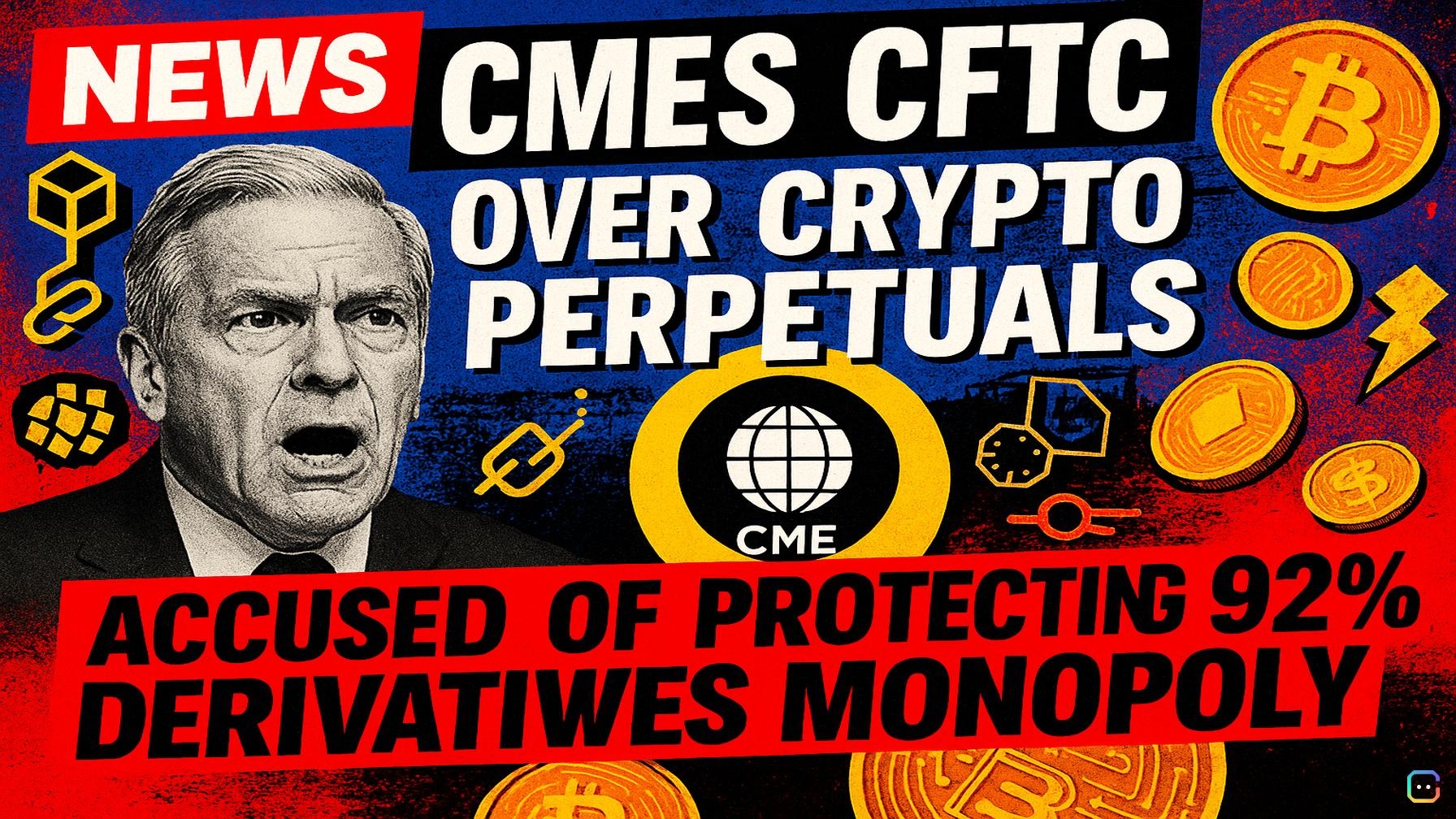
CME Sues CFTC Over Crypto Perpetuals, Accused of Protecting 92% Derivatives Monopoly
CME Group is under fire from crypto policy advocates who say the exchange is using the courts to protect a near-monopoly in U.S. derivatives markets. Jake Chervinsky, CEO of the Hyperliquid Policy Center, slammed CME this week after the exchange sued the U.S. Commodity Futures Trading Commission (CFTC) and its chairman, Michael Selig, over the regulator’s recent approval of regulated crypto perpetual futures. In a June 19 post on X, Chervinsky called the lawsuit a “shocking miscalculation” and accused CME of revealing itself as “a petty incumbent monopolist afraid of competition.” Hyperliquid’s criticism—made in a June 18 post that cites Better Markets data—spotlights just how dominant CME is: roughly 92% of U.S. exchange-traded derivatives volume, the post says. “When one venue holds that much volume, everyone else carries the cost. Less choice, higher prices,” the group wrote, arguing that years of U.S. traders being forced offshore to access perpetual-style products ended only after regulators recently opened a compliant domestic pathway. What triggered the legal fight The lawsuit challenges the CFTC’s decision to allow regulated crypto perpetual futures on U.S. platforms such as Coinbase and Kalshi, a move that has already produced more than $1 billion in trading volume, according to earlier reporting. CME contends that those perpetual contracts were mischaracterized by the agency—arguing they should be regulated as swaps under the Dodd-Frank Act’s Title VII framework, not as conventional futures. In public comments and court filings, CME said the CFTC departed from established treatment of similar instruments and approved a new product type without going through formal rulemaking. CME’s outgoing CEO Terrence Duffy told CNBC this week the exchange planned legal action after the approvals, reiterating the swap-versus-futures argument. Why it matters for markets and regulators Hyperliquid and Chervinsky frame the lawsuit as an incumbent pushing back against competition just as a genuinely new derivatives product—perpetual futures—enters regulated U.S. markets for the first time in over a decade. The group also quoted CFTC Chair Michael Selig’s recent remark that “vested interests always fear the future,” using it to argue that legacy firms often resist new entrants. The dispute comes as regulators themselves revisit the classificatory rules at issue. The CFTC and the Securities and Exchange Commission have launched a joint public consultation asking for input on how swaps, security-based swaps, mixed swaps and other modern derivatives should be treated under Dodd-Frank. The agencies say the review could clear “longstanding ambiguities”; SEC Chairman Paul Atkins has said clarification is overdue. The consultation will be open for public comment for 60 days after it appears in the Federal Register. Bottom line: the clash pits a dominant exchange defending its legal reading of Dodd-Frank against crypto firms and advocates who say opening a regulated path to perpetuals breaks a long-standing reliance on offshore venues—and could finally bring more competition and choice to U.S. derivatives markets. Read more AI-generated news on: undefined/news