Today's Cryptocurrency Prices by Market Caps
The global cryptocurrency market cap today i $2.35T
Market Cap
$2.35T
24h Trading Volume
$141.09B
BTC Dominance
56.47%
|
#
|
Name
|
Price
|
1h %
|
24h %
|
7d %
|
Market Cap
|
Volume (24h)
|
Chart (7d) |
|---|---|---|---|---|---|---|---|---|
|
|
—
|
|||||||
|
No cryptocurrencies found Try adjusting your search query |
||||||||
Latest Crypto News
View All News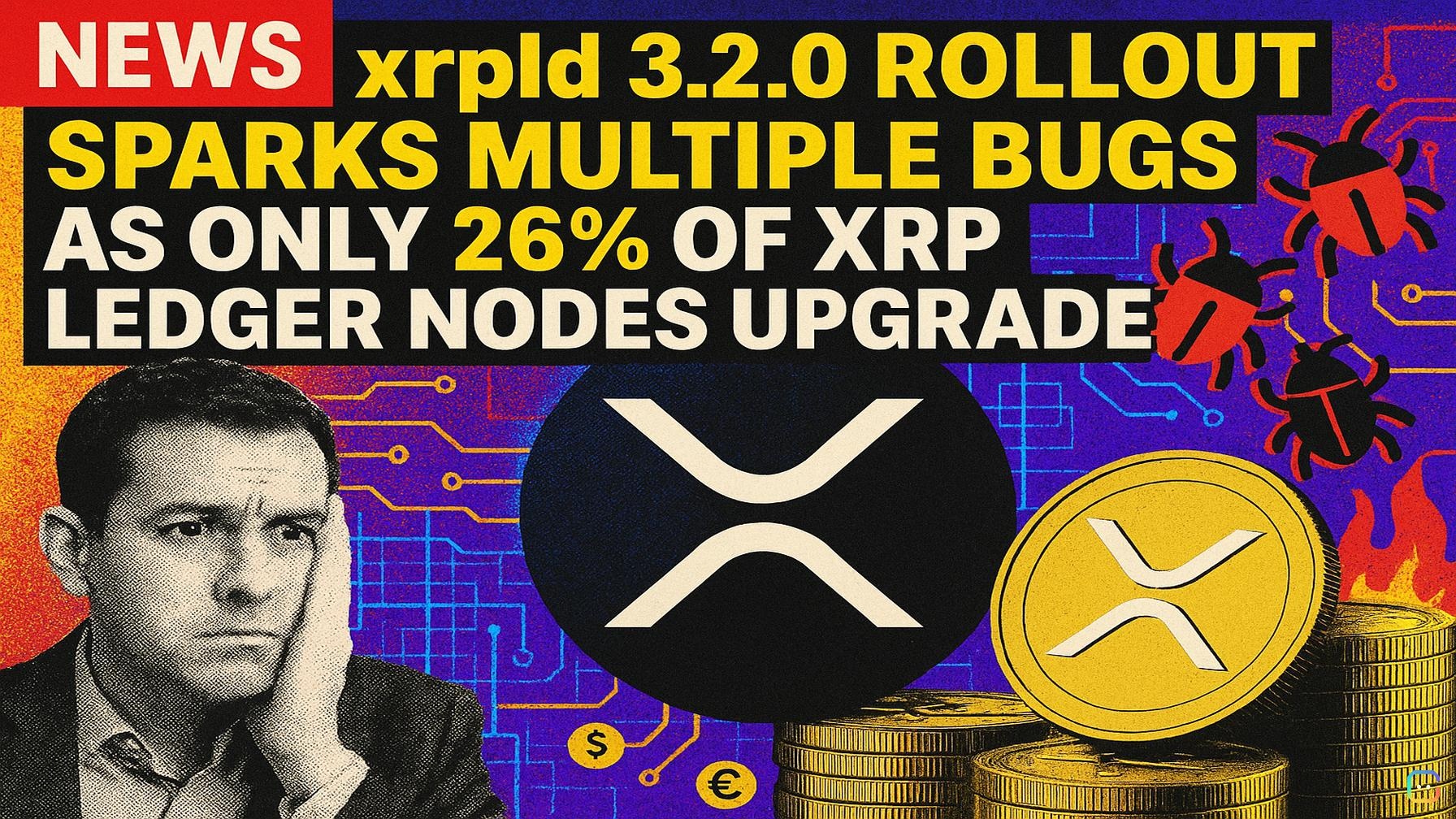
xrpld 3.2.0 rollout sparks multiple bugs as only 26% of XRP Ledger nodes upgrade
Headline: XRP Ledger’s xrpld 3.2.0 rollout surfaces multiple node bugs as adoption remains low The XRP Ledger community has begun uncovering a string of software issues after the June 15 release of xrpld version 3.2.0 — an upgrade that officially renames the server software from “rippled” to “xrpld” and promises security, performance and memory improvements. As of writing, just 26% of network nodes have upgraded, and developers and node operators are filing several bug reports on the project’s GitHub repository. What went into 3.2.0 - The update introduced performance and memory optimizations (community discussions projected 30–40% memory reductions), security enhancements, and other server improvements alongside the name change. Problems reported after the rollout Multiple issues have been raised by maintainers, node operators and contributors. Key reports logged on GitHub include: - Synchronization failure: One operator reported a server running xrpld 3.2.0 stuck in a “connected” state without downloading ledger data. The same machine synchronized normally after reverting to v3.1.3. That issue was submitted on June 18 and remains open. - Configuration parser crash: Configuration files with inline comments can trigger crashes during parsing. The legacy parser failed to strip comments in certain single-value fields, causing a “BadLexicalCast” error. - Transaction relay shortfalls: A relay calculation bug may cause transactions to be relayed to fewer peers than intended, potentially affecting transaction propagation. - Resource charging bug: The fee-recording mechanism reportedly only retains the highest fee observed and discards earlier fee data, which could distort resource accounting. - Peer/validator distribution gap: Validator list information is being sent only to inbound peers, leaving outbound peers uninformed. - Consensus and validation concerns: Reports flag an unsigned integer overflow risk during ledger sequence validation, inconsistencies in transaction routing flags, and broken proposal node identifiers tied to ephemeral keys. - Networking and message handling: Additional issues cover peer-to-peer communication behavior, message compression handling, message parsing policies, and consensus-related routing logic. - Ledger-tracking gaps: Some logic gaps could leave nodes in indeterminate states for extended periods. Project status and impact - Several reports have already been classified as confirmed bugs and assigned to maintainers for review; others remain under investigation. - The XRP Ledger Foundation and contributors are addressing the findings through the project’s open-source workflow. - According to the current GitHub records, none of the reported issues have caused a network-wide outage or disruption so far. Why it matters The xrpld 3.2.0 release targets important resource and performance gains, but the newly reported defects underscore the challenges of rolling out major node software upgrades across a distributed network. With only a quarter of nodes upgraded, the community is watching closely as maintainers triage and patch the problems to avoid fragmentation or degraded node behavior as adoption increases. Developers and node operators are encouraged to follow the GitHub issue tracker for updates and to report any additional anomalies they encounter during testing or production deployments. Read more AI-generated news on: undefined/news

OpenRouter's Fusion stacks cheap models to rival Fable 5 — half the cost as Fable goes offline
Headline: OpenRouter’s new “Fusion” stacks cheap models to mimic Claude Fable 5 — just as Fable goes offline for many users OpenRouter this week unveiled Fusion, an API that bets you can match a top-tier model by combining multiple cheaper ones and stitching their outputs together — at a fraction of the cost. The launch landed at an awkwardly perfect moment: Anthropic’s Fable 5 and Mythos 5 were suspended for foreign nationals after a U.S. export-control directive, opening a hole in the market that OpenRouter was quick to target with the claim of “Fable-level intelligence at half the price.” How Fusion works - A single prompt is broadcast in parallel to a panel of models. Each model can use web search and bash tools. - A judge model analyzes the panel responses to extract consensus points, contradictions, and blind spots. - A synthesizer (Claude Opus 4.8 by default) then writes the final, grounded answer based on the judge’s analysis. - All of this runs server-side through OpenRouter. Users can call the default panel by setting their model string to openrouter/fusion, add a fusion tool so their own model can call Fusion selectively, or build custom panels in a no-code Fusion chatroom. Benchmarks and pricing tradeoffs OpenRouter tested Fusion on DRACO, Perplexity’s benchmark drawn from real user deep-research tasks. Highlights: - A panel of Fable 5 + OpenAI GPT-5.5, synthesized by Opus, scored 69%. - Solo Fable scored 65.3% (seven tasks were blocked by Fable’s filters). - The “cheap” panel OpenRouter emphasizes — Google’s Gemini 3 Flash plus open-weight Chinese models Kimi K2.6 and DeepSeek V4 Pro, fused and synthesized by Opus — hit 64.7%. That beats solo GPT-5.5 (60%) and solo Opus 4.8 (58.8%), and sits within a percentage point of Fable, at roughly half the cost. - Pairing Opus 4.8 with a separate Opus instance scored 65.5%, a 6.7-point lift vs. solo Opus. OpenRouter attributes about 75% of the improvement to the synthesis step itself and the rest to model diversity. Quality control and limits - One issue found: when models had live web access, they could surface DRACO’s grading rubric in search results, contaminating the benchmark. OpenRouter fixed that with a one-line config to exclude the benchmark’s hosting domains; published results reflect the cleaned runs. - OpenRouter is candid that Fusion isn’t a drop-in Fable replacement. DRACO doesn’t evaluate long-horizon tasks where Fable reportedly still leads. For coding, Fusion is positioned as a tool a coding agent calls selectively rather than a wholesale replacement for a coding model — a limitation others testing cheaper Claude-compatible backends (e.g., DeepClaude) have also observed. - Fusion runs entirely on models routed through OpenRouter’s infrastructure, so it doesn’t circumvent the export-control problem at its source. Community reaction and implications for crypto developers Reactions to the launch skewed positive (roughly 2:1 in OpenRouter’s tracking). AI researcher Andrew Trask called Fusion “a way bigger deal than it seems,” saying frontier labs won’t automatically own the frontier anymore. Skeptics noted poorer coding/tool-calling outcomes in some cases and warned that the suspension of Fable 5 makes apples-to-apples public comparisons harder. For crypto projects and global dev teams, Fusion matters for a few reasons: - Cost: if you need near–top-tier reasoning but want to cut bills, model composition can get you close at substantially lower cost. - Availability: teams locked out of Fable 5 now have multiple fallbacks — Fusion panels, backend swaps like DeepClaude, or open-weight models (GLM-5.2 and others). - Centralization risk: Fusion still relies on OpenRouter’s routing and infra, so it’s not a full decentralization answer to export controls or model monopolies. Bottom line Fusion is a timely demonstration that “many middling-but-cheap models + a good judge + a good synthesizer” can approach the performance of an expensive single model — and at a lower price. It won’t instantly replace Fable for every high-end task, but for teams that prioritize cost and resilience over absolute top-end reasoning today, Fusion is a compelling new option. Read more AI-generated news on: undefined/news

Bio Protocol Unveils OpenLabs: AI-Driven, On-Chain Funding Hub for DeSci Research
Bio Protocol has unveiled OpenLabs, an AI-driven research hub that stitches together idea development, community funding and on-chain governance — a move the project says will streamline how scientific concepts turn into funded experiments. The platform was introduced on June 19 at DeSci.Berlin 2026, held at KÖNIG GALERIE during Berlin Blockchain Week. What OpenLabs is trying to solve Traditional research funding often depends on slow grant cycles and institutional gatekeepers. OpenLabs aims to replace that patchwork — grant applications, separate governance platforms and collaboration tools — with a single interface where researchers, community contributors and AI agents cooperate. According to Bio Protocol, the platform lets users: - Develop and refine proposals with AI-assisted workflows. - Coordinate contributors and project teams in one place. - Route funding and governance decisions on-chain using the BIO token. How governance and funding work OpenLabs integrates community voting and token-based governance into the research lifecycle. BIO serves as the ecosystem’s governance and utility token, used for voting and participation in platform activities. Bio Protocol’s broader fundraising arm, BIO Genesis, has raised more than $33 million to date — a figure the team highlights as evidence of growing ecosystem capital. Highlighted projects and prior AI work At the launch, Bio Protocol spotlighted two projects incubating on the platform: - RheumaAI — an AI agent focused on rheumatology research. - PeptAI — a project aimed at peptide discovery. OpenLabs builds on Bio Protocol’s earlier work with AI-powered research tools. In August 2025 the project ran an Ignition Sale for Aubrai, an on-chain “BioAgent” developed with VitaDAO for longevity research; Bio Protocol describes Aubrai as an AI co-scientist that can generate hypotheses and help design lab experiments. DeSci context and ecosystem links DeSci.Berlin has been a recurring showcase for decentralized science initiatives; prior editions helped incubate projects like Molecule Labs. OpenLabs is framed as another pillar of Bio Protocol’s decentralized science stack, which includes tokenized intellectual property and BioDAOs designed to direct funds to biotech and scientific programs. Market reaction and broader context Despite the launch, BIO traded lower, slipping more than 8% in the past 24 hours alongside the broader crypto market as investors digested a hawkish tone from Federal Reserve Chair Kevin Warsh and uncertainty tied to a proposed U.S.-Iran peace framework. Regulatory and commercialization headwinds Bio Protocol positions OpenLabs as an alternative to grant committees, but decentralized funding models raise regulatory questions. Tokenized IP and biotech projects intersect with securities law, patent rules and pharmaceutical oversight — complexities that grow as experiments move toward commercialization and clinical application. Bottom line OpenLabs packages AI, DeFi-style funding and on-chain governance into a single coordination layer for science. If it works as promised, the platform could shorten funding timelines and open up participation in research governance — but legal and compliance challenges remain significant as decentralized science projects scale. Read more AI-generated news on: undefined/news

MicroStrategy's STRC Plunge Sparks Fraud Claims and Liquidity Fears — Saylor Pushes Back
Headline: Michael Saylor pushes back as STRC plunge sparks fraud claims and liquidity worries Michael Saylor has mounted a robust defense of Strategy’s Bitcoin-backed capital plan after the company’s STRC preferred shares tumbled well below their $100 par value — a decline that has drawn fresh scrutiny and even fraud allegations from some market participants. In a June 20 post on X, Saylor said Strategy’s combined Bitcoin and cash reserves now exceed the company’s outstanding debt by roughly $48 billion. He reminded followers that since 2022 Strategy has raised more than $60 billion in new capital and used that money to buy Bitcoin, adding over 716,000 BTC to its holdings. A look back: why Saylor is drawing the contrast Saylor contrasted today’s balance sheet with the company’s position during the 2022 crypto bear market. In October 2022, when Bitcoin traded near $20,000, Strategy held about 130,000 BTC (roughly $2.6 billion at the time). A subsequent drop in Bitcoin below $16,000 briefly left the company’s debt exceeding its combined Bitcoin-and-cash reserves by about $300 million, and MSTR shares fell from roughly $24 to about $13 (split-adjusted). Saylor says the company weathered those stresses, strengthened its financial footing, and scaled its Bitcoin exposure since then. What triggered the current debate The recent sell-off in STRC — a preferred security tied to Strategy’s Bitcoin strategies — has prompted critics to question whether the financing model is sustainable and whether investors were given a full picture. Prominent Bitcoin critic Peter Schiff suggested investors could pursue legal action against Strategy and Saylor and argued Saylor’s marketing of the preferred stock might violate SEC rules. Alternative scenarios and market commentary Voices in the crypto and institutional trading community have put forward a range of potential responses to the STRC pressure: - Jeff Dorman, CIO at Arca, told crypto.news the company might ultimately need to sell $3–4 billion of Bitcoin to stabilize its capital structure and support STRC — a scenario he pegged at about a 25% probability. - Dorman’s base case (70% probability) is that Strategy would instead continue modest sales of MSTR shares, leaving most Bitcoin holdings intact but potentially saddling common shareholders with further downside. Supporters push back on criticism Several Bitcoin advocates have defended Saylor and the structure of STRC. David Gokhshtein argued on X that overall Bitcoin market moves can’t be blamed on one person and criticized comparisons to Terra. Analyst Ali Martinez earlier pointed out structural similarities between STRC and LUNA, which fueled debate. Samson Mow called STRC “a brilliant instrument” intended to reduce Bitcoin’s volatility for investors and said he sees no intrinsic structural flaw unless investors assume Bitcoin will fail to appreciate long term. Liquidity questions remain Market-maker QCP warned that Strategy’s current resources might cover preferred dividend obligations for roughly seven and a half months. If financing channels deteriorate, QCP said alternative funding — including possible Bitcoin sales — could become necessary. Bottom line The STRC sell-off has reopened fundamental questions about the viability and risks of Bitcoin-backed capital instruments. Saylor’s data-driven rebuttal aims to reassure investors by highlighting large reserves and capital raises, but critics point to short-term liquidity challenges and regulatory concerns. Watch for updates on dividend coverage, funding arrangements and any regulatory or legal moves as the debate unfolds. Read more AI-generated news on: undefined/news

Argentina Drops Cheque Tax for Registered Crypto Exchanges to Boost Onshore Trading
Argentina has reportedly removed the transactional “cheque tax” for registered cryptocurrency exchanges — a policy tweak that could lower operating costs for compliant platforms and bolster regulated crypto rails under President Javier Milei. What changed - The cheque tax is a levy on credits and debits in bank accounts. Until now, it applied to crypto firms and created a cost gap between regulated exchanges and traditional financial players. - The exemption applies only to registered, regulated exchanges operating inside Argentina’s domestic framework. Offshore platforms and informal peer-to-peer (P2P) markets remain outside the relief. Why it matters - Argentina’s retail crypto scene is shaped by high inflation, strict currency controls and strong demand for dollar-linked assets. For many Argentines, stablecoins and Bitcoin are everyday tools for preserving value, not just speculative bets. - By lowering a transactional cost for compliant exchanges, the measure could make local platforms more competitive versus offshore exchanges and informal P2P channels, helping shift volume into supervised channels. - Moving activity to regulated rails can improve transparency and make it easier for authorities to monitor flows — without cutting off access to crypto for the public. Market and trader implications - The change is primarily operational rather than an immediate price catalyst. It should reduce overhead for registered exchanges and could nudge some activity away from informal routes. - For traders, the development signals that the Milei administration is willing to reshape financial rules to favor market access and deregulation — a theme that may influence institutional and retail behavior over time. - As always, be cautious: weekend trading and thin liquidity can amplify narrative-driven price moves, so headlines alone aren’t a reliable buy-or-sell trigger. Bigger picture - Treat this update as part of broader crypto trends: stronger compliance pressure balanced by easier app-based access, renewed interest in DeFi funding, tokenized real-world assets, and altcoin dynamics that still depend heavily on Bitcoin’s direction. - The exemption is conditional: platforms and users must continue to meet local licensing and reporting requirements to qualify. Reporting note This report is based on information from Julian Colombo. Written by the News Desk; edited by Samuel Rae. Read more AI-generated news on: undefined/news

Venus Lets Users Pledge Tokenized Stocks as Collateral to Borrow on BNB Chain
Venus Protocol has added tokenized stocks as acceptable collateral for borrowing on BNB Chain, bringing equity-backed exposure into on-chain lending markets. What changed - Users can now pledge tokenized versions of traditional stocks to borrow stablecoins or BNB on Venus, without selling the underlying equity tokens. - The move expands borrowing collateral beyond crypto-native assets and makes DeFi lending more similar to traditional margin finance, where securities are pledged to access liquidity. Why it matters - Real-world assets (RWAs) are one of DeFi’s clearest growth narratives, and tokenized equities give users a familiar bridge between traditional finance and on-chain lending. - Chains are competing to capture RWA activity—tokenized stocks, treasuries and similar assets are attractive because they can bring more stable, less speculative liquidity to a network. Key risks and operational challenges - Off-chain dependencies: Tokenized stocks may trade on-chain, but their value and redemption depend on custodians, legal agreements and off-chain redemption processes. That adds counterparty and legal risk beyond smart-contract exposure. - Valuation and market hours: Stocks trade in traditional markets while DeFi runs 24/7. Protocols must manage price feeds, liquidation thresholds and gaps between market sessions to avoid unexpected liquidations or stale prices. - Infrastructure needs: Reliable custody, robust oracles, and clear rules for freezes, redemptions and liquidation events are essential for this model to scale safely. Market context - This integration is best read as part of broader trends—not a standalone buy/sell signal. It complements other themes shaping crypto today: tighter compliance, easier app-based access, renewed DeFi funding, growing RWA tokenization, and altcoin dynamics still tied closely to Bitcoin’s direction. - Weekend and thin-liquidity trading periods can amplify narrative-driven moves, so retail attention often focuses on whether a development changes access, liquidity, or risk profiles. What to watch - Whether liquidity and actual usage grow beyond headline integrations. Tokenized stocks can widen DeFi’s total addressable market, but real traction depends on custody robustness, oracle accuracy and clear operational rules around freezes and redemptions. Source and credits - This report is based on information from Venus Protocol’s X account. Written by the News Desk; edited by Samuel Rae. Read more AI-generated news on: undefined/news