Today's Cryptocurrency Prices by Market Caps
The global cryptocurrency market cap today i $2.38T
Market Cap
$2.38T
24h Trading Volume
$78.81B
BTC Dominance
56.10%
|
#
|
Name
|
Price
|
1h %
|
24h %
|
7d %
|
Market Cap
|
Volume (24h)
|
Chart (7d) |
|---|---|---|---|---|---|---|---|---|
|
|
—
|
|||||||
|
No cryptocurrencies found Try adjusting your search query |
||||||||
Latest Crypto News
View All News
Ethereum Falls to $2K as US‑Iran Rhetoric Triggers $1B+ Derivatives Liquidations
Ethereum’s battle to hold $2,000 wasn’t driven by on-chain signals or exchange flows — it was collateral damage from geopolitics. What happened A surprise escalation in US-Iran rhetoric after former President Donald Trump’s remarks sent global markets scrambling. Investors had been braced for a de-escalation; instead they got a timeline for potential further action. The reaction was immediate and violent: US Treasuries rallied as money fled to safety, the S&P 500 wiped out roughly $500 billion in market cap within minutes, and crypto markets were swept up in the spillover. Why this hit Ethereum Analyst Darkfost frames the move as a geopolitical event, not an Ethereum-specific story. ETH didn’t spark the sell-off — it absorbed it. Within a single hour of the comments, more than $1 billion in ETH derivatives sell volume flooded the market, with roughly $968 million of that activity hitting Binance. That avalanche of liquidations and risk reduction produced an intraday correction of roughly 4–5% for Ethereum — a number that understates the speed and intensity of the dump. Market mechanics and implications This was not a gradual repricing driven by fundamentals; it was a rapid unwinding of leverage and exposure in response to an unforeseen macro shock. In such episodes, the usual crypto market guides — on-chain flows, exchange reserves, moving averages — are temporarily overshadowed by a macro variable that doesn’t appear on price charts. Technically, Ethereum remains under pressure. After a sharp February breakdown from the $3,000 area, ETH settled into a lower range roughly between $1,900 and $2,200. Price sits below the 50- and 100-day moving averages (both trending down), while the 200-day moving average remains well above current levels — reinforcing a broader bearish structure. The initial breakdown came with high volume, suggesting forced selling; the current consolidation is on lower volume, indicating weak buyer conviction. Repeated failures to clear $2,200 have produced lower highs, so momentum stays skewed to the downside until ETH reclaims short-term moving averages with conviction. What traders should consider Darkfost’s takeaway is straightforward: expect elevated uncertainty and erratic price action. In these conditions the simplest risk-management steps are the most effective — reduce exposure, limit leverage, and avoid making large directional bets until volatility subsides and the macro picture clarifies. The market isn’t “broken”; it’s reacting to fear, and panicked markets punish overconfidence fastest. Bottom line Ethereum’s test of the $2,000 level is a reminder that crypto remains sensitive to broader geopolitical shocks. On-chain metrics and technicals matter, but they can be overridden by sudden macro events. For now, traders should prioritize risk control over prediction. Read more AI-generated news on: undefined/news

Minga: Buy the Dips — Bitcoin Eyes $190K Target, $37K 'Generational' Buy Zone
Crypto analyst Minga says Bitcoin could surge well past six figures in the next bull cycle — and he’s urging traders to start accumulating now. Key takeaways - Minga sees Bitcoin ultimately breaking out to a new all-time high in the next bull market, forecasting a possible run beyond $120,000 and targeting roughly $190,000 (he has also identified $194,742 as a level to begin taking significant profits). - He believes BTC is approaching a macro bottom, making current and future dips buying opportunities rather than times to panic. - Near-term support and spot-buy interest zones cited by Minga include roughly $58,900–$54,500, with a more extreme “max-pain” downside to $37,000 — a level he calls a potential generational bottom for building large positions. - Minga emphasizes dollar-cost averaging and building positions over time rather than “all-in” purchases. What Minga is recommending In a recent X post, Minga argued the market is entering the portion of the cycle where every dip should be treated as an accumulation opportunity for long-term holders. He flagged the $58.9k–$54.5k range as a primary point of interest for spot buys, while acknowledging that a more severe drawdown to $37k remains a possible worst-case scenario — and, if it happens, a place he’d view as ideal to “go all in.” On the topside, Minga is watching roughly $194,742 as a level to start unloading a large chunk of spot holdings. He stressed that profit-taking at that level is a plan, not a final decision, and will depend on price action when BTC approaches that region. Another analyst’s view: strategic accumulation windows Crypto analyst Ali Martinez shared a complementary technical perspective, outlining two principal accumulation zones based on historical bear-market resets that follow the 50/200 SMA crossover: - First target: $40,000 — about a 30% reset from then-current levels. - Second target: $30,000 — roughly a 50% decline, historically coinciding with the last leg down before a generational macro bottom. Martinez noted BTC has already experienced a ~52% correction and is about 30 days into a 3-day SMA cross. If past patterns repeat, he suggested the final accumulation window for this cycle could open within the next three to six days. Market snapshot At the time of the reports, CoinMarketCap data showed Bitcoin trading around $66,400, down just over 2% in the past 24 hours. Bottom line Minga’s bullish long-term targets and Martinez’s historical reset levels paint a familiar — if divergent — playbook: build positions gradually across dips, keep $37k–$30k on the radar as deeper accumulation zones, and consider significant profit-taking once prices approach the high-six-figure/low-seven-figure targets the bulls are now discussing. As both analysts emphasize, execution and timing should be driven by risk management and how price behaves at those key levels. Read more AI-generated news on: undefined/news
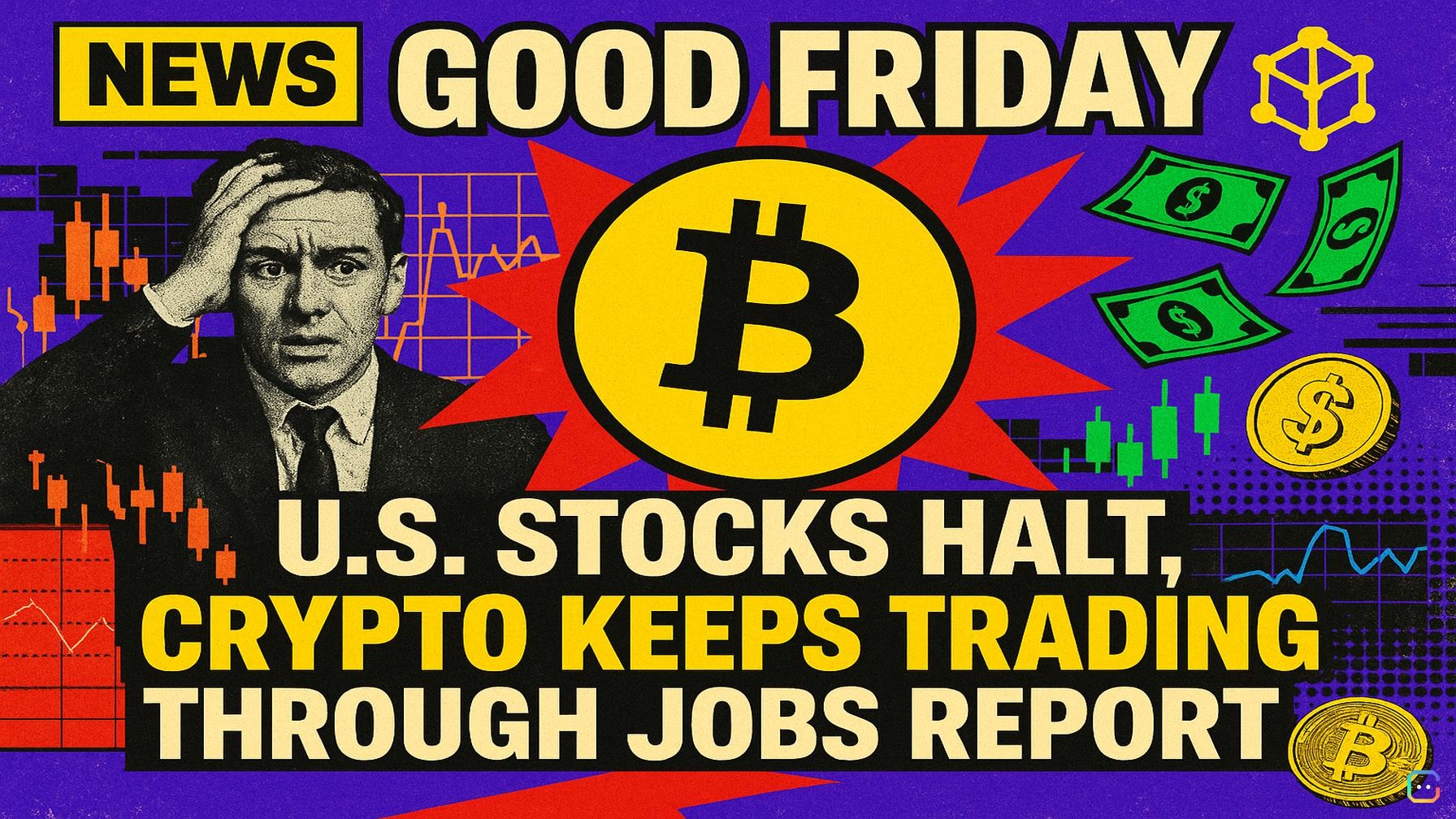
Good Friday: U.S. Stocks Halt, Crypto Keeps Trading Through Jobs Report
Headline: U.S. equities shut down all day on Good Friday 2026 — crypto keeps trading Quick take: On April 3, 2026 (Good Friday), the NYSE and Nasdaq implemented a full trading halt — no regular session, no pre-market, no after-hours. Markets reopen Monday, April 6 at 9:30 a.m. ET. What happened - The stock market was completely closed for the full day on Good Friday — not a partial pause, but a full stop. Thursday, April 2 was the last active session, ending at 4:00 p.m. ET. - Pre-market and after-hours mechanisms were inactive during the holiday, so anyone holding positions Friday had to wait until Monday’s open to trade. - The Labor Department released its March jobs report at 8:30 a.m. ET on Friday — a potentially market-moving data point that arrived with no live equity session to digest. Traders and analysts spent the Easter weekend running scenarios for what could be a choppy Monday open. “The markets could be extra choppy going into the Easter long weekend,” said Kyle Rodda, senior financial market analyst at Capital.com. Why this is noteworthy - Good Friday is not a U.S. federal holiday — banks, postal services, and most government offices remained open — yet Wall Street traditionally closes. That mismatch often surprises people. - Fixed-income desks followed SIFMA guidance to wind down by noon ET, and major exchanges CME and ICE pulled equity index futures off the board for the day. - European markets were also offline for Good Friday and Easter Monday: London Stock Exchange, Euronext, and Frankfurt/Xetra were closed, reducing the European flow into Monday’s reopen. Crypto angle - Crypto markets ignored the holiday and traded 24/7 as usual. With U.S. equities closed and futures pulled, crypto provided a continuous price discovery venue during a day many equities traders were sidelined. Expect crypto to react to any equity-driven volatility when U.S. markets resume Monday. Context and calendar notes - The Nasdaq 2026 holiday schedule lists 10 full-day closures; Good Friday is one of the rare market holidays not backed by federal statute. Other exchange holidays (New Year’s Day, MLK Day, Presidents’ Day, Memorial Day, Juneteenth, Independence Day, Labor Day, Thanksgiving, Christmas) coincide with federal holidays. - After Good Friday, the next NYSE/Nasdaq full-day closure on the calendar is Memorial Day (May 25). Regular market hours on trading days remain 9:30 a.m.–4:00 p.m. ET. Bottom line for traders and crypto market participants - Equities were offline all day Friday and resumed Monday at 9:30 a.m. ET, creating a window where news like the jobs report could generate outsized volatility at the open. Crypto traders, meanwhile, had uninterrupted markets and should watch for spillover moves when U.S. exchanges reopen. Read more AI-generated news on: undefined/news

McLaren Joins Hedera Council, Fuels HBAR Adoption as Token Eyes Breakout
McLaren Racing has officially joined Hedera’s governing council, handing the enterprise blockchain a fresh burst of mainstream visibility just as its native token HBAR trades near $0.08. Market snapshot - HBAR was up about 1.4% over 24 hours but remains roughly 6% lower on the week, painting a mixed short-term picture. - Coingecko data shows 24-hour trading volume slid about 15% to $87 million, suggesting softer activity even as price holds inside a narrow range. Technical picture Analysts see a potentially decisive setup forming. ChartNerd highlights a converging triangle pattern—higher lows meeting lower highs—which can compress price action before a strong breakout. He’s still pointing to a long-range target near $1.80, but stresses that move depends on a clear break above resistance and stronger volume; without confirmation the pattern could fail and price may slip instead. Other technical notes from the report: - The structure was likened to an Elliott Wave-style sequence, with the current leg finishing near support. - Momentum indicators have recently emerged from oversold territory, which some traders interpret as a precursor to a rebound—but that signal isn’t foolproof. McLaren deal: real-world utility and fan reach Beyond charts, the bigger story is the strategic win for Hedera. McLaren—active in Formula 1 and IndyCar and boasting fans across more than 180 countries—joins Hedera’s council to work on governance and fan engagement initiatives tied to racing events. Early elements of the collaboration reportedly include blockchain-based collectibles linked to major race weekends, with further launches planned through the 2026 season. Why it matters The partnership gives Hedera a tangible use case and a chance to onboard mainstream sports audiences through secure digital experiences, at a time when traders are watching both price patterns and real-world adoption. Short term, traders will be watching for a volume-backed breakout to validate bullish targets; longer term, McLaren’s reach could help drive real utility for HBAR-based products. Read more AI-generated news on: undefined/news

Analyst Compares Cardano to Early Bitcoin, Predicts $10+ ADA After Commodity Clarity
A prominent crypto analyst is drawing a bold parallel between Cardano’s current market position and Bitcoin’s early, overlooked years — and he believes a return to double-digit prices for ADA is only a matter of time. What the analyst is saying - Crypto Patel, posting on X, argues that today’s Cardano looks like a classic “buy the unloved” setup the market has seen before. He points to two main pillars of his thesis: recent U.S. regulator signals that treat ADA as a commodity, and price structure that, in his view, suggests a macro bottom may be forming. - “That’s like buying Bitcoin when everyone called it a scam,” Crypto Patel wrote, adding that this time the asset already carries a government classification that reduces a major legal overhang. - He concludes emphatically: “$10+ ADA is not a question. It’s just a matter of time.” Where ADA stands now (key facts) - ADA is trading around $0.24 and is roughly 91–92% below its all-time high of $3.09. - From 2020 lows into the 2021 peak, ADA once rallied roughly 3,402% before entering a prolonged correction. - On a biweekly ADA/USDT chart (Binance), Crypto Patel identifies a macro bullish order block — a demand zone between $0.13 and $0.18 that historically attracted buyers. - Between 2022 and 2025 the chart formed a large descending triangle (lower highs and higher lows). In 2025 the price broke below the triangle’s support; that former support has flipped into resistance in the $0.45–$0.50 area. The recovery roadmap Crypto Patel outlines - He frames the recovery as staged: first reclaim resistance at $1.20, then $2.95, with a subsequent bull market extension to $5.82 and a long-term target of $15.60 — a rise of roughly 12,471% from the alleged cycle bottom. - These targets are grounded in his interpretation of macro technical levels and the idea that regulatory clarity (commodity status) removes a major risk factor that once kept investors away. Context and caution - Some market participants view ADA as a struggling altcoin still far from its former prominence; others see signs of an early-cycle breakout. Crypto Patel’s view sits squarely in the latter camp and is driven by technical structure plus regulatory developments. - As with any price projection, these levels reflect one analyst’s interpretation of charts and macro conditions — not guaranteed outcomes. Bottom line Crypto Patel believes Cardano’s combination of a deep drawdown, a historical demand zone, and recent commodity classification could set the stage for a multi-stage recovery that eventually pushes ADA back into double-digit territory. Investors should weigh this bullish technical narrative alongside broader market conditions and the usual risks of crypto investing. Read more AI-generated news on: undefined/news

Ripple Bridges Fiat and Crypto for Treasuries as Ghana Turns National ID into XRP Ledger Wallet
Ripple is moving to close the gap between corporate finance and blockchain with a new treasury management offering aimed squarely at CFOs and corporate treasuries — and a separate development in Africa is showing how national finance can be reimagined on-chain. Ripple’s unified treasury system bridges fiat and crypto According to analyst Bird on X, Ripple has rolled out what’s being touted as the first treasury management system that lets finance teams handle traditional currencies (USD, EUR) and digital assets (XRP, RLUSD) from a single dashboard. Historically, treasuries have kept cash in bank systems while crypto balances lived across exchanges, wallets, or custodians — creating fragmented workflows, spreadsheets, and constant reconciliation. Ripple’s solution consolidates those worlds: finance teams can view real-time liquidity positions, see bank balances, stablecoins, and crypto holdings valued instantly, and have those values recorded automatically like any other financial transaction. The stated aim is to make digital assets behave like cash inside existing corporate processes, removing the need for specialized crypto expertise, separate wallets, or parallel infrastructure. If it works as described, this is a pragmatic step toward mainstreaming digital assets in day-to-day corporate finance — letting companies add crypto into their treasury stack without overhauling how treasury teams operate. Ghana integrates payments and ID on the XRP Ledger In a separate and noteworthy development, crypto commentator Pumpius reports that Ghana has become the first African country to integrate real payment functionality directly into its national ID — the Ghana Card — using the XRP Ledger. The upgraded Ghana Card is said to be usable across more than 200 countries for online and in-store purchases, ATM withdrawals, and international transfers, with additional services such as insurance and emergency assistance tied in. Behind the rollout, reports say, is DNAOnChain acting as the secure sovereign backend, with the DNA Protocol built on top of the XRP Ledger. Proponents frame this as a shift away from reliance on global payment networks and a move toward more locally controlled financial infrastructure. Why this matters Both stories highlight a common theme: moving blockchain technology from isolated use cases into core financial infrastructure. Ripple’s corporate-focused treasury tool targets easier enterprise adoption of crypto assets, while Ghana’s national ID integration demonstrates a sovereign use of ledger tech for payments and services. Together, they point to growing experimentation with blockchain as an operational layer — not just an investment vehicle — in both private and public finance. Read more AI-generated news on: undefined/news