Key takeaways
- Regulated futures markets have become the decisive gateway for ETF approval.
- XRP’s path shows market infrastructure can trump unresolved legal questions.
- A repeatable, rules-based pipeline for altcoin ETFs is emerging.
Why XRP’s ETF story matters
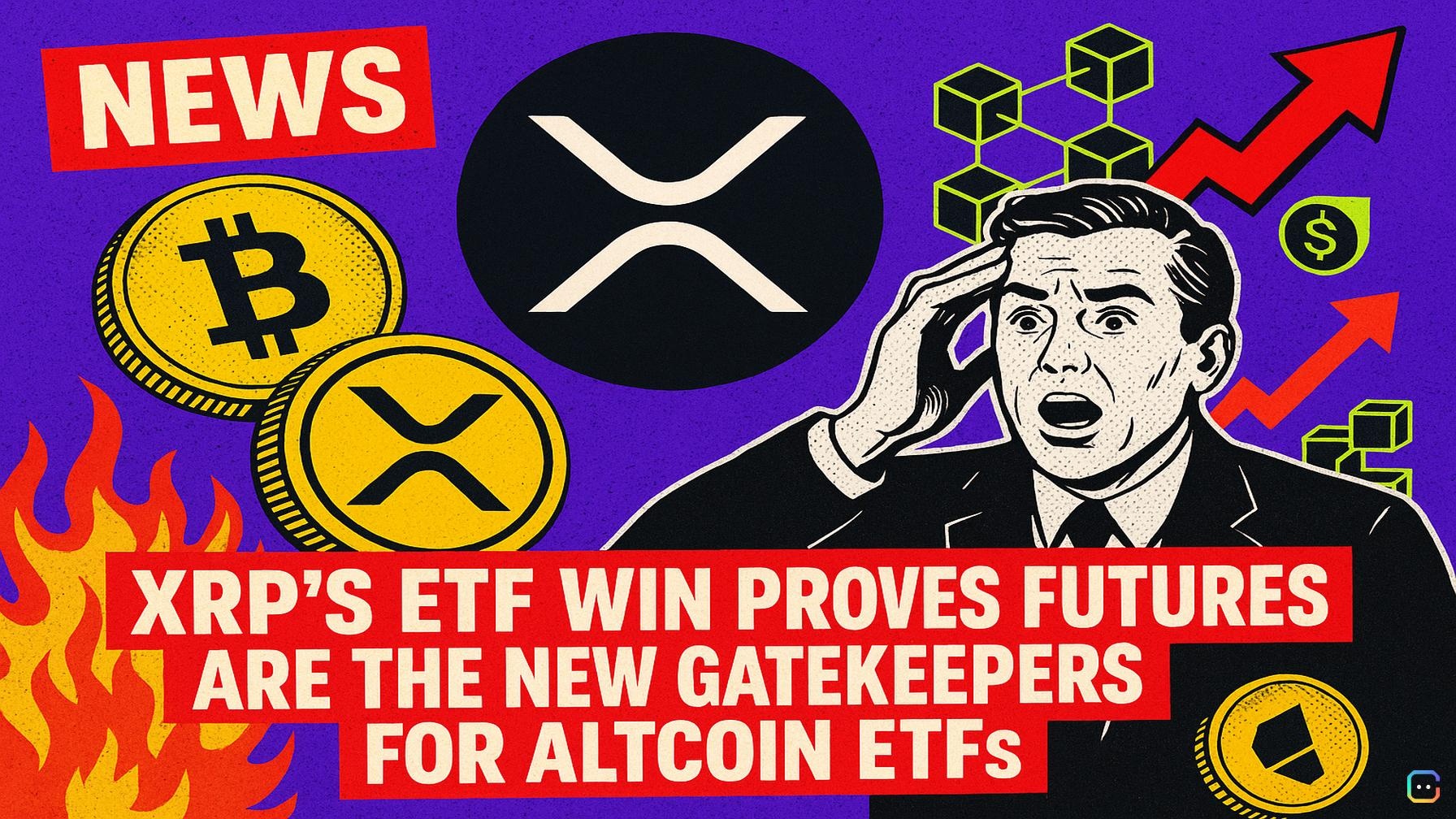
XRP’s journey from a headline-grabbing enforcement target to the underlying asset of a U.S.-listed exchange-traded fund isn’t an outlier — it’s a template. Rather than being decided primarily by legal clarity, ETF access for digital assets is increasingly determined by whether they can plug into regulated futures markets and the institutional infrastructure around them.
A procedural shift: from discretionary rulings to infrastructure tests
ETF approvals used to be slow and heavily discretionary, shaped by regulatory interpretation. That changed after the SEC’s September 2025 decision to allow generic listing standards for Commodity-Based Trust Shares. Under the new framework:
- Exchanges no longer need individual rule-change filings for each product.
- Approval timelines have compressed.
- Eligibility is now tied to measurable infrastructure criteria.
Put simply: once an asset satisfies predefined infrastructure requirements, approval becomes a compliance exercise rather than a policy debate.
Futures markets as the new gatekeepers
The single most important requirement today is a track record of trading on a CFTC-regulated futures market. Assets that show at least six months of activity on a designated contract market (DCM) can access an accelerated ETF approval path — shrinking the timeline from roughly 240 days to about 75. That makes futures listings the practical bottleneck for institutional access.
The emerging, repeatable pipeline is straightforward:
1. Secure a regulated futures listing.
2. Build the required trading history.
3. File under the generic ETF standards.
4. Launch.
XRP: proof that infrastructure can outweigh legal uncertainty
XRP illustrates how this new system works in practice. Despite ongoing legal ambiguity around Ripple — including penalties and partial rulings on securities classification — XRP moved through the pipeline:
- Regulated futures launched in early 2025.
- Institutional-grade pricing benchmarks were established.
- Spot ETF products were listed by September 2025.
By early 2026, XRP-linked ETFs had accumulated hundreds of millions in assets, showing that capital formation can proceed even without full legal resolution.
Who holds the keys now
The shift places power upstream of the SEC’s product approval desk and into the hands of market infrastructure players:
- DCMs (futures exchanges) control when an asset becomes eligible.
- Clearinghouses enable institutional participation.
- Benchmark providers define the pricing standards.
For altcoins, the hurdle is no longer just regulatory compliance — it’s securing access to these infrastructure layers.
A predictable pipeline for altcoin ETFs
The model appears to be scaling. In early 2026, futures listings for assets such as Cardano, Chainlink, Stellar, Aptos, and Tezos went live on regulated markets. Given the six-month futures trading requirement plus roughly 75 days for approval, market observers expect a wave of altcoin ETFs to emerge in late 2026 — driven not by fresh regulatory rulings but by assets following the established sequence.
The big-picture implication
This is more than a single product approval: it’s a structural change. ETF access is shifting from discretionary, regulator-led decisions to a rules-based process governed by market infrastructure. The result will likely be a bifurcated market: assets that meet infrastructure criteria become “ETF-eligible” and attract institutional capital, while those that do not risk being structurally excluded.
Bottom line
XRP’s ETF debut is a blueprint, not just a headline. The road to institutional capital for digital assets is increasingly defined by regulated futures listings and the surrounding ecosystem. As that system scales, the fundamental question for any altcoin will be whether it can secure the infrastructure required to be investable at the institutional level.
Read more AI-generated news on: undefined/news