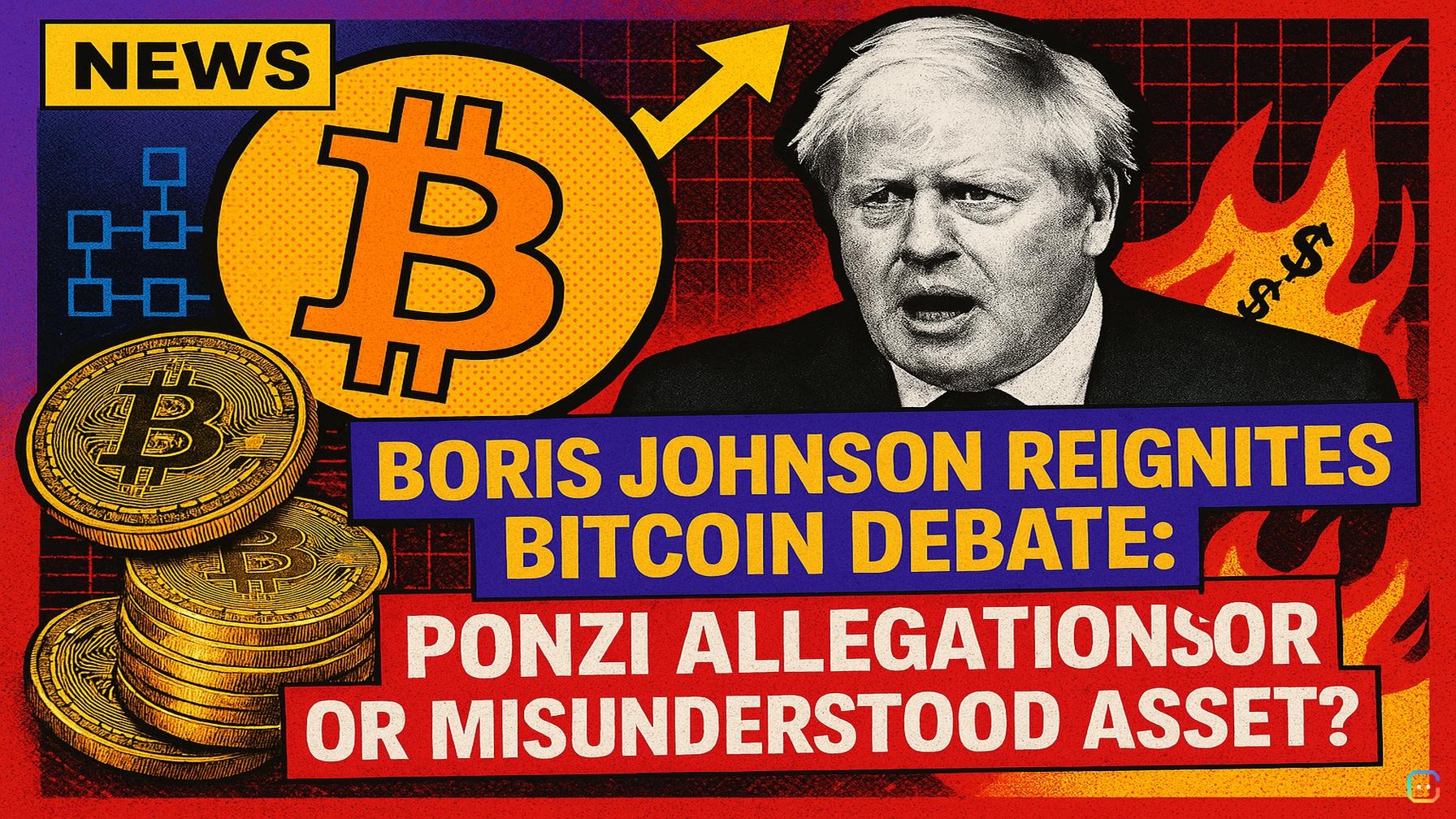
Headline: Boris Johnson Revives Bitcoin Debate — Is the Cryptocurrency Fundamentally Flawed or Just Misunderstood?
Summary
Former UK prime minister Boris Johnson reignited criticism of Bitcoin in a post on X on March 13, 2026, arguing the world’s largest cryptocurrency may be structurally risky and questioning its legitimacy. His comments — illustrated by anecdotes of heavy investor losses and the anonymity of Bitcoin’s creator, Satoshi Nakamoto — have reopened familiar debates about value, accountability and investor protection. But while Johnson suggested Bitcoin may resemble a Ponzi scheme, the comparison misses key technical and economic distinctions.
What Johnson said
- Johnson reiterated long-standing scepticism about Bitcoin, citing reports of investors who lost large sums after being lured by profit promises. He highlighted a case of a retiree who put in £500 hoping to double it, then spent years trying to withdraw funds, paid fees along the way, and ultimately lost roughly £20,000.
- He questioned Bitcoin’s intrinsic value, calling it a “digital construct” without physical backing or cultural meaning, and flagged the anonymity of Satoshi Nakamoto as a source of accountability risk.
- Johnson implied that Bitcoin’s dependence on investor interest and its decentralized, opaque origins could expose participants to dynamics that feel exploitative or fraudulent.
Is Bitcoin a Ponzi scheme?
- A conventional Ponzi involves a central operator promising fixed returns and paying earlier investors with funds from newcomers. Bitcoin does not fit that model: there is no central organizer, no guaranteed returns, and no built-in mechanism to redistribute new investors’ money to earlier ones.
- Bitcoin’s supply is capped at 21 million coins, and transactions are validated by a decentralized network rather than a single authority. Market demand, not new arrivals, determines price. Advocates such as Michael Saylor point to decentralization as removing the core elements necessary for Ponzi fraud.
Where Johnson’s criticisms resonate — and where they don’t
- Resonance: Johnson’s focus on real investor harm is legitimate. Scams, poor user interfaces, fraudulent services, custodial failures and deceptive marketing have resulted in severe losses for individuals — and those stories shape public perception. Price surges driven by sentiment, adoption narratives and liquidity can also produce boom‑and‑bust episodes that feel superficially similar to Ponzi dynamics.
- Limits: These market problems and bad actors live alongside Bitcoin’s transparent ledger, voluntary participation, and protocol‑enforced scarcity. Those technical features distinguish the system from classic frauds even as they don’t eliminate volatility or the risk of external abuses.
Bottom line
Boris Johnson’s remarks revive important public-policy and consumer‑protection questions — especially around regulation, custodial safeguards and investor education — but labeling Bitcoin itself a Ponzi scheme overlooks the cryptocurrency’s decentralized mechanics. Bitcoin remains a high‑risk, highly volatile asset whose structure differs fundamentally from the fraud model Johnson invoked, even as its ecosystem still contains vulnerabilities that can harm retail investors.
Read more AI-generated news on: undefined/news