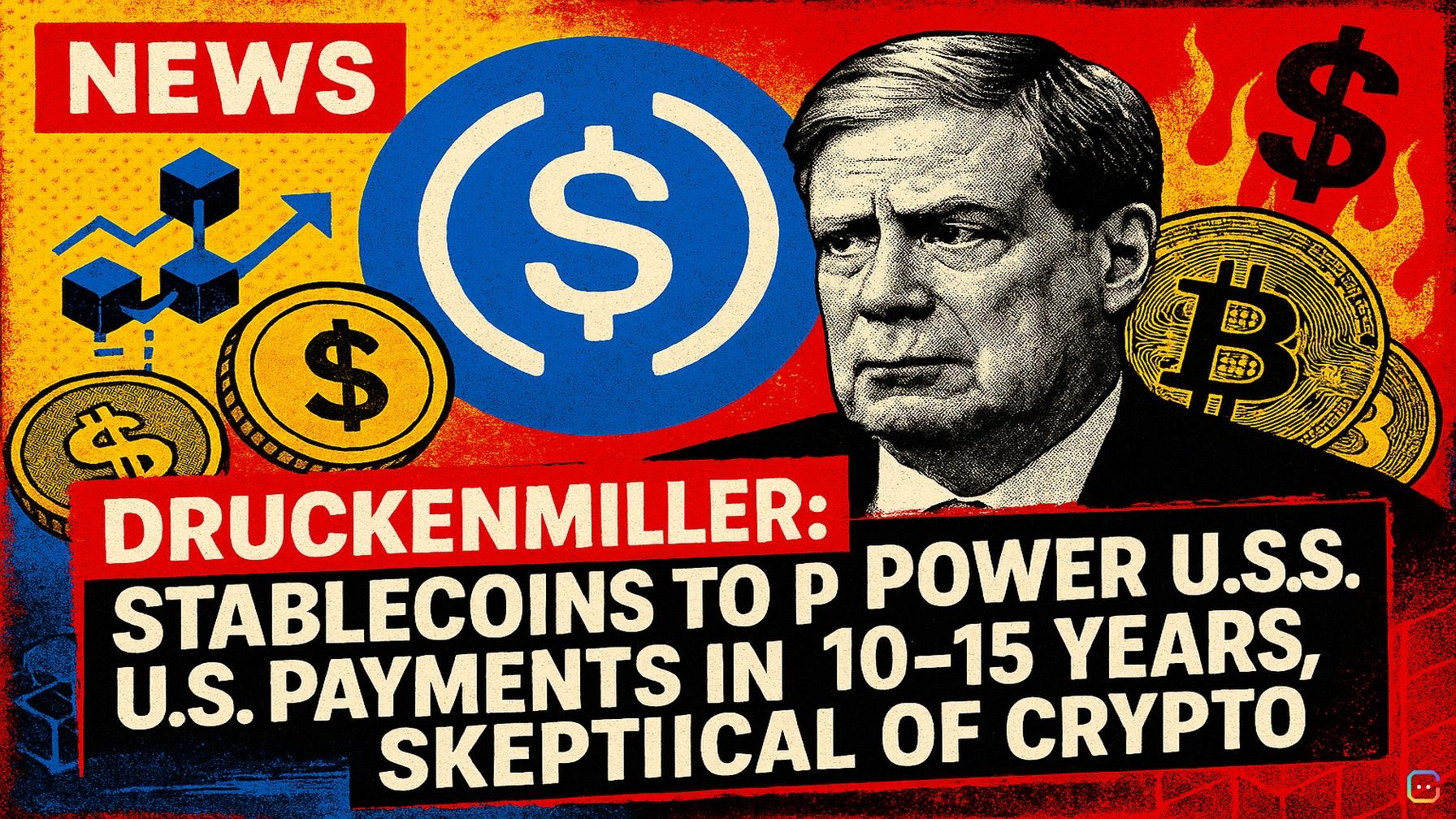
Billionaire investor Stanley Druckenmiller predicts stablecoins will become central to the U.S. payments system within the next decade, even as he remains unconvinced by regular cryptocurrencies.
In a recent interview with Morgan Stanley, the veteran fund manager called blockchain and stablecoins “incredibly useful in terms of productivity,” arguing that stablecoins are likely to power U.S. payments in the next 10–15 years because they are “efficient, quicker, and cheaper.” Druckenmiller — the former chairman and president of Duquesne Capital, which he founded in 1981 and closed in 2010 with roughly $12 billion AUM — sees practical payments use as the big win for tokenized dollars.
That view comes against a backdrop of fresh U.S. regulation: months after President Donald Trump signed the GENIUS Act into law to create a formal framework for stablecoin issuance and operations, market participants have been moving quickly. Tether announced a U.S.-focused product, USAT, aimed at American regulatory and market conditions, while banks including JPMorgan, Citigroup and even the Bank of North Dakota are developing their own stablecoin offerings to capture anticipated adoption.
Druckenmiller’s optimism about stablecoins contrasts sharply with his take on broader crypto. He described many cryptocurrencies as “a solution looking for a problem,” adding, “I am very sad it ever happened as a store [of] value because it wasn’t needed. But it’s a brand that people love, so it’s going to be a store of value.”
He also raised a broader macro question: the dollar’s long-term role as the world’s reserve currency could be challenged within the next 50 years, and he didn’t rule out a cryptocurrency emerging as a contender.
For context, the crypto market today sits around $2.42 trillion, with stablecoins accounting for roughly 13% of that total. Druckenmiller’s remarks underscore a growing industry view: while speculative crypto narratives remain divisive, policy moves and incumbent financial institutions are increasingly treating dollar-pegged tokens as a realistic infrastructure play for payments.
Read more AI-generated news on: undefined/news