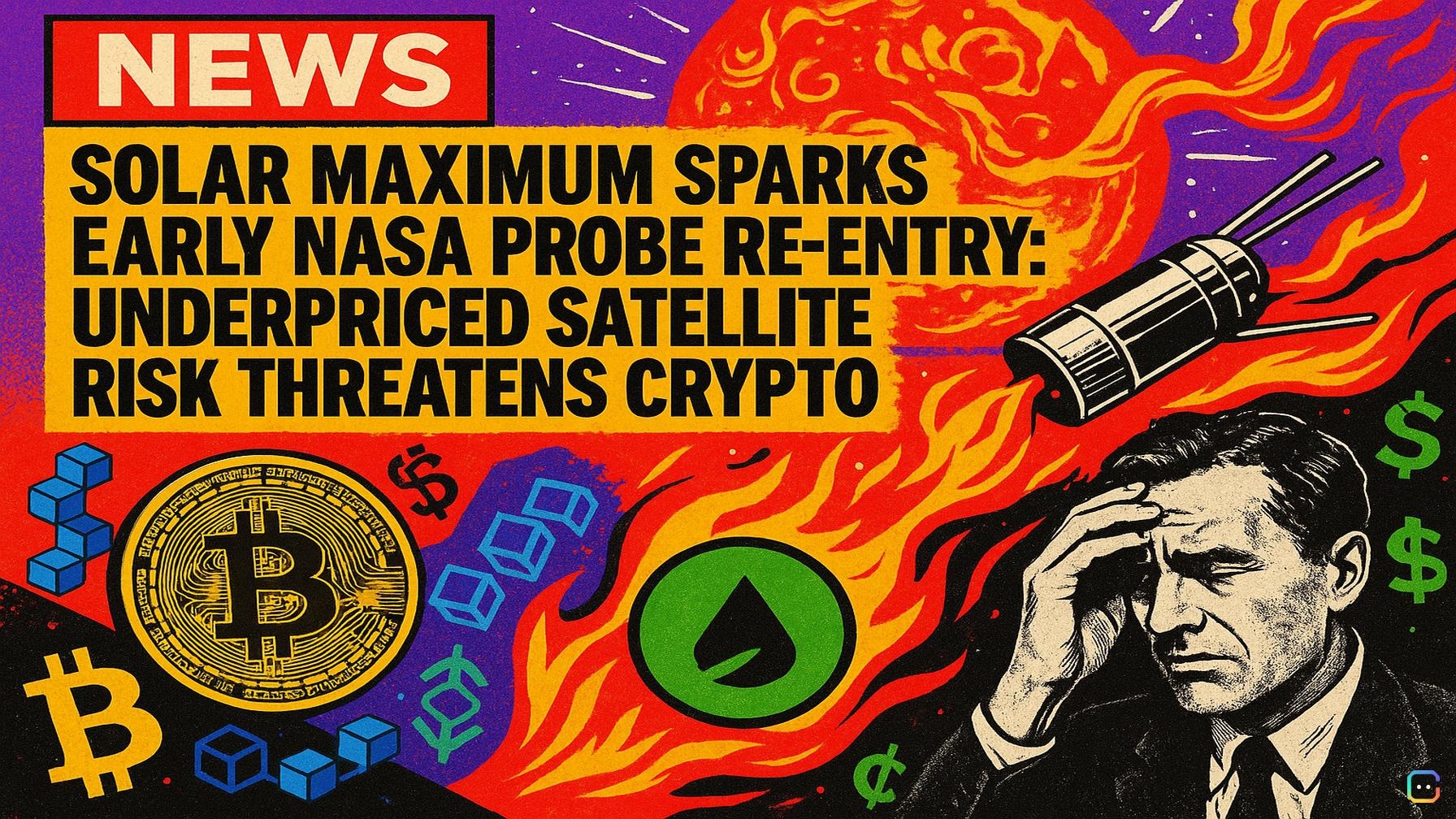
A NASA satellite unexpectedly plunged back to Earth on March 11, 2026 — eight years earlier than everyone expected — and that early re-entry exposes a broader, underappreciated risk to financial markets, including crypto.
What happened
- Van Allen Probe A, a 1,323‑pound spacecraft that monitored Earth’s radiation belts from 2012 to 2019, was expected to re-enter in 2034 after its fuel ran out. Instead it came down in 2026.
- NASA says the original re-entry estimate didn’t account for a far more active solar cycle. Solar maximum was confirmed in 2024, and increased solar activity boosted atmospheric drag on low-Earth objects, hastening Probe A’s demise.
- NASA summary: earlier calculations assumed a quieter solar cycle; the unexpectedly strong solar maximum increased space weather and atmospheric drag well beyond those estimates.
Why it matters beyond space nerds
- Experts say this is not just a one-off. Marlon Sorge of The Aerospace Corporation notes rising awareness of the problem: solar-driven drag is changing satellite lifespans in ways many operators didn’t foresee.
- Hundreds of commercial satellites had lifetime and replacement schedules set before the current solar cycle. Many operators and analysts haven’t updated those forecasts.
- That has knock-on financial effects: GPS, timing services, communications links, and other space-based infrastructure underpin markets, payment systems, and critical financial communications. The global space insurance market (roughly $350–$400 million in premiums a year) has been priced on pre‑solar-maximum assumptions. If satellites fail earlier, premiums rise and those costs propagate through services that depend on satellite reliability.
Why crypto teams should pay attention
- Crypto infrastructure is increasingly diversified — some projects use satellite relays (for example, to broadcast blockchains), many services depend on precise GPS timing for order matching and timestamping, andacles/feed reliability and exchange connectivity can be affected by satellite outages or degraded service.
- Early re-entries and underpriced satellite risk mean exchanges, custodians, oracle providers, and firms relying on satellite-enabled redundancy need to reassess continuity plans and insurance exposure. Markets broadly — traditional and crypto — may be underestimating how space weather and satellite failure translate into real-world operational and financial disruption.
Bottom line
The premature fall of a high-profile NASA spacecraft is a practical warning: solar activity can materially shorten satellite lifetimes, and the industry’s models — along with insurers and market analysts — have not fully caught up. Investors and crypto operators that rely on space-based services should factor in that risk now before it gets priced into premiums and operations down the line.
Read more AI-generated news on: undefined/news