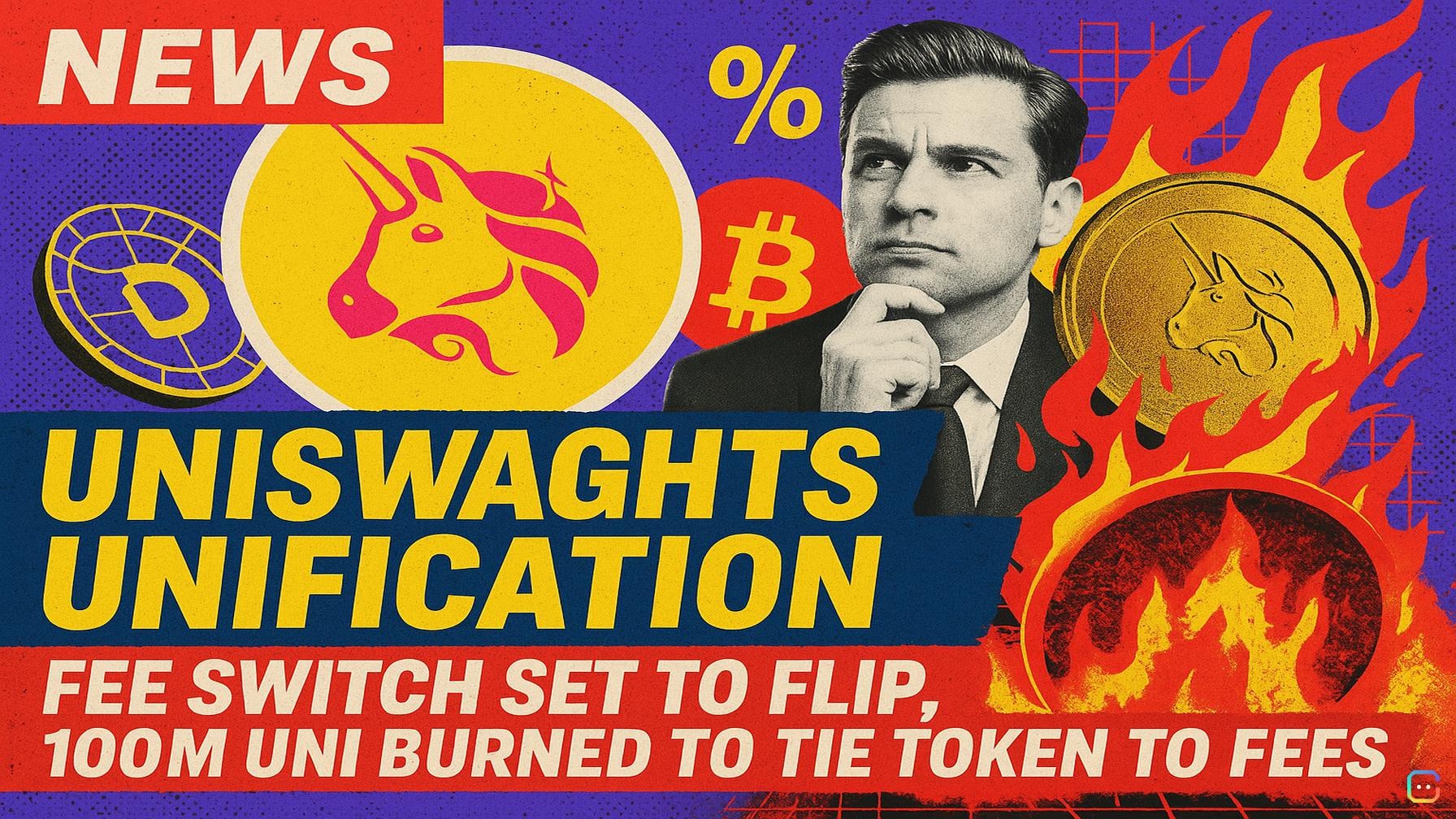
Headline: Uniswap community greenlights “UNIfication” — fees activated, 100M UNI burned, token tied to protocol economics
The Uniswap community has approved a landmark governance proposal called “UNIfication,” switching on protocol fees and initiating a large retroactive token burn — a structural move designed to link UNI’s economic value to the DEX’s ongoing activity.
What passed
- The proposal, co-authored by Uniswap Labs and the Uniswap Foundation, cleared governance with overwhelming support: more than 125 million UNI votes in favor, versus only a few hundred opposing, comfortably exceeding the quorum.
- Once the governance timelock expires, the fee switch will be flipped and the changes will go live.
How the fee activation works
- Historically, all Uniswap trading fees flowed directly to liquidity providers; UNI was a governance-only token with no direct claim on protocol revenue.
- UNIfication routes a portion of protocol fees into an on-chain mechanism designed to burn UNI — removing tokens from circulation whenever the protocol generates fees.
- The logic: higher platform usage → more fees collected → more UNI burned → a tighter supply profile that could help support price appreciation over time.
The retroactive burn
- The proposal also triggers a one-time burn of 100 million UNI from the treasury. At recent market prices this was worth roughly $590 million.
- The team frames this as compensation for fees that might have accumulated since Uniswap launched in 2018 had the fee switch been active earlier.
Scale of the protocol
- Uniswap remains the leading DEX, handling roughly $2 billion in daily trading volume. Aggregated data sources such as DeFiLlama indicate those volumes translate to hundreds of millions of dollars in annualized fees — a meaningful stream to feed the new burn mechanism.
Market reaction and technicals
- Following the vote, UNI traded near $5.90 as markets priced in the deflationary implications. Technical indicators suggest budding bullish momentum:
- RSI sits around 53 and is rising from neutral territory, implying room for further upside without being overbought.
- The MACD histogram recently turned positive, signaling growing upward momentum.
- Analysts point to the $6.50–$6.60 area as an early resistance zone that could come into play if buyer volume increases.
Why it matters
- UNIfication converts UNI from a governance-only token into one with an explicit economic linkage to Uniswap’s performance. That alignment could attract new holders and shift market dynamics if protocol usage stays robust or grows.
- The 100M token burn is both a symbolic and substantial supply reduction, creating an immediate deflationary event on top of the ongoing burns tied to future fee flows.
What to watch next
- The changes take effect only after the governance timelock completes, so the full economic impact will unfold over weeks and months.
- Key variables to monitor: actual fee volumes routed to the burn mechanism, DEX trading volumes, and how much selling pressure (if any) occurs as holders rebalance positions.
- As always, technical momentum can shift quickly; while fundamentals have improved, risks remain and outcomes are not guaranteed.
Bottom line: UNIfication is a major governance win for Uniswap that reconfigures UNI’s role in the ecosystem — turning governance token economics toward deflationary mechanics that could support price upside if protocol activity continues to be strong.
Read more AI-generated news on: undefined/news