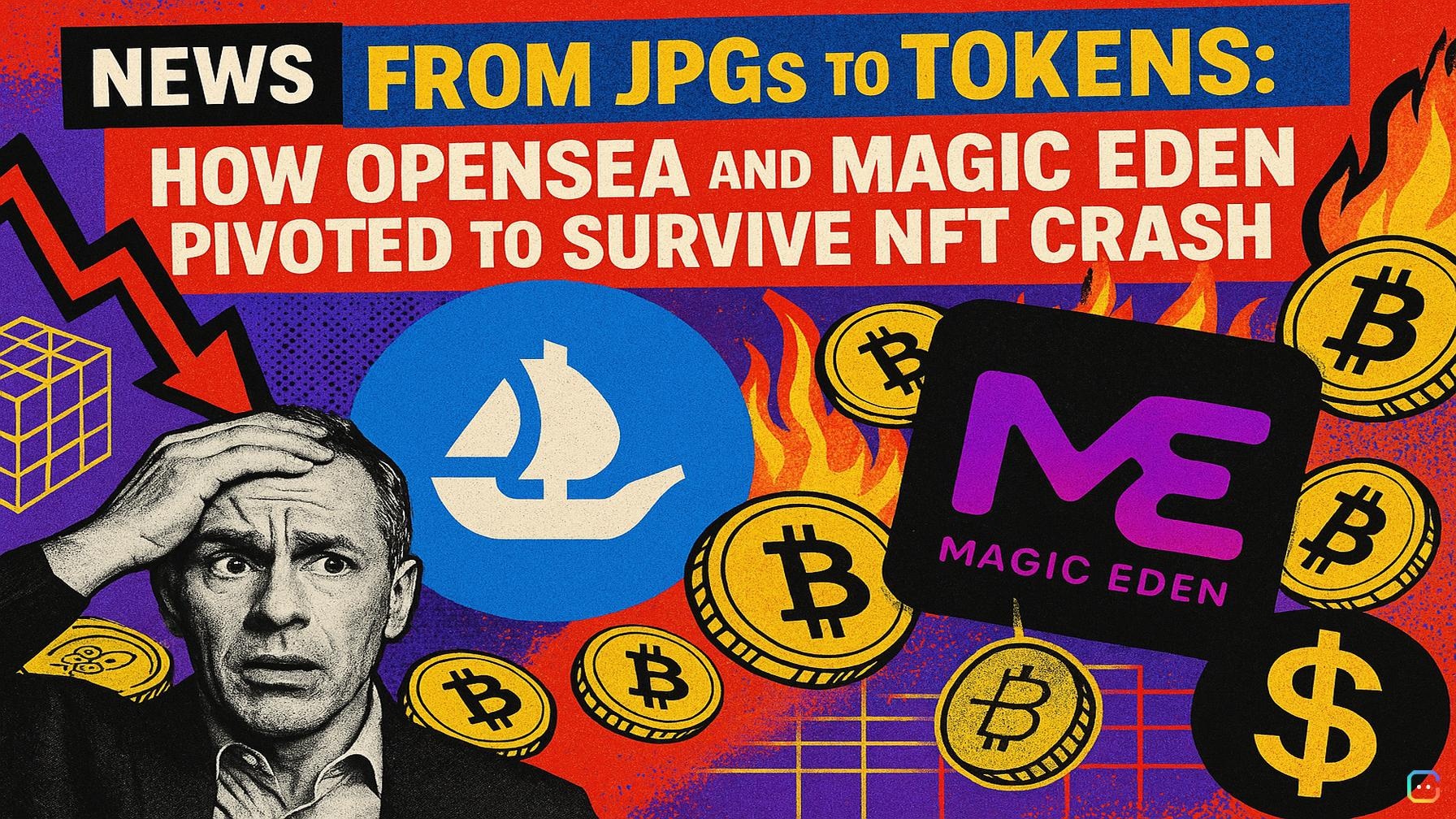
NFT fever is long gone — but NFT marketplaces aren’t. In 2025, the boom that produced headline-grabbing sales like Beeple’s $69.3 million JPG and CryptoPunks trading for tens of millions has collapsed into what many describe as a barren landscape. According to CoinMarketCap, the cumulative NFT market cap has plunged from a 2023 high of $184 billion to roughly $487 million — a drop of about 99%. That seismic contraction forced marketplaces to evolve or risk irrelevance.
Two of the biggest players, OpenSea and Magic Eden, responded by broadening their product mix to include fully fungible tokens and other non-NFT trading — effectively blurring the line between NFT marketplaces and token exchanges. “The move is largely a response to a structural slowdown in pure NFT activity and the need for marketplaces to defend relevance in a maturing digital asset ecosystem,” James Butterfill, head of research at CoinShares, told Decrypt. “A marketplace that once thrived on high-velocity trading of profile picture collections now needs a broader economic base.”
OpenSea’s answer was a ground-up rebuild. In February it launched OS2, a revamped platform that integrates cross-chain token trading via its own decentralized exchange (DEX), adds new discovery features, and introduces a rewards system called “Voyages” — which many have suggested could tie into a future SEA token. OpenSea CMO Adam Hollander framed the change as an evolution rather than a pivot: the company wants to support “tokens, digital collectibles, tokenized real-world assets, perps, prediction markets—whatever people are valuing online,” he told Decrypt.
The results have been uneven. OpenSea’s DEX posted a peak month of $2.41 billion in volume in October, but volumes slid roughly 75% to about $581.5 million in November, per DefiLlama. Even at peak, those figures remain small compared with DEX heavyweights: Uniswap handled nearly $80 billion in November alone.
Magic Eden has pursued a similar expansion, but with its own flavor. In April it acquired meme-coin trading app Slingshot and added multi-chain token trading across its marketplace and Wallet app. Still, Magic Eden’s leadership has downplayed tokens as core to its identity. “Token trading is not a real focus nor a meaningful percentage of our business,” Chief Business Officer Chris Akhavan told Decrypt, calling the token market “incredibly commoditized” with many apps and exchanges already serving traders.
Analysts, however, see Magic Eden as more proactive than it lets on. Butterfill says Magic Eden has been “more aggressive” than OpenSea in integrating token trading—especially within Solana-based and gaming ecosystems—and now views the platform as an “application layer” for digital culture, expanding its strategic identity beyond pure NFTs. That diversification has, in his view, helped both platforms stabilize engagement and broaden fee revenue in a year when traditional NFT activity remained muted.
Still, Butterfill warns the playbook isn’t settled: “For marketplaces to succeed long-term, they need to offer either structural differentiation or seamless integration between NFT and token rails that users cannot easily replicate elsewhere.” In other words, simply listing tokens isn’t enough — marketplaces must create experiences or integrations that are hard to copy.
Magic Eden’s chief focus is what the company calls “crypto entertainment.” Its Packs product — virtual packs that can contain real-world items (currently Pokémon cards) as well as NFTs — has already processed tens of millions in volume and sits at the center of a broader roadmap. The company also plans to launch Dicey, a crypto casino and sportsbook that Akhavan describes as a “major new product,” as it pursues an ambition to become the “biggest crypto entertainment brand in the world.”
Where does that leave the market? Both OpenSea and Magic Eden are redefining themselves as cultural liquidity hubs: platforms that sit at the intersection of creators, collectors, and token communities. Their future depends on whether the cultural economies that fuel digital collectibles expand again — and whether users begin to see these marketplaces as essential infrastructure rather than optional front ends. For now, adaptation has bought them time and diversified revenue streams, but the long-term winners will be the platforms that create unique, hard-to-replicate value between NFTs and tokens.
Read more AI-generated news on: undefined/news