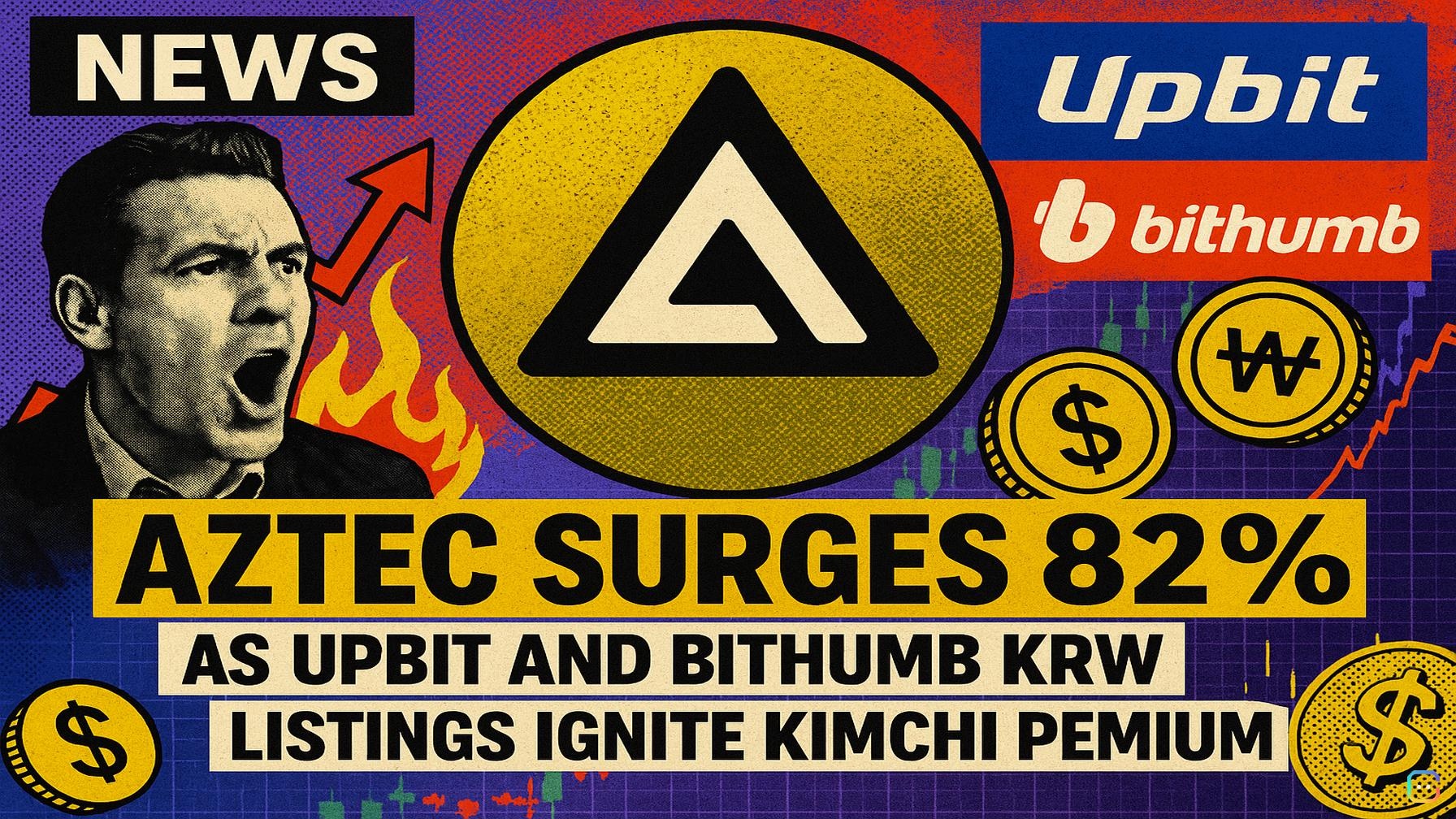
Aztec’s AZTEC token exploded higher this week after South Korea’s two biggest spot exchanges listed won trading pairs, briefly sending prices about 82% higher and igniting a surge in volume.
What happened
- Upbit added AZTEC trading in KRW, BTC and USDT markets, while Bithumb opened an AZTEC/KRW pair. Both listings went live around the same time on Friday in Korea, concentrating demand into a short window.
- The token rallied from earlier levels to roughly $0.035 in 24 hours, spiking as high as about $0.038 before easing back toward the mid-$0.03 range.
- Trading volume surged into the hundreds of millions of dollars as new KRW-driven demand hit order books that are still forming for the newly transferable token.
Why Korean listings mattered
South Korea’s fiat rails and deep retail demand can move smaller tokens fast. When both Upbit and Bithumb listed AZTEC simultaneously, that compressed what might normally be a staggered listing effect into one sharp event—producing a rapid price repricing on Korean venues.
The kimchi premium and arbitrage response
Korean quotes initially ran above offshore markets—a classic kimchi premium—because local buy orders outpaced available sell liquidity. That gap invited arbitrageurs to buy AZTEC on non-Korean venues and sell into KRW demand, which helped narrow the spread as liquidity rebalanced across markets.
Where AZTEC fits in the protocol
Aztec is a privacy-focused Ethereum layer-2 that uses zero-knowledge proofs. AZTEC the token functions as a staking and governance asset tied to the network’s sequencer set; operator docs also define a minimum stake to run a sequencer. The token became broadly transferable after a February token generation event that followed an earlier on-chain sale and a community vote to unlock supply.
What’s next
Listings broaden who can buy AZTEC, but they don’t instantly create deep two-way liquidity. The key question now is whether trading holds up once the initial wave of momentum buyers and forced demand subsides. If KRW liquidity persists and order books deepen, the price could stabilize; if not, volatility may continue as markets digest newly unlocked supply.
Read more AI-generated news on: undefined/news