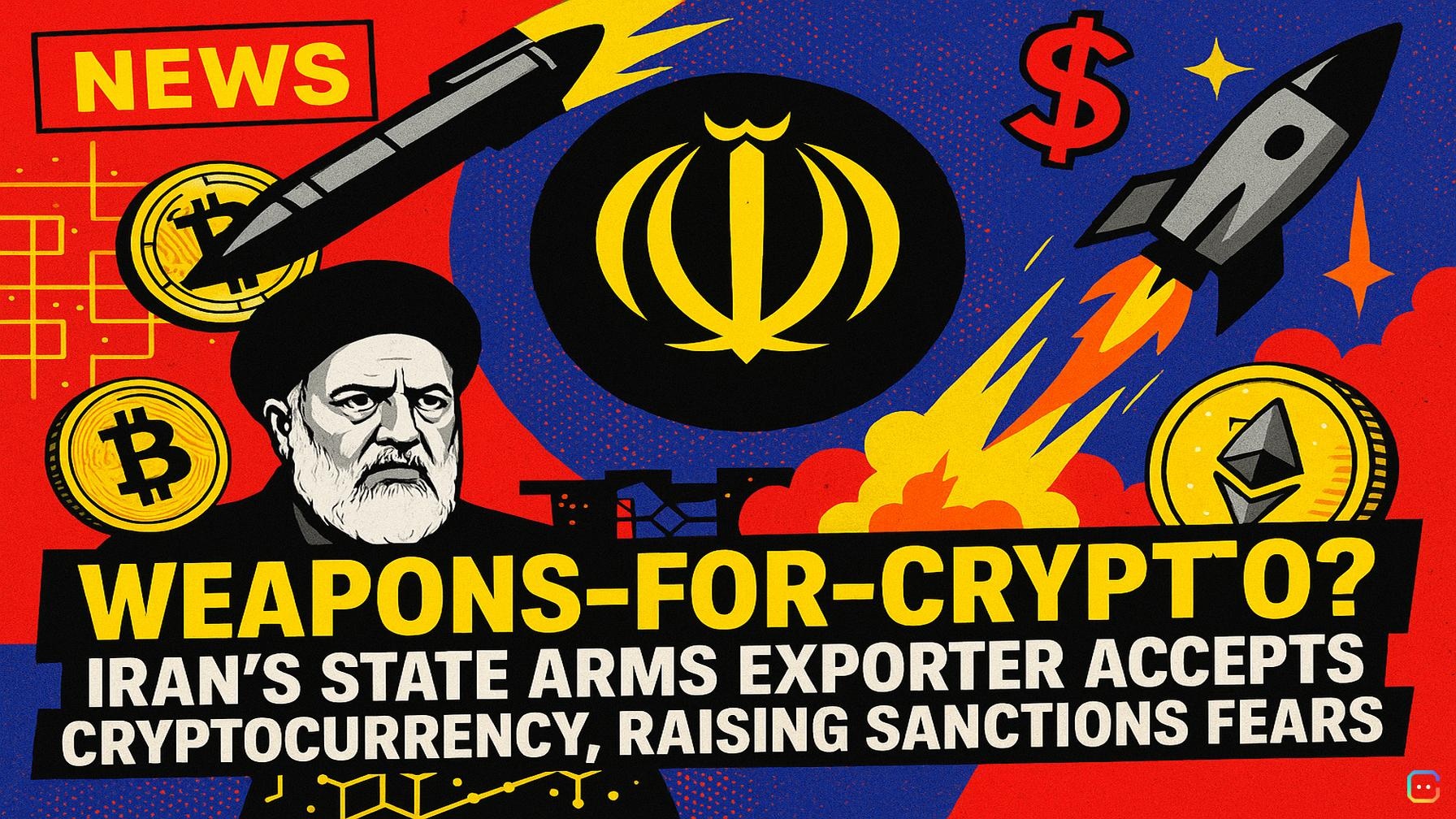
Headline: Iran’s Arms Exporter Says It Will Accept Cryptocurrency — A New Sanctions Workaround?
Iran’s state-run arms export arm has quietly started offering foreign buyers the option to pay for advanced weapons with cryptocurrency, in what analysts say looks like a deliberate effort to sidestep Western financial restrictions.
What’s changed
- According to a Jan. 1 Financial Times report, Iran’s Ministry of Defence Export Center (Mindex) has added digital currencies alongside barter deals and Iranian rials as permitted payment methods for overseas military sales. FT’s review of promotional materials indicates the policy has been active for roughly a year.
- Mindex — which describes itself as having clients in 35 countries — markets a wide range of systems, including Emad ballistic missiles, Shahed drones, Shahid Soleimani-class warships, short-range air-defence systems, small arms, rockets, and anti-ship cruise missiles.
How Mindex is presenting the service
- FT verified Mindex’s website through archived records and technical checks. The site is hosted on an Iranian domestic cloud provider that is under U.S. Treasury sanctions and has been characterized by Washington as having close ties to Iran’s intelligence services.
- Prospective buyers are funneled through an online portal and a virtual chatbot. An FAQ explicitly addresses sanctions risk, stating Iran’s policies on “circumventing sanctions” can ensure contracts are fulfilled and goods delivered. Pricing isn’t public; Mindex says in-person inspections are possible but require security clearance.
Why it matters
- If confirmed, this would be one of the first widely reported instances of a nation-state explicitly offering strategic military hardware in exchange for cryptocurrencies. Western governments have warned that anyone using traditional financial channels to transact with Tehran risks being cut off from U.S., EU, and U.K. systems.
- U.S. authorities have previously accused Iran of using cryptocurrencies to facilitate oil sales and move funds outside formal banking rails. In September (year cited in the FT report), the U.S. Treasury sanctioned individuals tied to the Islamic Revolutionary Guard Corps over a crypto-based “shadow banking” network.
Broader context
- The revelation arrives amid heightened Western pressure on Tehran over its nuclear programme. SIPRI ranked Iran 18th globally in major arms exports in 2024, and analysts say Tehran’s export role has expanded as Russia’s capacity has been affected by the Ukraine war.
- Domestically, crypto use has grown despite sanctions: roughly 5 million Iranians are estimated to be active traders, and inbound crypto volumes reportedly rose 11.8% year-over-year in 2025. Local exchanges include Bit24, Excoino, and Nobitex — the latter suffered an $80–90 million hack in June 2025, a major breach that nonetheless didn’t halt wider adoption.
Implications for crypto markets and compliance
- The move highlights how digital assets can complicate enforcement of international sanctions and poses operational and legal risks for intermediaries and service providers. It also underlines the evolving role of crypto in geopolitics: beyond investment and payments, tokens are increasingly entwined with state-level economic and strategic maneuvering.
What to watch next
- Whether more nation-states will explicitly offer crypto payment options for sensitive exports, how Western authorities respond, and how crypto firms and exchanges adapt their compliance frameworks will be key developments for both the digital-asset industry and global non-proliferation efforts.
Read more AI-generated news on: undefined/news