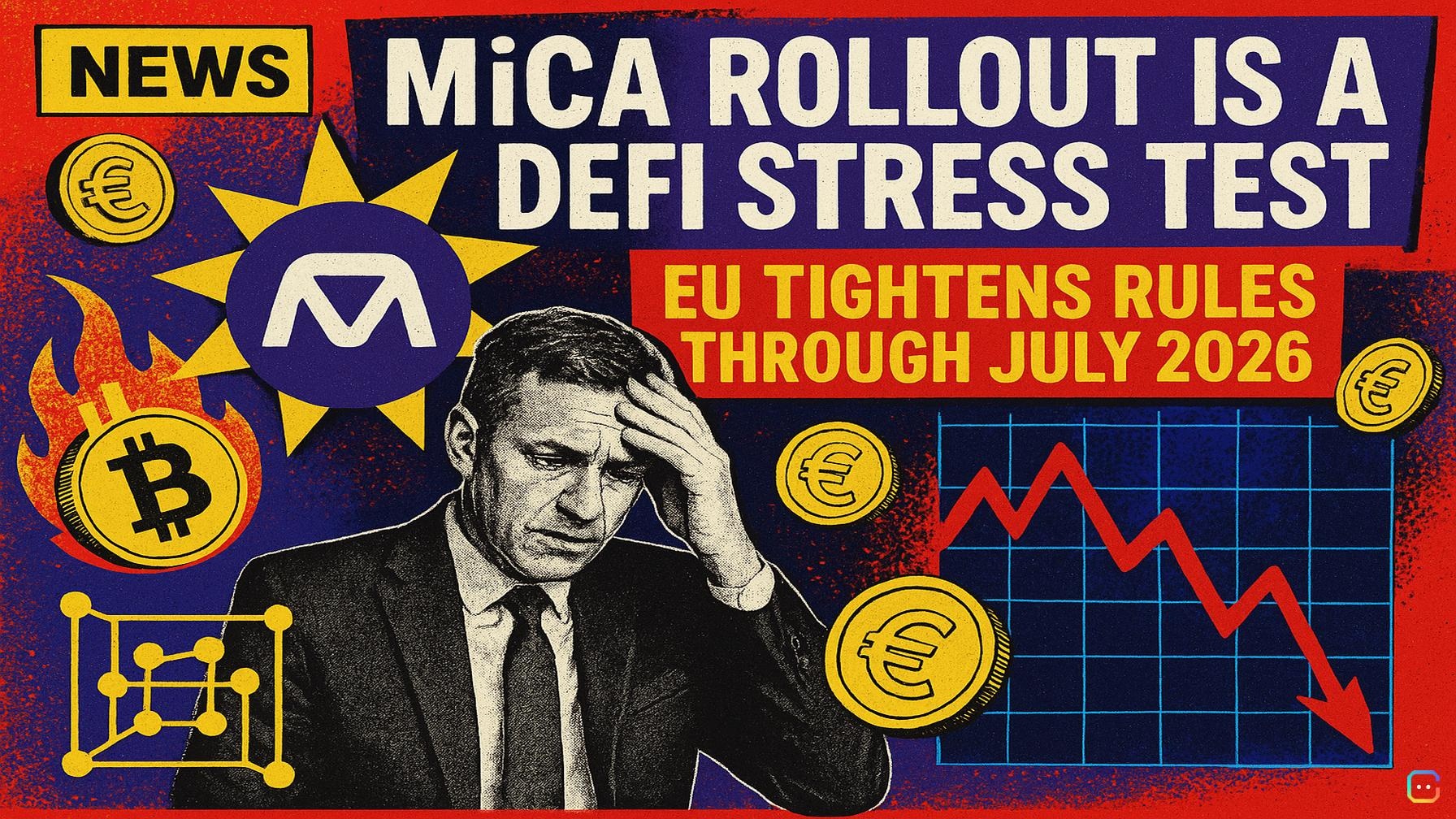
Headline: MiCA’s full rollout becomes a DeFi stress test — EU tightens rules through July 2026
The EU’s Markets in Crypto-Assets (MiCA) regime is moving from framework to enforcement, with full implementation expected between late 2025 and July 2026. The shift will force exchanges, custodians, wallet providers, stablecoin issuers and portfolio managers to obtain formal authorization to serve customers in the bloc — a change that could re-shape who can operate in Europe and how decentralized finance (DeFi) services are accessed.
What’s changing
- Authorization and on‑site presence: Crypto firms that want to operate in the EU must be authorized as Crypto-Asset Service Providers (CASPs). The regulation bars “third-country equivalence,” meaning firms based in Singapore, the U.S. or other non-EU jurisdictions will need an EU legal presence before they can apply — a move intended to curb regulatory arbitrage.
- Bank-like obligations for CASPs: Exchanges such as Binance and Coinbase are explicitly treated as CASPs, facing reporting duties, fees and capital-reserve requirements comparable to traditional financial institutions. Analysts say these compliance costs will favor larger, well-capitalized players.
- Self-custody and transaction logging: Popular self-custody wallets — MetaMask, Phantom, WalletConnect, Binance Wallet — are not classified as CASPs. But the EU’s Transfer of Funds Regulation (TFR) requires CASPs to log transactions when users move funds from self-custody wallets to regulated platforms, typically above €1,000, for AML and tax purposes.
DeFi: exemption on paper, stress test in practice
MiCA contains an exemption for “fully decentralized” protocols, but it stops short of a precise legal definition. That ambiguity leaves DeFi projects in limbo and opens the door to regulatory scrutiny focused on centralization points.
- ESMA’s “spectrum of decentralization”: The European Securities and Markets Authority has introduced an assessment framework to evaluate decentralization, looking beyond smart-contract code to front-ends and infrastructure providers such as Infura and Alchemy — which themselves often rely on centralized cloud hosts like Amazon Web Services.
- Precedent: OFAC’s actions against the Tornado Cash ecosystem show the practical limits of code-level immunity. While authorities couldn’t sanction blockchain code itself, targeting front-end intermediaries effectively blocked access for most users. MiCA-era enforcement may produce similar results: blocking front-ends, imposing terms of service restrictions, or implementing geo‑blocks. Using VPNs to bypass these measures could breach platform terms and expose users to legal risk.
Regulatory fragmentation and enforcement
A July ESMA report flagged uneven national implementation among EU member states, potentially creating arbitrage opportunities. Poland currently remains the sole holdout: President Karol Nawrocki vetoed MiCA-compliant legislation, arguing it threatened individual freedoms and state stability; overturning the veto would require a three-fifths parliamentary majority.
To tighten oversight, the European Commission proposed in December to expand ESMA’s enforcement powers, aiming to reduce cross-border inconsistencies before the July 2026 deadline.
Macro and market implications
The European Central Bank has warned that stablecoins could siphon retail deposits from euro-area banks, a risk MiCA aims to address through stricter rules for issuers. Meanwhile, the landscape for digital money differs globally: the euro area pursues a digital euro while other jurisdictions have taken alternate paths, with private stablecoins gaining prominence where central bank digital currency (CBDC) progress has stalled.
Bottom line
As MiCA’s enforcement window approaches, the EU is tightening oversight across centralized crypto intermediaries and probing the edges of DeFi. The regulation favors firms that can absorb significant compliance burdens and places real-world pressure on DeFi front-ends and infrastructure — making the next 12–18 months a critical stress test for the industry’s decentralized claims and its ability to operate within Europe’s evolving rulebook.
Read more AI-generated news on: undefined/news