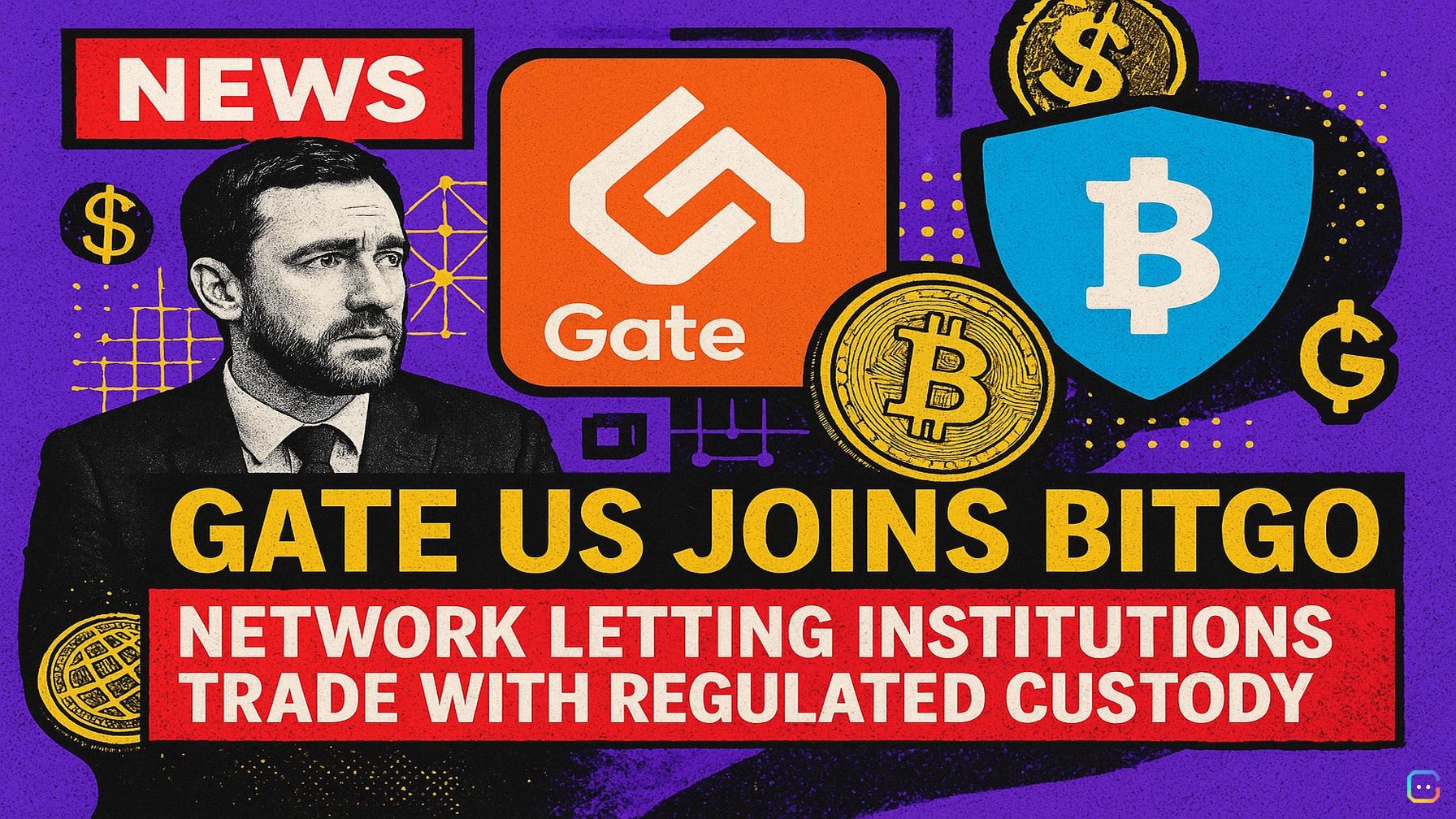
Gate US has joined BitGo’s Go Network Off-Exchange Settlement (OES) service, linking the U.S. arm of the crypto exchange to BitGo’s custody-and-settlement infrastructure and giving eligible institutional clients access to Gate US liquidity while keeping assets in regulated custody.
Key facts
- The integration went live on July 28 and extends a broader partnership the companies announced five days earlier.
- BitGo will provide institutional custody, wallet management and risk-control technology while Gate US continues to operate the market and execute orders. Financial terms, expected volume and a rollout timetable for the OES connection were not disclosed.
How the connection works
- Institutions earmark part of their balance held at BitGo Bank & Trust for trading on Gate US.
- BitGo projects that available balance to Gate US for order execution; the underlying assets remain in segregated custody at BitGo until settlement.
- Completed trades settle through BitGo’s Go Network off-chain rather than requiring customers to transfer assets into an exchange wallet before each trade. BitGo’s documentation says assets remain in its cold-storage system throughout this lifecycle.
What Gate US and BitGo say
- Gate US COO Laura Liu described the connection as providing clients “a framework built around regulated custody” and called it a “secure and efficient path” — language presented as the company’s claim.
- BitGo’s role: custody and settlement via BitGo Bank & Trust (a national trust bank chartered and regulated by the Office of the Comptroller of the Currency). Gate US retains market operation and order execution.
Regulatory and charter notes
- BitGo’s conversion from a South Dakota trust company to a national trust bank became effective Dec. 12, 2025, per OCC records. The charter permits fiduciary and custodial services but does not make digital assets eligible for federal deposit insurance.
- Gate US says it holds 36 state money-transmitter licenses and serves 47 U.S. jurisdictions. Its legal disclosures also note cryptocurrency accounts are not covered by FDIC or SIPC protections.
Risks and limits of off-exchange settlement
- Keeping assets with a regulated custodian instead of on an exchange can lower exposure to venue insolvency, withdrawal freezes or custody breaches.
- But BitGo’s SEC filing stresses that OES services still create operational, regulatory and counterparty risks — including trade-data errors, delayed transfers, insider misconduct, cyber incidents, tech outages and reconciliation failures. A participating exchange or its clients could also fail to meet obligations or provide inaccurate data.
- Those disclosures temper claims that off-exchange custody removes counterparty exposure entirely: settlement still depends on BitGo’s systems, Gate US execution records and enforceable agreements between the parties.
Context and comparisons
- The model mirrors traditional markets where a custodian holds assets while a separate venue executes trades. OKX US added BitGo OES in April; Binance has connected to Anchorage Digital’s Atlas under a similar structure.
- BitGo now lists Gate US alongside venues such as Crossover Markets (CROSSx), Deribit (via Copper ClearLoop), Finery Markets, Gate Global, HTX, INX, KuCoin, OKX US and STS Digital. Clients may trade directly with connected venues or use BitGo Prime for aggregated access to exchanges, market makers and OTC liquidity providers. BitGo markets this expanding setup as its “Global Liquidity Layer,” a strategic description rather than a regulated market category.
What’s missing and what to watch
- The announcement did not specify which assets will be supported on Gate US via OES, margin mechanics, settlement frequency, default procedures, OES fees, or performance metrics. The firms also have not disclosed expected trading volume or a rollout schedule.
- The next measurable updates to watch are the start of client activity on Gate US through Go Network, the list of supported assets, and any settlement or volume data the firms publish. So far, no verified market-price reaction has been attributed to the integration.
Bottom line
The Gate US–BitGo OES connection is another incremental step toward institutional-style settlement infrastructure in crypto: it aims to combine regulated custody with exchange liquidity, but it leaves open key operational and disclosure questions that will determine how much value institutions actually get from the integration.
Read more AI-generated news on: undefined/news