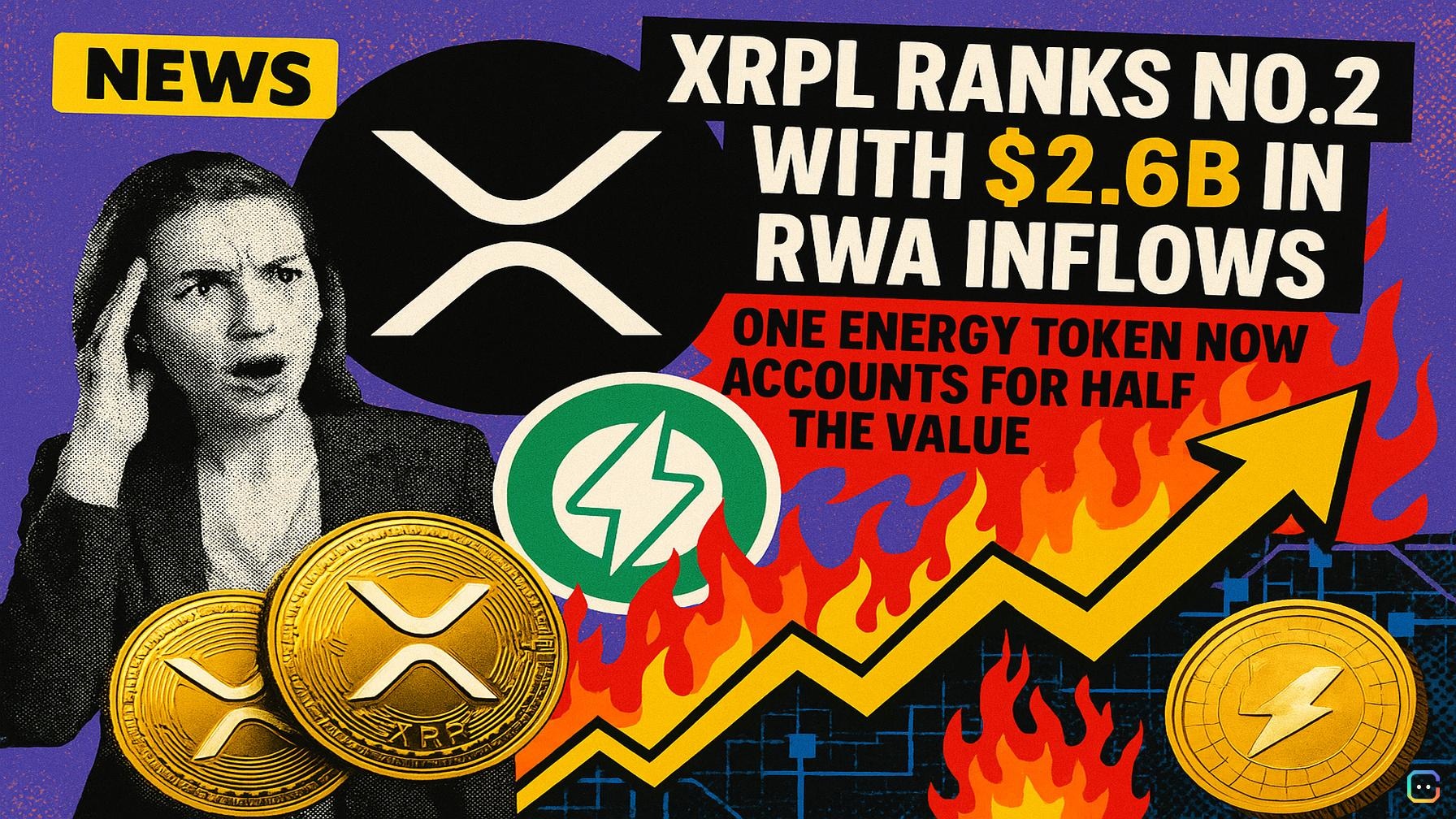
The XRP Ledger (XRPL) has seen a sharp uptick in tokenized real-world asset (RWA) value, adding roughly $2.6 billion over the past six months and ranking second among blockchains for net RWA inflows, according to RWA.xyz.
Quick snapshot
- Six-month net RWA inflows: XRPL ~$2.6B (2nd), BNB Chain ~$3.0B (1st), Stellar ~$2.1B (3rd).
- XRPL total RWA value (July 26): ~$4.38B, split into $4.06B represented and $323.21M distributed.
- Including stablecoins ($995.12M), XRPL’s broader on-ledger asset pool tops ~$5.37B.
- Other chains’ six-month additions: Solana ~$1.6B, Avalanche ~$972M, Ethereum net +$424M (still largest for distributed tokenized assets).
What’s driving the surge
A single product—Justoken’s JMWH energy token—accounts for the lion’s share of XRPL’s RWA value. RWA.xyz valued JMWH at $2.229 billion on July 26; each JMWH token corresponds to one megawatt-hour of contracted energy. Issuers mint JMWH against energy supply contracts and burn tokens after electricity is delivered, making the token primarily a blockchain record of energy agreements rather than a liquid trading instrument.
That distinction is important: JMWH has just 19 holders, only one active address in 30 days, and no monthly transfers or transfer volume—yet it alone represents roughly 51% of XRPL’s RWA value. Justoken says it has tokenized more than $2.84 billion across its products and has partnered on projects such as an energy tokenization initiative with Argentina’s YPF Luz.
Represented vs distributed: value ≠ liquidity
RWA.xyz separates “represented” assets—off-chain holdings or contracts recorded on-chain—from “distributed” assets, which are issued and held directly on-chain. XRPL’s represented assets make up more than 92% of its non-stablecoin RWA total, while its distributed segment remains smaller (about $323M) but active, with issuers such as Ondo Finance, Braza Crypto, OpenEden Digital and Société Générale-FORGE listing tokenized Treasuries, credit products and regulated digital cash.
Stablecoins and transaction rails
Stablecoins are a major component of XRPL’s broader value stack. Ripple’s RLUSD is the largest stablecoin on XRPL with about $894.7M, and total XRPL stablecoins equal ~$995.12M. Stablecoin transfer volume reached roughly $4B over 30 days.
Notable pilot: In May, a cross-border test tied tokenized funds on XRPL to traditional bank rails. Ripple redeemed part of its Ondo Finance OUSG Treasury holdings on XRPL, while Mastercard sent settlement instructions to Kinexys via J.P. Morgan, moving USD to Ripple’s Singapore bank account. Ondo reported the asset leg settled in under five seconds; Ondo President Ian De Bode described it as “the first time tokenized U.S. Treasuries have settled across borders and banks in near real time.” The trial combined public blockchain asset transfers with conventional bank settlement flows.
Growth, concentration and infrastructure
XRPL’s RWA count rose to 373 assets, and the number of tracked RWA holders climbed 14.29% over 30 days to 176, while stablecoin holders reached about 60,080—signs of a broader tokenization base even if ownership is concentrated in a few large products.
Developers and Ripple are building market-ready infrastructure: permissioned domains, credentials, a permissioned exchange layer and proposed lending standards aimed at identity-based access and fixed-term credit products. Those tools could enable more regulated institutional activity—if issuers turn the growing record of tokenized assets into actual transfers, trading and settlement.
A measured headline
The latest RWA inflows show XRPL gaining momentum in tokenization, but metrics are nuanced: RWA growth tracks ledger-recorded asset value, not XRP purchases or native-token usage. Many institutional products use XRPL for issuance and settlement while relying on stablecoins or off-chain cash rails rather than moving XRP as a bridge asset. Whether XRPL’s expanding asset base becomes a liquid, traded market will depend on how issuers and market participants activate the tokens on-chain.
Read more AI-generated news on: undefined/news