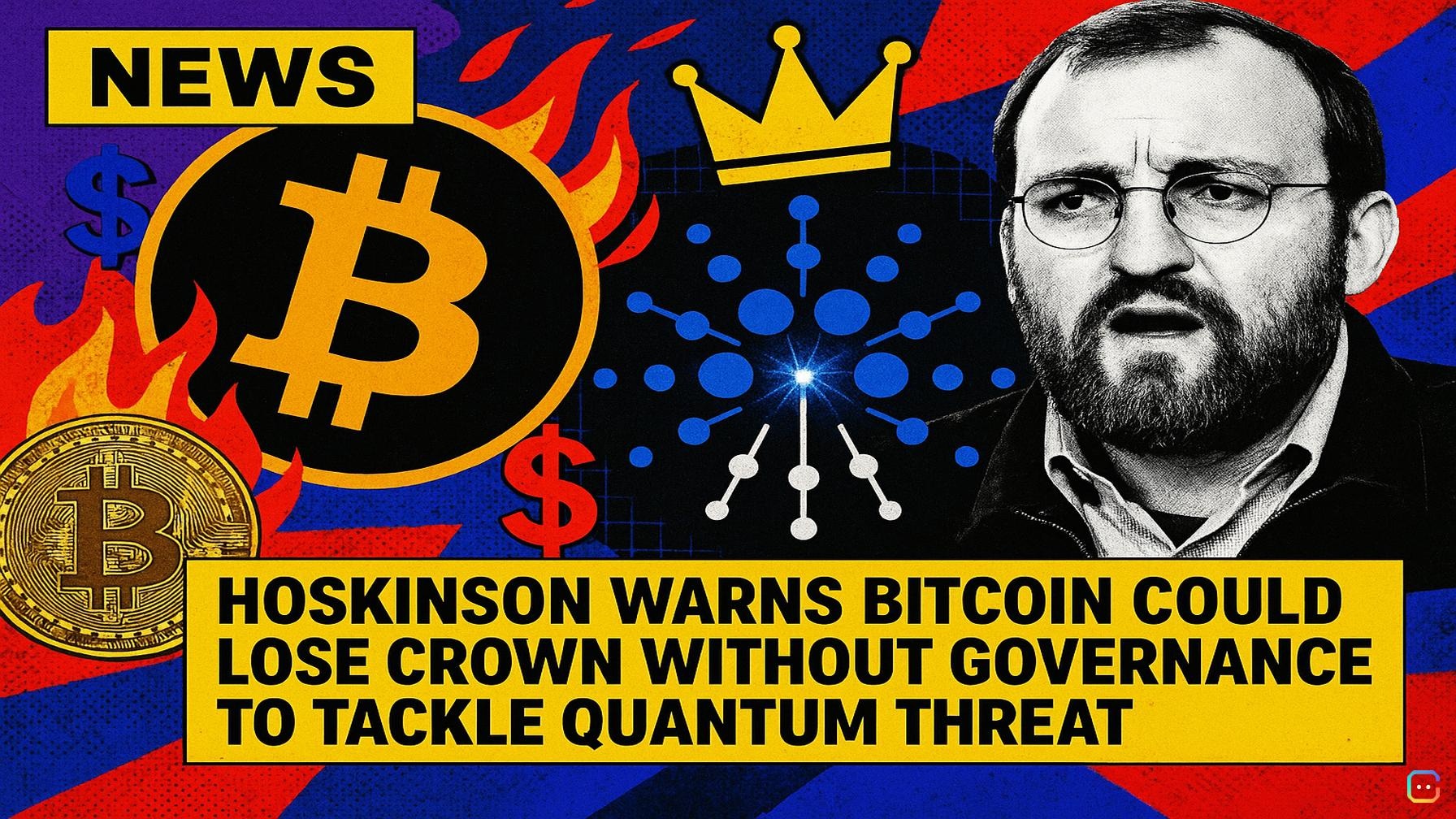
Cardano co-founder Charles Hoskinson has warned that Bitcoin risks losing its top spot if it cannot coordinate a response to the future threat of quantum computers — but his critique is about governance, not an imminent attack.
What he said
- In a July 24 interview with The Starting Block, Hoskinson called Bitcoin “frozen in time,” arguing that its lack of a formal onchain governance process could make urgent, coordinated upgrades difficult.
- He contrasted that with Cardano’s post‑Plomin onchain voting system, which he says provides a clearer route for approving protocol changes — including any migration away from quantum‑vulnerable cryptography.
- Hoskinson did not name a likely successor to Bitcoin nor assign a timeline for a quantum threat; his point focused on whether Bitcoin’s governance could move fast enough when change is necessary.
Why quantum matters
- Bitcoin uses elliptic‑curve cryptography (ECDSA and Schnorr) to prove ownership of funds. In theory, a sufficiently powerful quantum computer could derive private keys from public keys and sign transactions without an owner’s consent.
- The U.S. National Institute of Standards and Technology (NIST) describes this as a future risk and is standardising post‑quantum algorithms to resist such attacks.
Where both ecosystems stand
- Bitcoin: No formal onchain voting body. Developers can propose upgrades, but miners, node operators, exchanges, wallets and users decide whether to adopt them. This decentralised, offchain consensus slows change by design — a feature for security but a potential liability for rapid coordination.
- Work is underway: Bitcoin Optech has tracked BIP 361, which sketches a phased move away from ECDSA/Schnorr after a post‑quantum signature scheme is chosen. Other proposals cover hybrid signatures, new address formats and recovery paths. These ideas remain under review.
- Practical obstacles include getting wallets, exchanges, custodians and dormant holders to migrate funds without network splits or conflicting ownership rules. Some researchers estimate millions of BTC are in addresses with exposed public keys, which would be more vulnerable if a capable quantum computer appears.
- Cardano: Completed a full community governance migration via the Plomin hard fork in January 2025. ADA holders can vote directly or delegate to DReps; stake pool operators and a constitutional committee also participate in selected decisions. The system can approve hard forks and treasury spends onchain.
- Hoskinson says Cardano’s governance could vote on a migration away from quantum‑vulnerable infrastructure. Cardano has funded research into quantum resistance, but it has not deployed a complete post‑quantum transaction system.
- Governance is not automatic consent: in 2026 Cardano delegates rejected or challenged several proposals tied to Hoskinson and IOHK, including research requests for Leios scaling and quantum‑resistant cryptography — showing that formal voting does not guarantee approval of founder‑backed plans.
- Cardano developers are also testing Ouroboros Leios, a protocol design meant to boost throughput by separating block roles and enabling parallel work. Hoskinson claimed the upgrade could make the network “60 times faster,” but that figure is his estimate; Leios still requires testing, review and governance approval. Recent hard forks (e.g., van Rossem) demonstrate the ecosystem can coordinate upgrades when consensus exists.
Bottom line
- Hoskinson frames the quantum question as a governance stress test: can a network change quickly enough, without undermining the qualities that make it valuable?
- Both Bitcoin and Cardano are exploring technical paths to quantum resistance, but neither has a full post‑quantum transaction system in production. The real challenge will come when communities reach consensus on secure cryptography and must organize a migration that keeps funds safe and the network intact.
Read more AI-generated news on: undefined/news