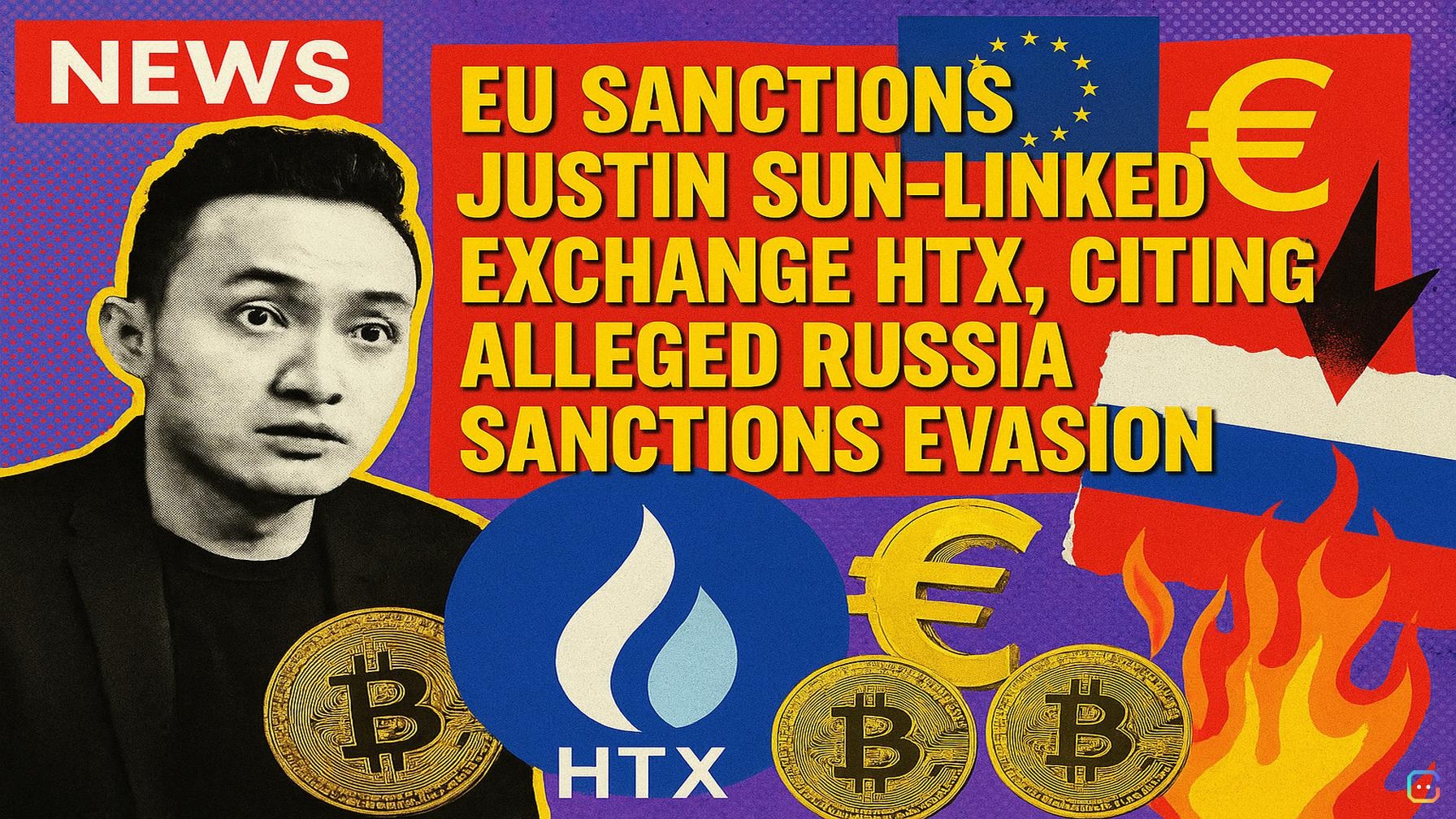
The European Union has added HTX — the exchange tied to crypto entrepreneur Justin Sun — to a sanctions list targeting firms accused of helping Russian users evade sanctions, marking another headache for one of the world’s largest crypto platforms.
What happened
The EU published the list on Friday after approving a new round of restrictions the previous day. HTX (formerly Huobi) was named among 18 crypto companies flagged in the bloc’s 21st sanctions package targeting Russia over the war in Ukraine. The package targets a wide range of entities, from banks and energy traders to crypto platforms and vessels allegedly operating in Russia’s “shadow fleet.”
Who’s behind HTX
HTX traces its roots to Huobi, founded in China in 2013. Justin Sun acquired a controlling stake in 2022; the company, however, characterizes Sun as an adviser rather than an owner. HTX did not immediately respond to requests for comment about the EU action.
What the measure does — and doesn’t do
Unlike a full asset-freeze designation, the EU’s measure does not automatically require HTX’s assets to be frozen. Instead, HTX has been placed under the package’s transaction controls — a restriction that curbs certain dealings with the exchange. For the first time, the EU also adopted a tool allowing it to prohibit transactions with crypto providers in third countries if those services are judged to be facilitating sanctions evasion. The Council presented this as a deterrent to jurisdictions hosting such platforms.
Counting differences: 18 vs. 14
Media reports listed 18 crypto-related companies on the published list, but the Council of the European Union separately said transaction restrictions were extended to 14 crypto services. That discrepancy reflects different counting methods — whether a measure lists individual companies or the platforms they operate. The Council says the 14 services were singled out because they were linked to financial channels used by Russia to bypass sanctions, and those services operate from jurisdictions including Georgia, Panama, the UAE, the Marshall Islands, Kyrgyzstan and Belarus.
Previous UK sanctions
HTX had already been targeted by the United Kingdom. On May 26, British authorities sanctioned Huobi Global S.A., the Panama-based entity behind HTX, alleging it provided services to A7 (a payments network backed by Russia’s state-linked Promsvyazbank) and Moscow exchange Garantex — both previously sanctioned. UK restrictions included an asset freeze and bans on UK firms maintaining financial relationships with the designated entities. HTX rejected the UK allegations at the time, stressing that regulatory compliance is its “absolute top priority.” The exchange has not issued a public response to the EU action.
Wider sweep of the package
This sanctions round is broad. Adopted on July 23, the package contains 218 individual listings — 48 people and 170 entities — and is described by the Council as the bloc’s largest set of listings in four years. Measures include asset freezes and funding restrictions on 94 banks and major financial institutions, transaction bans for dozens of Russian and non-Russian banks alleged to be involved in circumvention, and listings tied to Russia’s shadow fleet and energy sector. EU High Representative Kaja Kallas said the measures cover more than 100 banks and crypto operators, over 40 vessels linked to the shadow fleet, multiple refineries in Russia and Belarus, and more than 50 entities in Russia’s military-industrial complex, including firms connected to long-range drone production.
New limits on Belarus and MiCA implications
Separately, Council Decision (CFSP) 2026/1847 adds specific restrictions on Belarusian participation in the EU crypto industry. From Aug. 25, Belarusian nationals and residents will be banned from owning, controlling or managing crypto-asset service providers that are regulated under the EU’s Markets in Crypto-Assets (MiCA) framework. The earlier rules had focused mainly on wallets, accounts and custody; the amendment expands the ban to all MiCA-defined services, including operating trading platforms, token placement, order execution, transfer processing, investment advice and portfolio management. That decision took effect on July 24, with a one-month implementation window for the ownership and management prohibitions. It follows MiCA’s transition deadline of July 1, after which unauthorized crypto firms were required to stop operating in the EU.
What it means for crypto markets
Together, the two decisions tighten the EU’s grip on how foreign crypto platforms and certain nationalities can participate in regulated EU markets. HTX now faces transaction-level restrictions tied to alleged Russian activity, and Belarusian nationals will face explicit limits on roles inside MiCA-authorized firms. The moves signal the EU’s growing readiness to use crypto-specific sanctions tools to close off channels it believes are being used to evade financial restrictions, and they raise fresh compliance and operational challenges for exchanges and service providers operating across borders.
Read more AI-generated news on: undefined/news