Lido launches major Ethereum staking overhaul, aims to consolidate validators and boost efficiency
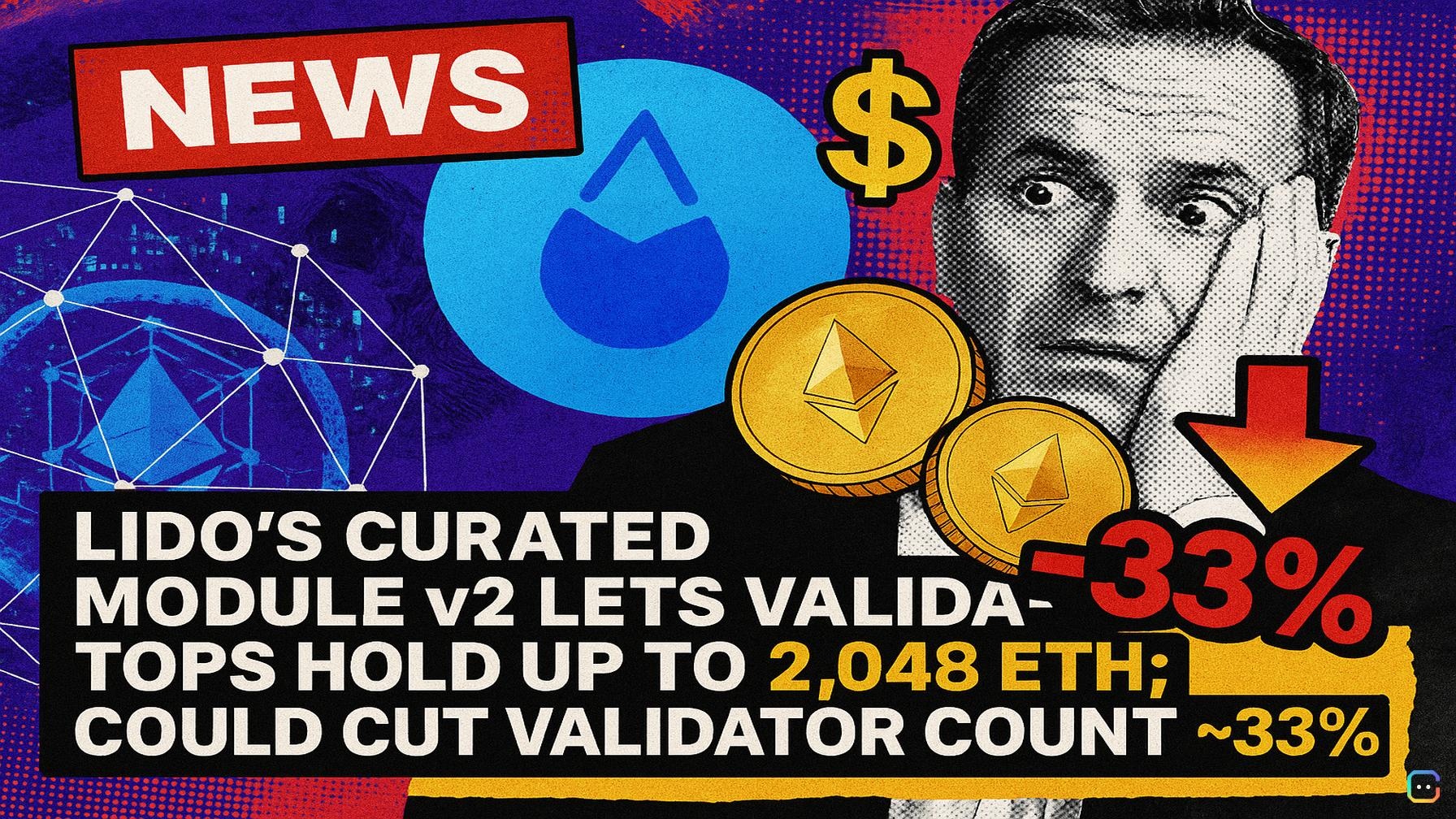
Lido has rolled out a major upgrade to its Ethereum staking stack — Curated Module v2 — that lets protocol-managed validators hold much larger effective balances and could shrink the total validator count by roughly one-third, the team said Monday.
What changed
- Curated Module v2 adds support for Ethereum’s 0x02 withdrawal credentials, enabling validators to raise their effective balance from the base 32 ETH up to as much as 2,048 ETH.
- By consolidating stake into larger validators, Lido estimates the total number of Ethereum validators could fall from about 880,000 today to roughly 628,000. The protocol cautioned the migration has not started and those figures are projections from internal modeling, not live network data.
Why it matters
Lido says the change is designed to make validator operations more efficient by reducing the volume of validator messages on Ethereum’s consensus layer. That should simplify validator management without affecting execution-layer activity — transaction processing, gas fees and user-facing costs are not expected to change as a result. Lido also emphasizes this remains a validator-management change and does not alter Ethereum’s core staking rules.
User impact
stETH holders do not need to take any action; the migration will be executed at the protocol level.
New accountability for node operators
Curated Module v2 also introduces stronger accountability for node operators in Lido’s curated staking arm. New bond requirements and penalty mechanisms are intended to tighten operator incentives, and future stake allocation may factor in operator performance, fee structures and contributions to the Ethereum ecosystem — rather than relying solely on previous allocation methods. Lido describes the upgrade as combining operator incentives, bond-backed security and governance refinements to improve validator set operations over time.
Security, distribution and institutional traction
Lido framed the release as part of a broader push to harden its platform and expand institutional access:
- The protocol distributes staked Ether across more than 900 node operators, with no single operator controlling more than 1% of Lido’s network, the team said.
- Lido has spent over $4 million on smart contract audits, claims an A+ security rating from firms including Credora, and notes it has operated without a smart contract exploit since its 2020 launch.
- Earlier this month Anchorage Digital integrated Lido into its institutional platform, enabling clients to mint and burn wrapped staked Ether (wstETH) while keeping assets inside Anchorage’s regulated custody systems. Anchorage’s leadership has argued liquid staking eases operational complexity for institutions while maintaining custody and reporting controls.
Recent governance and financial context
The Curated Module v2 rollout arrives amid other governance moves and financial headwinds at Lido:
- In March, Lido DAO proposed using up to 10,000 stETH from its treasury for a one-time buyback of LDO tokens, structured as 1,000-stETH tranches that would require token-holder votes before proceeding. The proposal followed concerns that LDO was trading below what the DAO considered its intrinsic fundamentals.
- At the time, Lido remained the largest liquid staking protocol on Ethereum with around 23% market share. Financials published with the buyback showed protocol revenue dipped 23% to $40.5 million for 2025, operating costs improved 13% year-over-year, and the protocol’s take rate rose from 5% to 6.11%.
Bottom line
Curated Module v2 is another step in Lido’s effort to refine staking infrastructure, tighten operator controls, and expand institutional integration — all while preparing for migration to Ethereum’s updated validator credential framework. If the projected consolidation occurs, the change could materially reduce consensus-layer messaging overhead and streamline validator operations, without changing user-facing execution-layer behavior or requiring action from stETH holders.
Read more AI-generated news on: undefined/news