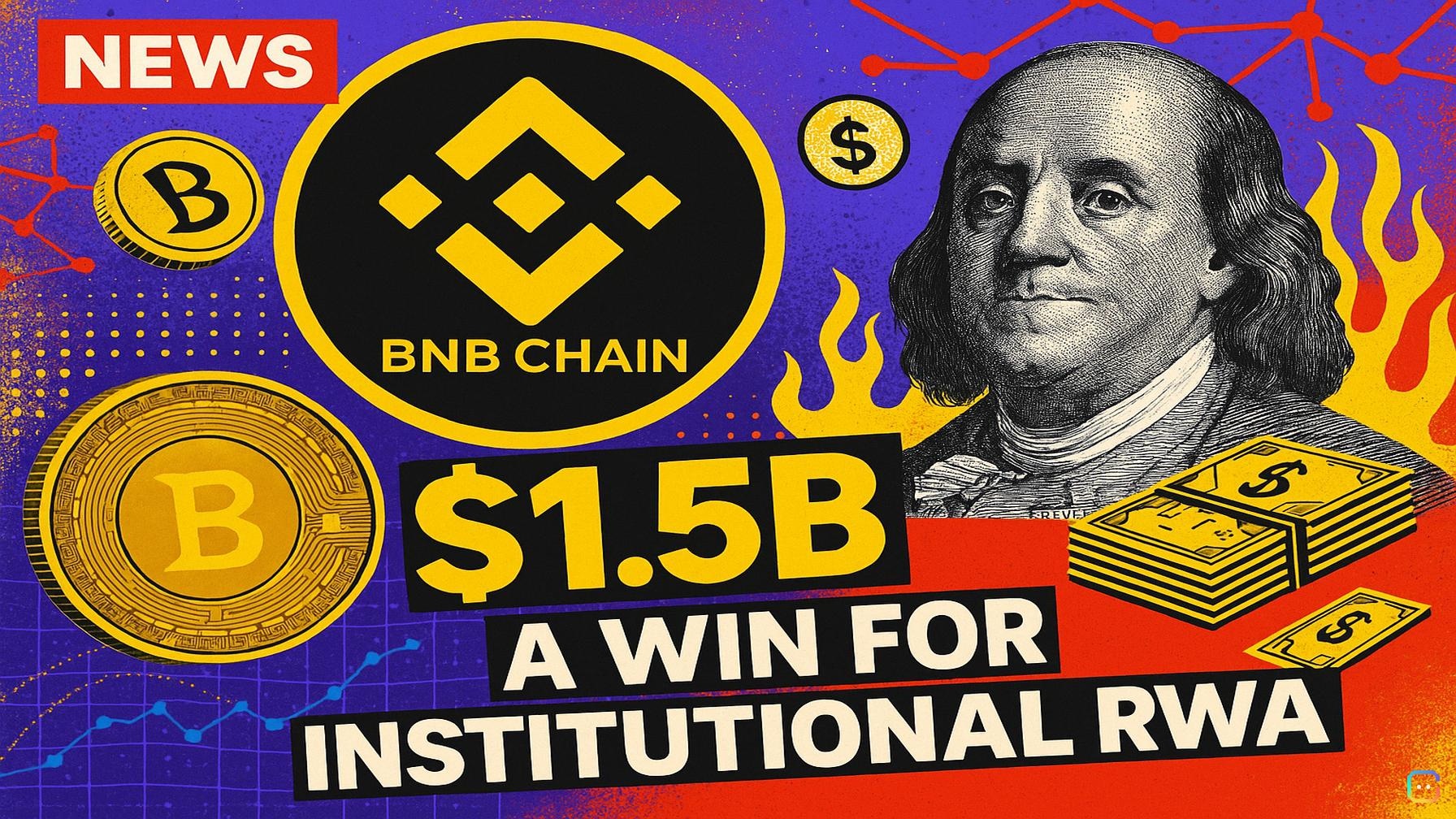
BNB Chain has emerged as the largest on-chain host for Franklin Templeton’s Benji tokenized money market fund, giving the network a notable foothold in the growing real-world assets (RWA) market.
Key figures
- Benji total assets under management: $2.44 billion
- Assets on BNB Chain: ~$1.5 billion — 61.7% of Benji’s AUM
- Stellar: ~ $573 million
- Ethereum: ~ $159 million
(According to validated Benji platform data.)
Why this matters
Benji is a multi-chain platform, so Franklin Templeton hasn’t abandoned Ethereum or Stellar. Still, BNB Chain now holds the largest single share of those tokenized assets — a meaningful institutional signal for a network often discussed in the context of retail trading, exchange activity, and low-cost DeFi.
Real-world assets change the calculus of chain choice
Tokenized treasuries, money market funds, private credit and other RWA products create new settlement and operational demands once they go on-chain. Transaction costs, throughput and execution reliability become business issues, not just retail headaches. BNB Chain’s low-fee, high-throughput model is an obvious draw for asset settlement where moving and reconciling funds at scale matters.
It’s not only about price
Institutions weigh security, compliance, custody support, liquidity, tooling and operational risk alongside fees. If those elements meet institutional standards, lower costs can tip the balance — which helps explain why RWA adoption is spreading across multiple chains rather than clustering on one.
Multi-chain is the default — for now
Benji’s distribution highlights a wider trend: tokenized assets are likely to remain multi-chain. Different issuers, custody partners, investors and regions will prefer different settlement environments. Ethereum’s deep liquidity and ecosystem, Stellar’s payments pedigree, and BNB Chain’s low-cost distribution all have roles to play. The market may evolve into a landscape where issuers deploy across several networks and let demand determine where balances concentrate.
What this means for BNB Chain
Holding the largest share of Benji assets boosts BNB Chain’s institutional narrative. It signals that major financial products can settle there, which could attract more builders working on tokenized assets, institutional DeFi, compliance tooling, custody integrations and stablecoins. However, this development should not be overhyped: Benji’s presence on BNB Chain doesn’t automatically move token prices, guarantee broad DeFi composability around those assets, or ensure other issuers will follow.
Bottom line
BNB Chain’s rise to the top host for Benji is an important data point in the RWA race. It underscores that institutional tokenized assets aren’t locked to the chains many expect and that networks offering the right mix of cost, infrastructure and distribution can win share. Whether BNB Chain expands that lead — or whether balances rotate again — depends on evolving institutional needs and integrations. For now, BNB Chain has earned a stronger seat at the RWA table.
Source: Franklin Templeton Benji platform disclosures. Reported by the News Desk; edited by Samuel Rae.
Read more AI-generated news on: undefined/news