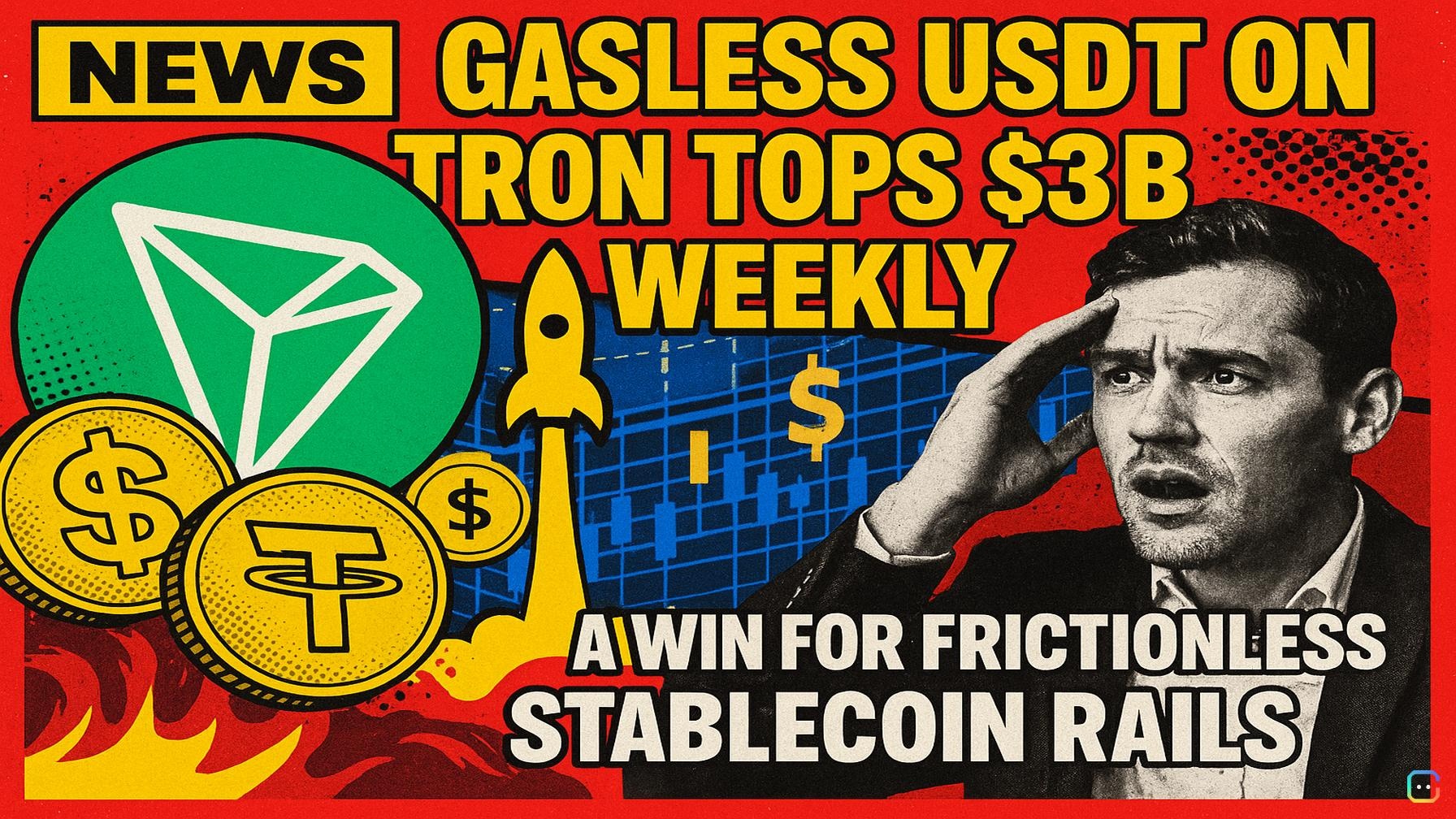
Headline: TRON’s gasless USDT transfers top ~$3B weekly, underscoring demand for seamless stablecoin rails
TRON’s gasless USDT transfers have reached about $3 billion in active settlement volume over a single week — a clear sign that users want to move dollar-pegged tokens without worrying about native gas tokens.
Important distinction: this number measures active settlement volume (how much value is moving through gasless transfers), not total value locked (TVL). In other words, it shows transaction flow — money in motion — rather than how much capital is parked inside DeFi protocols.
How gasless transfers work
TRON’s gasless model lets people send USDT without first acquiring TRX to pay network fees. Transaction costs are abstracted away or handled within the transfer UX, so the sender doesn’t need to think about buying a separate token just to move dollars. That UX simplification is small in concept but big in practice for real-world payments.
Why this matters
- Convenience: Consumers and businesses sending stablecoins don’t want to pause and buy gas tokens. Gas abstraction removes that friction.
- Practicality over hype: While TRON may not dominate developer conversations the way Ethereum or Solana do, it has become a heavyweight for USDT movement thanks to low fees, broad exchange support, and deep USDT liquidity.
- Durable demand: Stablecoin transfers often reflect concrete activity — remittances, business settlements, exchange flows, and treasury moves — not just speculative volume.
Scale and context
The weekly $3 billion headline sits alongside a cumulative gasless transfer figure above $114 billion, showing this is not an experimental feature used by a few wallets but a substantial transaction rail. Still, it’s crucial not to conflate transfer volume with DeFi TVL: high transfer activity doesn’t automatically mean high locked capital in TRON protocols.
Broader landscape
TRON isn’t the only chain focused on making stablecoin payments frictionless. Sui, BNB Chain, Solana, Ethereum Layer 2s, and others are building sponsored transactions, gas abstraction, and payment-specific flows. The common incentive is simple: if stablecoins are going to be used regularly for real-world payments, the experience must be as seamless as traditional rails.
What to watch next
Adoption by more wallets, merchants, and payment platforms will be the key test. If gas abstraction becomes standard, users may stop asking which token pays gas — they’ll simply expect transfers to work, invisibly.
Source and credits
Data from TRON and Tronscan stablecoin transfer disclosures. Story by the News Desk; edited by Samuel Rae. Based on information released in primary source documentation.
Read more AI-generated news on: undefined/news