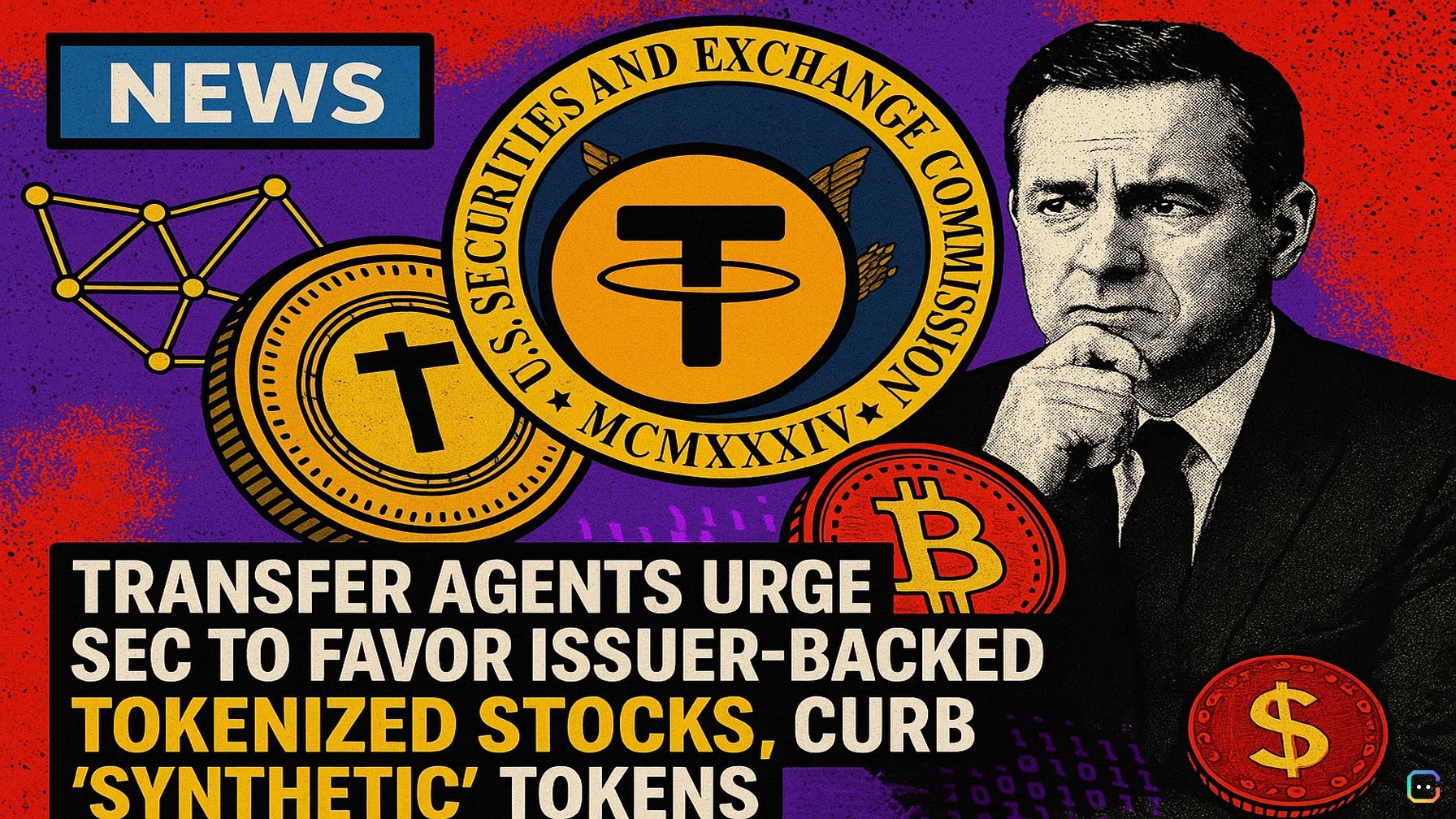
Headline: Transfer agents urge SEC to favor issuer-backed tokenized stocks and curb unaffiliated “synthetic” tokens
Continental Stock Transfer & Trust Company and the Securities Transfer Association have asked the SEC’s Crypto Task Force to draw a firm line between issuer-approved tokenized securities and tokens created by unaffiliated platforms. In letters to the agency, both groups said they support tokenization — but only if it preserves the same investor protections, ownership records and transfer controls that exist in traditional markets.
What the industry groups want
- Prioritize issuer-sponsored tokenization programs that give token holders direct legal rights recorded by transfer agents.
- Limit or subject to stricter rules unaffiliated tokens that merely track a stock’s price or represent indirect interests in shares held by third parties.
- Avoid broad “innovation” exemptions for third-party tokenized stocks and ETFs unless investor safeguards are required.
- Modernize registration documents so issuer-approved token programs get regulatory priority.
Why they’re pushing for a distinction
Continental Stock Transfer & Trust (CSTT) and the STA say issuer-sponsored tokens are fundamentally different: when an issuer authorizes a blockchain-based security, transfer agents can record shareholders and apply conventional controls for voting, dividends, custody and corporate actions. Third‑party tokens, by contrast, may not establish any legal relationship between the token buyer and the issuing company, creating risks that buyers could misinterpret their rights.
Specific risks called out
- Unclear ownership and missing shareholder records that could disrupt voting, dividend payments, tender offers, stock splits and other corporate actions.
- Lack of disclosure around custody, voting rights, dividend entitlement and insolvency claims.
- Market risks including insider trading, manipulation, sanctions-screening failures and transfer-restriction issues.
- Reputational harm when a company’s shares are used in token products without its consent.
Regulatory context and industry momentum
The transfer agents’ request echoes comments from SEC Commissioner Hester Peirce, who warned in July 2025 that blockchain “does not have magical abilities to transform the nature of the underlying asset” — tokenized securities remain securities, and third‑party versions can pose unique investor risks.
At the same time, demand for blockchain access to traditional assets is growing. Crypto exchanges such as Coinbase, Kraken and Binance have launched services linking digital-asset users to stocks, ETFs and derivatives (structures and availability vary by jurisdiction). Traditional market players are also pursuing tokenization inside regulated infrastructure:
- In March, the New York Stock Exchange announced a partnership with Securitize to build a platform for tokenized securities with Securitize acting as a digital transfer agent; NYSE leadership emphasized retaining trust, transparency and investor protections.
- The SEC approved a Nasdaq proposal that allows certain stocks to trade and settle in tokenized form within an exchange system governed by existing securities rules.
- The Depository Trust & Clearing Corporation has run trials tokenizing assets tied to Microsoft, Circle, the Invesco QQQ Trust, State Street’s SPDR S&P 500 ETF and BlackRock’s iShares 0–3 Month Treasury Bond ETF — using transfer agents, exchanges or clearing infrastructure to keep reliable ownership records.
Bottom line
CSTT and the STA want the SEC to preserve the connection between tokenized securities and established transfer and clearing systems as it crafts rules. Their message: embrace tokenization, but protect investors and issuers by prioritizing issuer‑authorized programs and tightening oversight of unaffiliated “synthetic” tokens that could obscure legal ownership and weaken market integrity.
Read more AI-generated news on: undefined/news