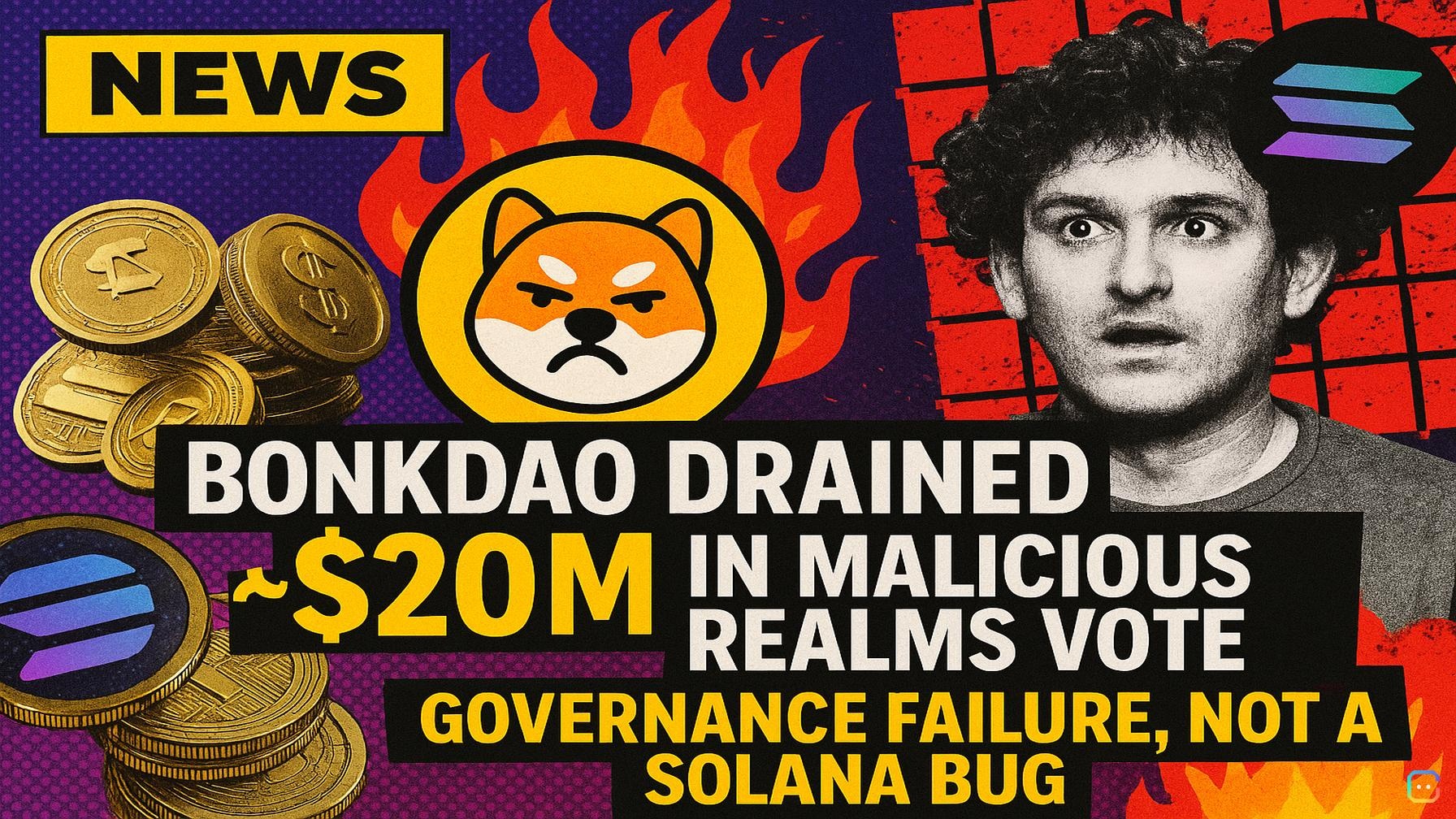
Breaking: BonkDAO Loses ~$20M After Malicious Governance Vote — Not a Solana Bug, But a Governance Failure
BonkDAO’s treasury has been hit for roughly $20 million after a malicious proposal passed through a Realms governance vote, creating a stark example of DAO governance risk on Solana. Importantly, this was not a failure of the Solana blockchain itself — transactions were validated on-chain — but an attack that exploited governance mechanics to move funds.
What happened
According to public records and the DAO’s statement, a proposal cleared the governance process and triggered a transfer of treasury assets. On-chain evidence points to how voter weight and proposal rules were configured inside the DAO as the enabling factors, rather than any underlying smart-contract vulnerability in Solana.
Why it matters
This incident highlights a key lesson: governance is an attack surface. Smart contracts often get the spotlight, but if an attacker can manipulate voting power, proposal parameters, timelocks, or execution permissions, they can produce actions that look legitimate on-chain while being malicious in effect. In other words, the governance process itself can be weaponized.
Risks for DAOs on Solana (and beyond)
Realms is widely used across Solana projects to manage proposals, voting, and treasury execution. That makes it critical infrastructure — and also ensures that a high-profile exploit draws broad scrutiny. But the problem is not unique to Solana. Ethereum, BNB Chain, Arbitrum and Optimism projects have all faced governance-related failures. The underlying point is universal: decentralized decision-making must be paired with robust defensive design.
What DAOs should review now
The BonkDAO event should prompt every DAO to audit governance configuration, including:
- Quorum thresholds and voting periods
- How voter weight is calculated and delegated
- Timelocks on treasury moves and multisig requirements
- Execution permissions and limits on spending
- Emergency pause powers and rapid response procedures
Weak defaults or permissive settings can let attackers win without ever touching a smart-contract bug.
Impact on BONK and the community
BONK is one of Solana’s best-known meme assets, and BonkDAO is central to that identity. A multi-million-dollar treasury drain undermines trust: community members will demand transparency about how the vote passed, whether any accounts or delegates were compromised, and whether funds can be recovered. Traders will watch liquidity, incentives, and market confidence closely. How the DAO responds — detailed forensic information, clear governance analysis and credible reform or recovery plans — will shape whether confidence can be restored.
A constructive outcome is possible
If projects learn from this and harden governance setups — adding timelocks, stricter quorum rules, clearer delegation models and emergency controls — the episode could force healthier defaults across ecosystems. The takeaway is simple but urgent: governance is not just politics; it’s security infrastructure. A well-designed DAO must balance decentralization with safeguards that prevent hostile capture of community assets.
Sources and credits
This report is based on BONK’s public statement, Solscan transaction data, and Realms proposal records. Written by the News Desk; edited by Samuel Rae.
Read more AI-generated news on: undefined/news