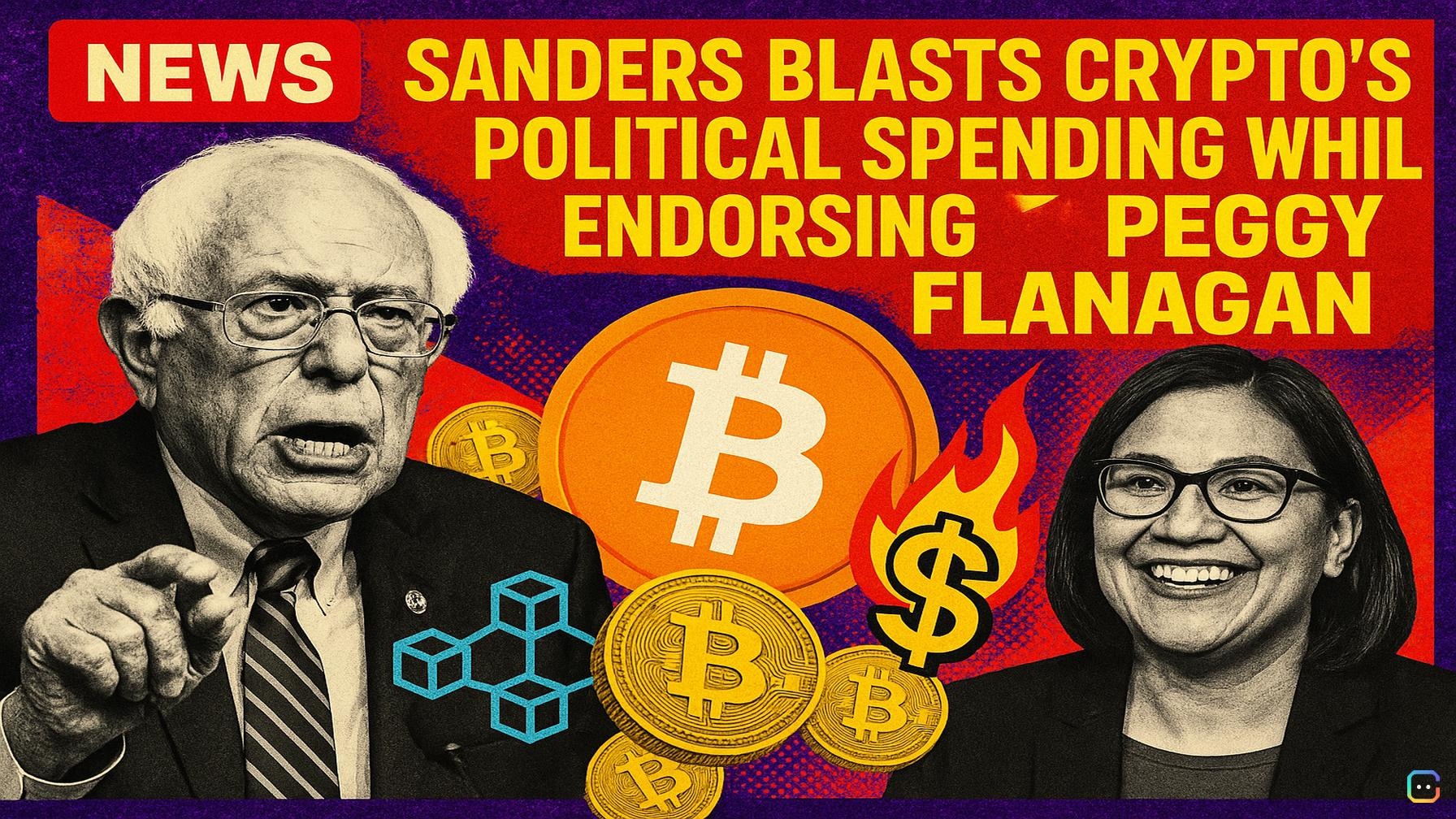
Headline: Sanders singles out “crypto” as he backs Peggy Flanagan — renews fight over industry political spending ahead of 2026
U.S. Senator Bernie Sanders has sharpened his criticism of the cryptocurrency industry while campaigning for Minnesota Lieutenant Governor Peggy Flanagan’s Senate bid, casting digital-asset interests as part of a wider problem of outsized political influence ahead of the 2026 cycle.
In a July 21 post on X, Sanders told supporters, “Together, we are going to take on crypto, the AI industry, AIPAC and other billionaire super PACs,” framing the remarks around political spending rather than technical or market issues. He made the comments in Minneapolis at an event supporting Flanagan and thanked a “packed house” for turnout; he did not name any specific crypto companies, PACs or propose new legislation tied to the comment.
Why this matters to crypto
Sanders’ comments land amid a surge of industry-backed political spending. Public Citizen estimated that the crypto industry had contributed roughly $189 million in the current election cycle by late June. Much of that cash has flowed through groups tied to major firms — including Ripple, Coinbase and venture firm Andreessen Horowitz — with Fairshake and other affiliated organizations among the biggest political spenders.
These groups have shifted from national lobbying to targeting individual races. Crypto.news and other outlets reported that Fairshake-linked entities spent more than $8 million ahead of several high-profile primaries in Maryland, New York and Utah. The network has supported both Democrats and Republicans: for example, crypto-linked spending helped Adrian Boafo win a Maryland Democratic primary, and a Fairshake-linked PAC reportedly spent over $12 million supporting Barry Moore in Alabama’s Senate primary and runoff. Industry-aligned groups generally back candidates who favor clearer, industry-friendly digital-asset rules.
Sanders frames the issue as political influence, not tech
Sanders’ rebuke is part of a broader critique of “billionaire” political influence; it does not equate to a call for a blanket crypto ban or to a specific new regulatory proposal. Instead, he placed crypto alongside other well-funded interests that he and allies say can distort elections and policy outcomes.
That framing dovetails with his recent policy activity. In June, Sanders joined Senators Elizabeth Warren and Representative Bobby Scott in urging the U.S. Labor Department to withdraw a rule proposal that would make it easier for 401(k) plan managers to include alternative assets — including crypto — arguing retirement savers could face increased volatility and weaker investor protections if safeguards were not strengthened. The Labor Department’s plan would not force employers to offer crypto, but would allow plan sponsors to consider alternative investments under existing fiduciary standards.
Lawmakers, industry spending and the legislative calendar
Sanders remains part of a bipartisan array of lawmakers raising concerns about crypto regulation, investor protection and possible conflicts of interest among public officials. Those debates are unfolding as Congress considers market-structure rules and other digital-asset legislation that could define the industry’s future in the U.S.
At the same time, industry-backed organizations are stepping up spending as policy fights advance. Earlier coverage found Fairshake affiliates spent roughly $7 million in select Democratic primaries while negotiations over measures such as the CLARITY Act were underway. With the midterm cycle approaching, these groups still have substantial resources to influence races and messaging.
What’s next
Sanders’ endorsement of Flanagan brings the national clash over crypto money and political influence into Minnesota’s Senate race. His recent remarks put political spending — rather than technical debates about blockchain or token markets — at the center of his criticism. With Congress and regulators continuing to shape the policy landscape, and industry-linked PACs actively financing campaigns across party lines, the tussle over how much influence crypto interests should wield in U.S. politics looks set to intensify through 2026.
Read more AI-generated news on: undefined/news