Bank of Korea Amplifies CBDC Trial — Up to 500,000 Users, Programmable Money, and Real Government Funds on the Line
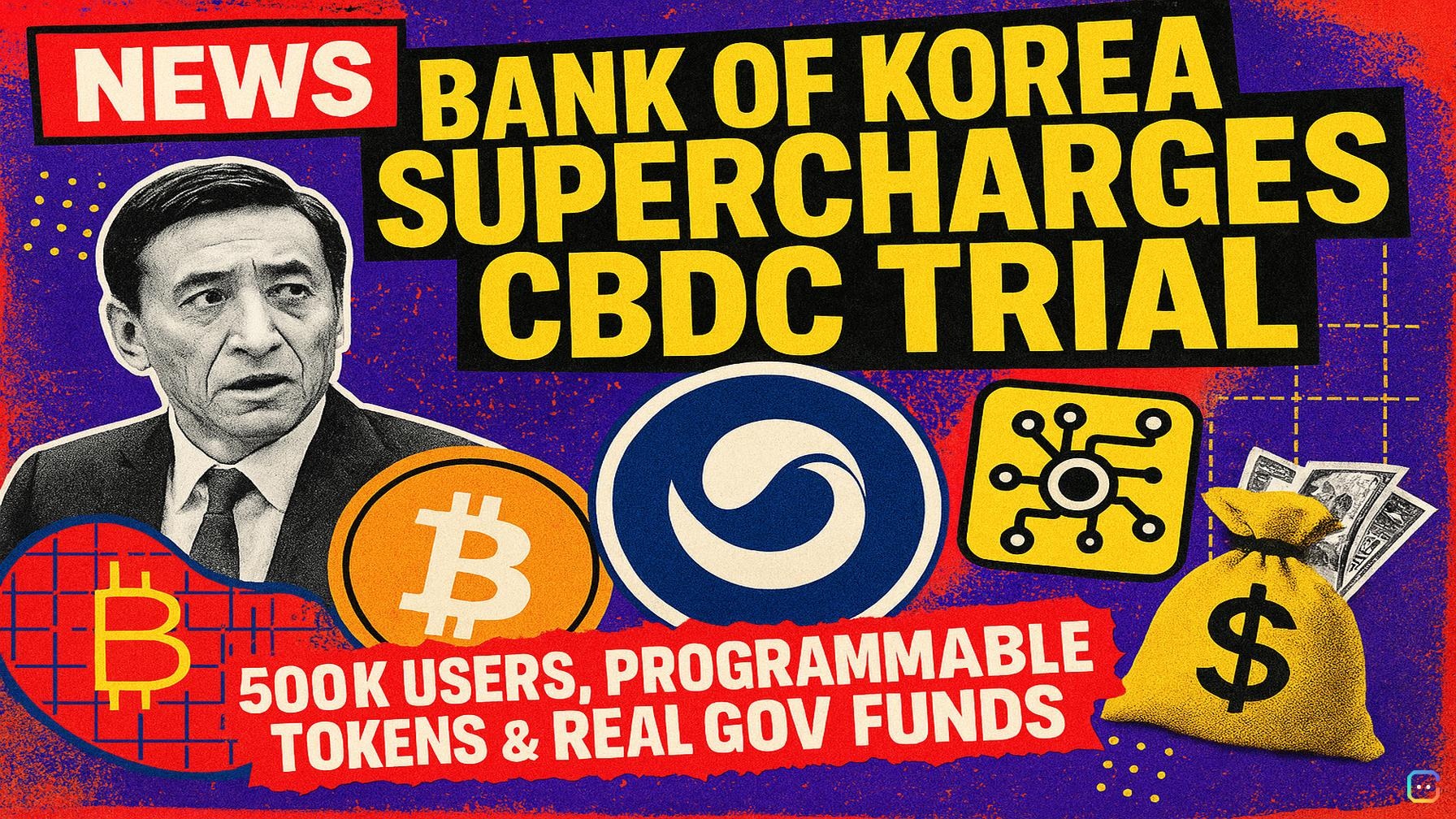
South Korea is dramatically stepping up its central bank digital currency (CBDC) experiment. The Bank of Korea (BOK) announced Monday that the next phase of Project Hangang — its blockchain-based digital won initiative — will begin this September and expand to nine commercial banks and as many as 500,000 users. Unlike the earlier test, this round will move beyond play money: real government funds and new programmable features will be trialed.
What happened so far
Phase 1 ran from April to June 2025. Seven banks and roughly 12,000 merchants took part, producing 114,880 transactions. While some reports said about 81,000 wallets were opened during earlier tests, only about 42% of wallet-holders actually spent tokens — a clear engagement problem. The HRF CBDC tracker estimates banks spent roughly 30–35 billion won building the infrastructure that supported those results.
What’s changing in Phase 2
The new phase is designed to simulate everyday banking and address low user engagement. Features being added include:
- Biometric (fingerprint) approvals
- Person-to-person wallet transfers
- Automatic top-ups from linked bank accounts
- Recurring auto-pay and interest payments
- Cash receipt generation
- Programmable deposit tokens to test government subsidy disbursements
For the first time the pilot will use programmable tokens to distribute government subsidies, allowing funds to be limited to certain vendors, purposes, or time windows. The Bank of Korea says Phase 2 is intended to “lay the groundwork for commercialization,” according to a BOK official quoted by Yonhap.
How the system is structured
The BOK issues a wholesale CBDC — a settlement-only digital currency for financial institutions. Commercial banks then create deposit tokens (blockchain-based representations of customer deposits) that consumers and merchants use for payments. Kim Dong-seop, head of the BOK’s Digital Currency Planning Team, described the model as “a middle ground between a CBDC and a stablecoin.”
Why merchants and users care
For consumers, programmable deposit tokens could eventually mean receiving government benefits directly into a digital wallet instead of waiting for vouchers or checks. For merchants, token-based payments could reduce the interchange and card fees that eat into margins — a particular boon for high-volume retailers. The pilot will specifically test whether programmable deposit tokens can cut fraud and audit costs by enforcing spending rules at the point of disbursement.
Participants and timeline
The original seven banks — KB Kookmin, Shinhan, Hana, Woori, Nonghyup, Industrial Bank of Korea, and BNK Busan — will be joined by Gyeongnam Bank and iM Bank. The pilot will run on an open-ended basis. Project Hangang has become a policy priority under new BOK Governor Shin Hyun-song; he made it a centerpiece of his first policy address after taking office in April 2026.
Broader policy moves and private-sector activity
Hana Bank is reportedly designing a won-backed stablecoin (a private token pegged 1:1 to the won) as Seoul debates stablecoin legislation. The Ministry of Economy and Finance has also proposed updating a 76-year-old national asset law to classify cryptocurrencies as national assets — signaling broader regulatory changes ahead.
Privacy and civil liberties concerns
The programmability that makes deposit tokens attractive to governments also raises civil liberties alarms. Rules that restrict funds to specific vendors, categories, or timeframes can easily be expanded beyond targeted subsidies: expiry dates, spending restrictions, or wallet freezes could be enacted without the protections that come with cash. Every CBDC transaction is recorded on a ledger accessible to central banks and their partners, a structural concern activists say applies to CBDCs broadly, not just South Korea’s design.
China’s e-CNY and the U.S. counterpoint
Critics point to China’s digital yuan, which has had expiry dates on some stimulus payments — framed by Beijing as anti-hoarding, criticized by others as coercive. Researchers have warned e-CNY could set a precedent for state-controlled financial surveillance. By contrast, the United States recently moved in the opposite direction: a four-year ban on CBDC issuance became law on July 11 when the 21st Century ROAD to Housing Act took effect without President Trump’s signature.
Bottom line
Phase 2 of Project Hangang significantly raises the stakes: more users, real government funds, and programmable money that could reshape payments, benefits distribution, and merchant economics in South Korea. But it also sharpens the debate over privacy and state control in a world where money can be coded with conditions. The pilot’s outcomes will be watched closely by policymakers, banks, merchants, privacy advocates, and other countries considering CBDCs.
Read more AI-generated news on: undefined/news