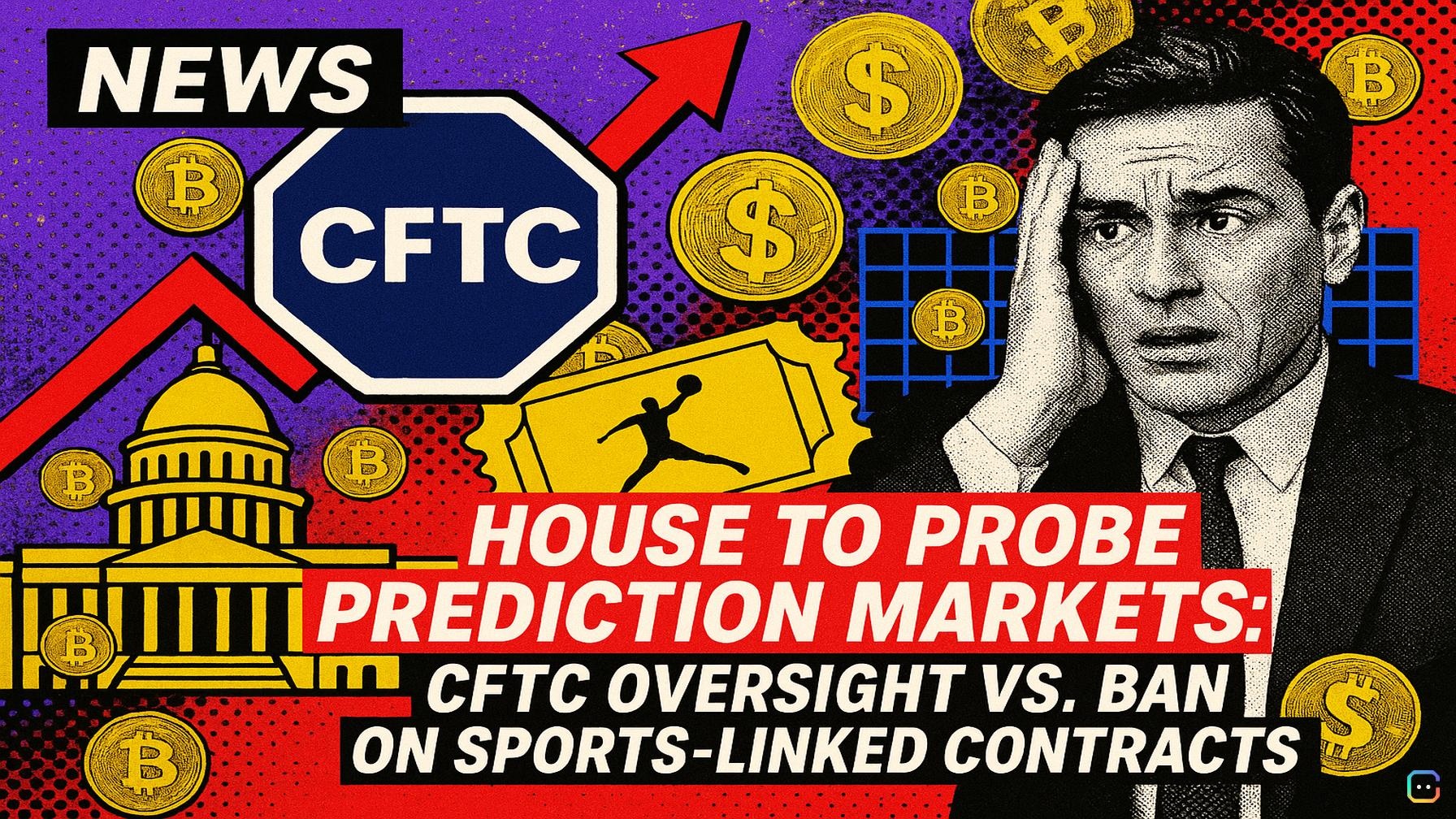
The US House is preparing to put prediction markets under the microscope as lawmakers weigh whether sports-linked contracts should be treated as derivatives or banned as gambling.
What’s happening
- The House Agriculture Committee’s Subcommittee on Commodity Markets, Digital Assets, and Rural Development has scheduled a hearing to examine customer protections and market integrity in prediction markets. Legal experts and executives — including witnesses from the American Gaming Association and the Indian Gaming Association — are expected to testify.
- The hearing follows a growing legal and regulatory fight over whether products offered by prediction-market platforms such as Kalshi and Polymarket are federally regulated derivatives under the Commodity Futures Trading Commission (CFTC) or unlicensed sports betting subject to state gambling laws.
Two camps: CFTC oversight vs. outright ban
- Prediction-market backers argue the CFTC already has the authority to police problematic contracts. Legal observers who reviewed prepared testimony say supporters do not want new Congressional legislation clarifying CFTC powers; they maintain existing law gives the regulator tools to disallow harmful listings. Robert Schwartz, one witness, said the CFTC “has powerful authority to disallow exchanges from listing problematic contracts.”
- Opponents — led by the American Gaming Association and Indian Gaming Association — want Congress to ban sports contracts on regulated exchanges entirely. They argue that certain markets economically function like traditional sports wagers and that leaving enforcement to the CFTC risks turning federally regulated derivatives exchanges into nationwide online gambling platforms. Indian Gaming Association chair David Bean says the economic reality of the contracts, not just their legal label, must determine the response.
Recent rulings and enforcement add urgency
- The dispute is not purely theoretical. France’s gaming regulator recently blocked access to Polymarket and treated the platform’s activity as illegal gambling with potential criminal penalties.
- In the US, a federal judge in New York, Analisa Torres, ruled that New York gambling laws can apply to Kalshi’s sports-related event contracts. That decision undermines the argument that federal commodities oversight automatically preempts state gambling rules and raises the prospect of state-level enforcement against similar platforms.
What’s at stake
- If Congress sides with gaming groups and enacts a ban, regulated exchanges would likely be prohibited from listing sports-linked event contracts. If lawmakers instead accept the CFTC-centered approach, disputes would continue to be litigated and regulated primarily at the federal derivatives level — but state regulators may still press enforcement actions.
- The outcome will influence the business models of prediction markets and decentralized alternatives, and will determine whether platforms face a patchwork of state actions or a single federal regime.
Meanwhile: a technical development in decentralized markets
- Separately, decentralized exchange Hyperliquid announced plans for HIP-4, a system to let users create outcome markets permissionlessly. Because validators cannot vet every possible market, Hyperliquid proposed standardized, validator-approved templates that would be enforced onchain. Deployers could launch markets using an approved template without a new validator vote; validators would still create a small number of “canonical markets.”
- Hyperliquid’s change is a technical scaling solution for launching many types of markets, not a legal fix for the sports-contract controversy. The House hearing will focus on whether the CFTC’s existing powers are sufficient to protect participants or whether Congress should step in to bar sports-linked products from federally regulated exchanges.
Bottom line
The hearing will bring competing legal philosophies into direct view: one side trusting the CFTC under existing law to police risky contracts, the other pressing Congress to prohibit sports-related markets outright. The decision will shape how prediction markets operate in the US and whether platforms such as Kalshi, Polymarket and decentralized rivals can continue listing sports outcomes.
Read more AI-generated news on: undefined/news