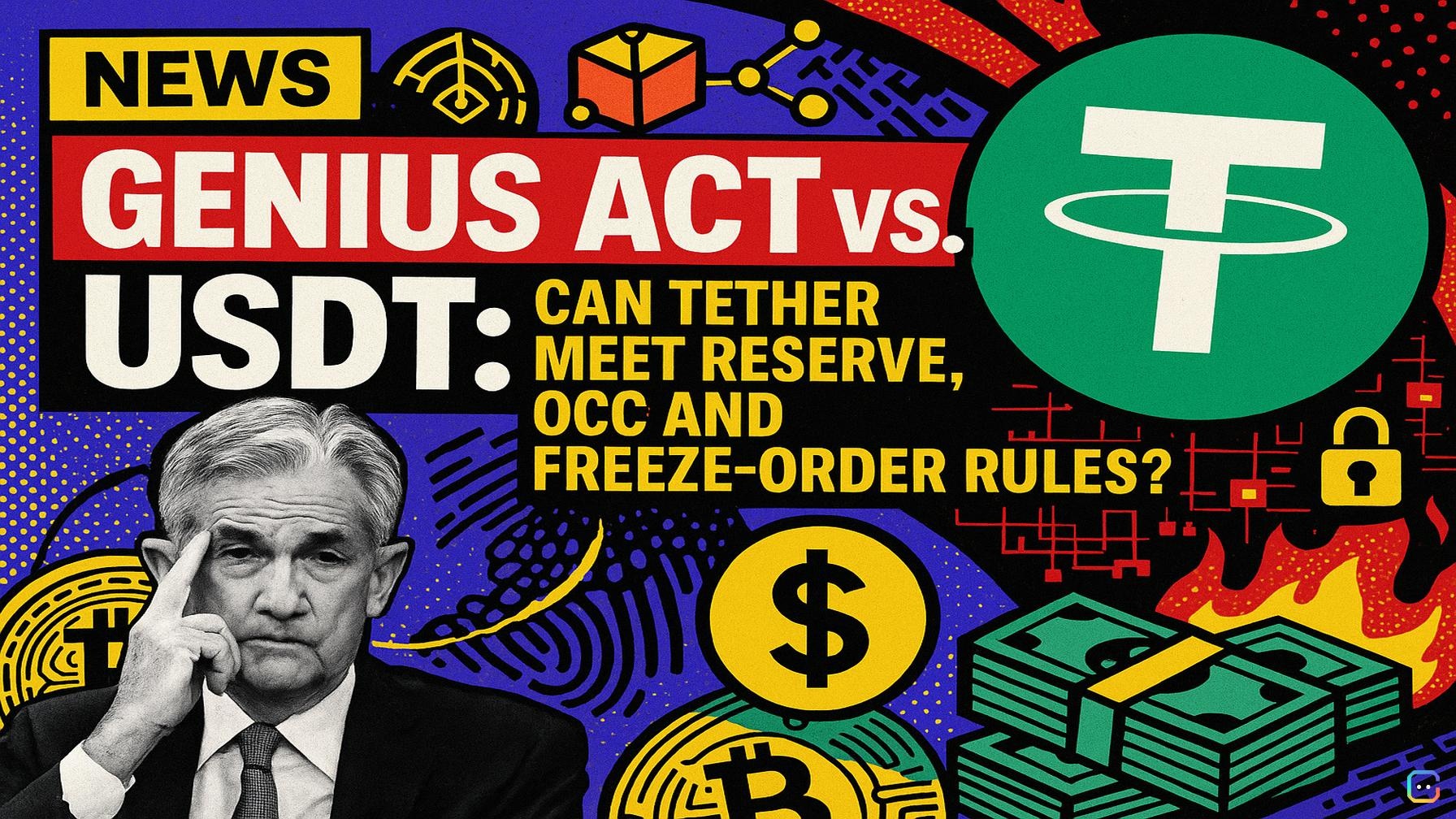
Headline: Can Tether keep USDT on U.S. exchanges under the GENIUS Act? Regulators, lawyers and markets weigh in
One year after President Trump signed the GENIUS Act, questions are mounting over whether Tether’s USDT—the world’s largest stablecoin by market value—can remain listed on U.S. trading platforms unless the issuer meets new U.S. rules before the compliance window closes.
What’s at stake
- The GENIUS Act established a framework for “qualified” stablecoins and created a transition period for compliance. But the law also appears to impose some immediate obligations on foreign-issued coins once it takes effect, and the milestones and timing for those obligations remain unsettled.
- For USDT, continued access to U.S. centralized exchanges—along with the institutional liquidity that comes with it—depends on satisfying requirements such as cooperation with asset-freeze and seizure orders, registration with the Office of the Comptroller of the Currency (OCC), holding reserves at U.S. financial institutions, and being subject to home-country supervision that the U.S. Treasury deems comparable.
What the law likely requires (and when)
- Lawyers and regulators are divided on timing. Justin Levine of Davis Polk told CoinDesk that foreign issuers must immediately comply with lawful orders to freeze and seize assets once the law becomes effective (expected around January), but that other listing-related obligations carry a longer runway—roughly until the general compliance deadline in July 2028.
- The OCC’s guidance has added ambiguity: a proposal and its footnote appear to leave 2028 as the broad compliance deadline while indicating some foreign-issuer obligations begin at effectiveness. An early legal memo from Paul Hastings that suggested a different timeline was later removed from the firm’s website after requests for clarification.
Where Tether stands
- Tether has not publicly laid out a detailed plan to bring USDT fully into GENIUS compliance, and CoinDesk said Tether didn’t respond to requests for an updated position before its report. Last July, however, CEO Paolo Ardoino said the company intended to comply and planned both a U.S.-focused token and steps to ensure USDT met the law’s foreign-issuer requirements.
- Tether has already launched a U.S.-focused stablecoin, USAT, via banking partner Anchorage Digital. Adoption of USAT has been limited compared with USDT so far, but Anchorage’s head of policy, Kevin Wysocki, expects institutions to migrate to compliant, bank-issued digital dollars before the 2028 deadline.
Reserve mismatches and implications
- CoinDesk flagged that Tether’s most recent reserve disclosures show about one-quarter of USDT backing is invested in assets that would not qualify under GENIUS reserve standards—holdings such as bitcoin, precious metals, and lending exposure. The law instead requires reserves made up of highly liquid assets like cash and short-term U.S. Treasuries.
- Converting reserve mixes and meeting OCC registration requirements would be a “significant undertaking,” Levine said—another reason why foreign issuers should be planning well ahead even if some deadlines are delayed.
Market moves and commercial activity
- Tether has been active beyond regulatory debates: it led a $7 million round for Pact Labs to integrate USAT into payroll rails, backed corporate treasury pilots (including a $20,000 cross-border Hyundai payment settled in about seven minutes on Avalanche), and invested in Latin American firms—$20 million in Mercado Bitcoin, $20 million in Ualá, and earlier $14 million in Belo.
- Bolivia is reportedly evaluating proposals to recognize USDT in parts of its payment system, and local banks are already offering some USDT services—illustrating Tether’s continued international expansion.
Who might delist first?
- With implementing rules still unfinished, exchanges face choices. Trevor Tanifum of FS Vector told CoinDesk that smaller or more risk-averse platforms might delist non-compliant stablecoins early; larger exchanges with deeper legal resources could keep USDT listed until regulators provide definitive guidance.
- Industry attention is also split: lawmakers are still debating the CLARITY Act, which could amend parts of GENIUS and add another layer of uncertainty for issuers like Tether and Circle.
Bottom line
Tether has time to adapt but faces concrete hurdles. Immediate cooperation with law enforcement orders appears unavoidable; reforming reserve composition, securing OCC registration, and meeting custody and supervision rules will be complex and potentially costly. Market pressures—particularly from U.S. institutions and banks—may push migration to GENIUS-compliant alternatives well before 2028, even as legal debates and regulatory guidance continue to evolve.
Read more AI-generated news on: undefined/news