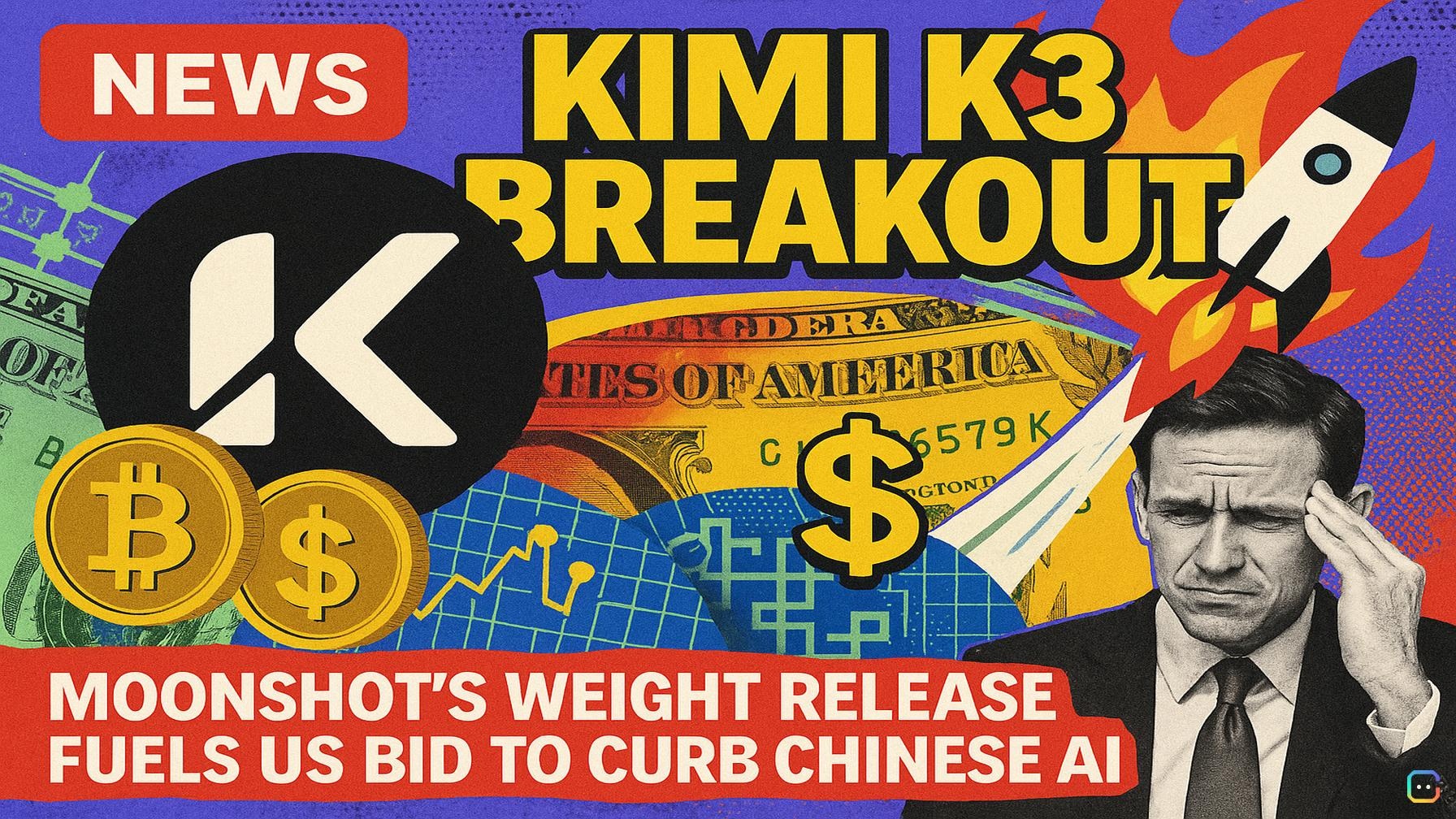
Moonshot AI’s breakout model Kimi K3 — and the prospect it will soon publish its full weights — has reignited U.S. government interest in limiting access to powerful Chinese AI systems, raising fresh questions for developers, investors and the crypto community about enforceability and decentralised distribution.
What happened
- Moonshot’s 2.8‑trillion‑parameter Kimi K3 surged to the top of Arena’s frontend coding leaderboard (1,679 points) and posted frontier‑level results on other benchmarks, prompting renewed scrutiny from U.S. officials, Axios reports.
- Parts of the administration have discussed de facto limits on foreign open‑source models and even putting Chinese AI labs on the Commerce Department’s Entity List, which would curb their access to U.S. technology unless licenses are granted. No formal policy or ban has been announced.
- Moonshot says it plans to publish Kimi K3’s full model weights by July 27. Once weights are public, developers can download, host and modify the model on private infrastructure — a move that would make blanket U.S. restrictions much harder to enforce.
Why the U.S. is worried
- American companies have been trialing Chinese systems that deliver strong performance at lower cost. Open‑weight models let firms run the software on their own servers without relying on the originator’s platform, reducing both vendor lock‑in and U.S. visibility into usage.
- The model’s success has increased political pressure: former White House crypto and AI czar David Sacks called Kimi K3’s ranking “concerning,” and CIA Director John Ratcliffe has likened frontier AI systems to “digital nuclear weapons,” elevating them as a national‑security priority.
Moonshot’s momentum — and limits
- Founded in 2023 by AI researcher Yang Zhilin, Moonshot has raised over $5.5 billion and was valued at about $30 billion in June. The Beijing firm is also preparing for a possible Hong Kong IPO with Goldman Sachs and China International Capital Corp advising.
- Demand has already strained Moonshot’s infrastructure: Reuters reported the company briefly stopped taking new Kimi subscriptions after usage exceeded available compute, prioritizing existing paying customers.
Market and crypto angles
- Prediction markets treated a federal move to broadly block public access to a major Chinese model as unlikely in the near term: Polymarket priced that outcome at roughly 15%. A separate Polymarket contract giving odds on which company will operate the best AI model at the end of August placed Anthropic at 91% and Moonshot at 1%.
- For crypto and decentralization advocates, the timing of Moonshot’s planned weight release is crucial. Public weights can be copied, hosted on distributed infrastructure, or mirrored across jurisdictions, complicating any attempt at centralized censorship or export controls.
- The story sits against a backdrop of massive AI spending and investment. JPMorgan’s Jamie Dimon projected $725 billion in AI‑related spending this year. Binance founder Changpeng Zhao contrasted these investments with Bitcoin’s fixed 21 million supply, arguing AI drives productivity and requires continual capital and dilution (via equity issuance), while Bitcoin offers a capped monetary asset. Former Fidelity manager George Noble warned of a potential AI bubble whose fallout could, in his view, far exceed the dot‑com crash — a speculative risk investors are weighing.
What to watch next
- Whether the U.S. moves to place Chinese AI labs on the Entity List or adopt other formal restrictions.
- What happens after July 27 if Moonshot releases Kimi K3’s weights: how quickly independent developers replicate, host, and adapt the model, and how markets and regulators react.
- How prediction markets, venture flows and investors recalibrate odds and capital allocation as real‑world access to high‑quality, open models increases.
Bottom line
Kimi K3’s leaderboard victory has turned a technical milestone into a geopolitical flashpoint. For crypto and decentralization communities, the stakes are practical: downloadable model weights mean AI tools can be distributed in the wild, testing the limits of any government attempt to centrally control access. The situation is fluid — both markets and policymakers are watching closely.
Read more AI-generated news on: undefined/news