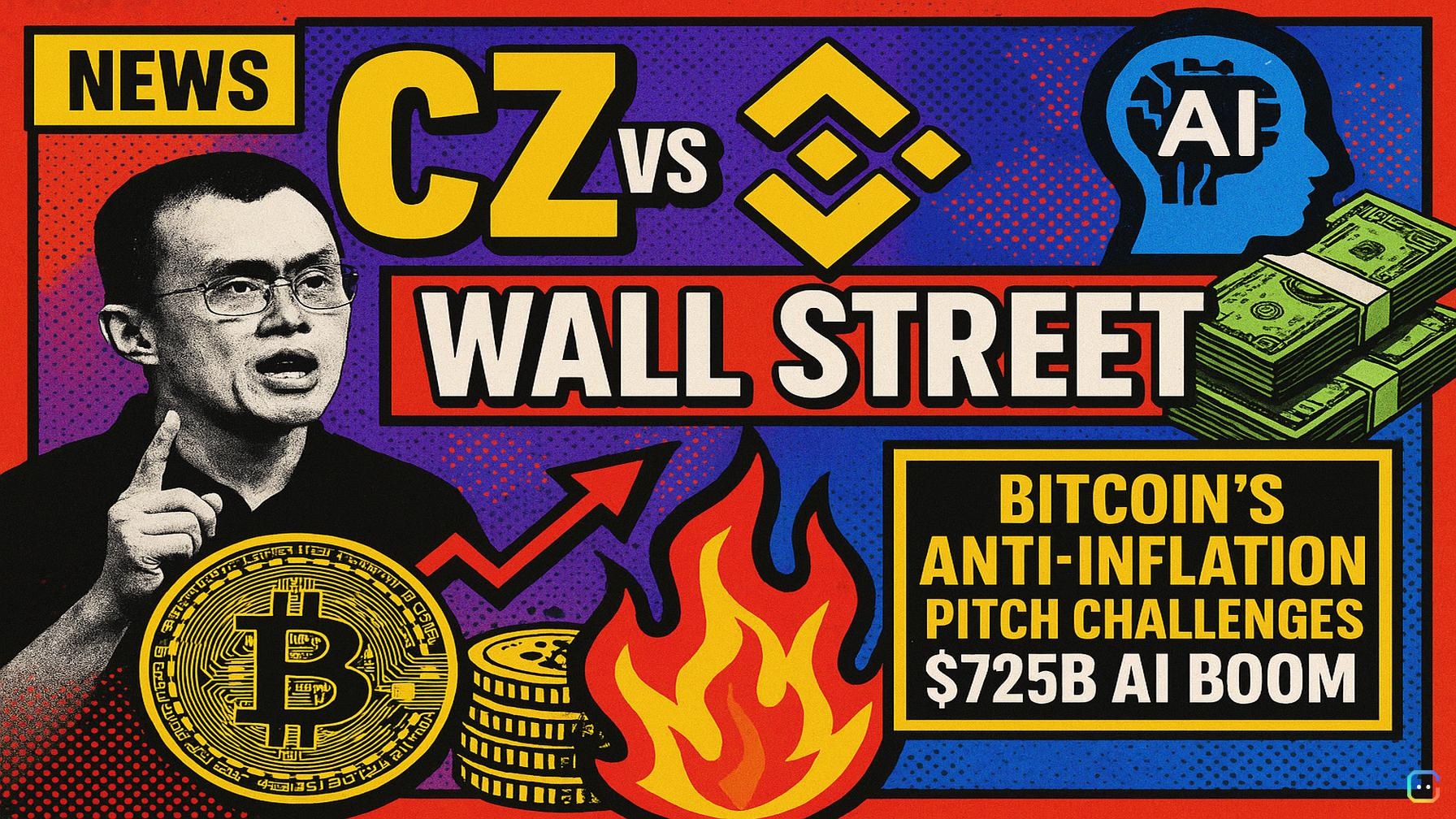
Headline: CZ pits Bitcoin’s anti-inflation case against Wall Street’s $700B AI boom
Changpeng “CZ” Zhao, co-founder of Binance, on X staked a blunt claim against Wall Street’s surging AI narrative: “AI is great, but it does not protect you against inflation. Bitcoin does.” His one-line contrast frames a growing debate on whether floodgates of AI capital or Bitcoin’s capped supply offer the better hedge for investors worried about monetary debasement.
The math behind the headlines is huge. JPMorgan CEO Jamie Dimon has forecast roughly $725 billion of AI investment this year, fueling a wave of spending on chips, data centers and software. That surge has driven enthusiasm — and risk — across equities and infrastructure plays. Former Fidelity manager George Noble warned that an AI crash could be far worse than the dot-com bust, suggesting it might inflict up to 17 times more damage than the roughly $5 trillion Nasdaq wipeout of the early 2000s.
Yet BlackRock’s digital-assets team argues a parallel story is unfolding in macroland. Robert Mitchnick says investors have dialed back attention to Bitcoin as spot-Bitcoin ETFs saw heavy outflows, but he expects that could reverse if U.S. borrowing and the risk of money printing become more pronounced. “The more fear there is over the borrowing level and the risk of money printing, that is ultimately the most important, I think fundamental driver ahead,” Mitchnick said, summarizing the monetary-case logic that CZ echoed.
Price context: Bitcoin recently hovered near $65,000 after recovering from a dip, still well under its October 2025 peak of more than $126,000 — a record set amid strong inflows into BlackRock’s spot Bitcoin ETF. Proponents contrast AI’s dependence on future revenue from a huge capex cycle with Bitcoin’s fixed 21 million supply, positioning the crypto as a hedge against loss of purchasing power from inflationary policy.
Not everyone is convinced AI’s expansion is unalloyed good. Prediction market Polymarket currently prices a meaningful chance (one contract above 17%; other contracts in the 16–24% range) that an AI bubble could burst in 2026 — down from earlier odds around 30%. Former White House economists Jared Bernstein and Ryan Cummings have also warned corporate AI spending is “still inflating,” arguing it is both draining corporate cash reserves and pushing tech’s share of U.S. GDP beyond dot-com-era norms.
Asset managers are already adjusting. BlackRock’s Rick Rieder has signaled plans to pare exposure to firms directly burning cash on AI buildouts while increasing allocations to companies that stand to profit from AI demand without the biggest capex burdens. That playbook fits stories like Bitcoin miner TeraWulf, which recently signed a 20-year deal to host AI data-center infrastructure for Anthropic — a hybrid exposure to both crypto and AI tailwinds.
CZ’s tweet crystallizes a broader divergence in investor thinking: back a technology-driven spending cycle that could multiply corporate earnings — or buy into a scarce monetary asset that claims to guard against future inflation and currency debasement. With huge sums chasing both narratives, the coming months will test which thesis best insulates portfolios from macro shocks.
Read more AI-generated news on: undefined/news