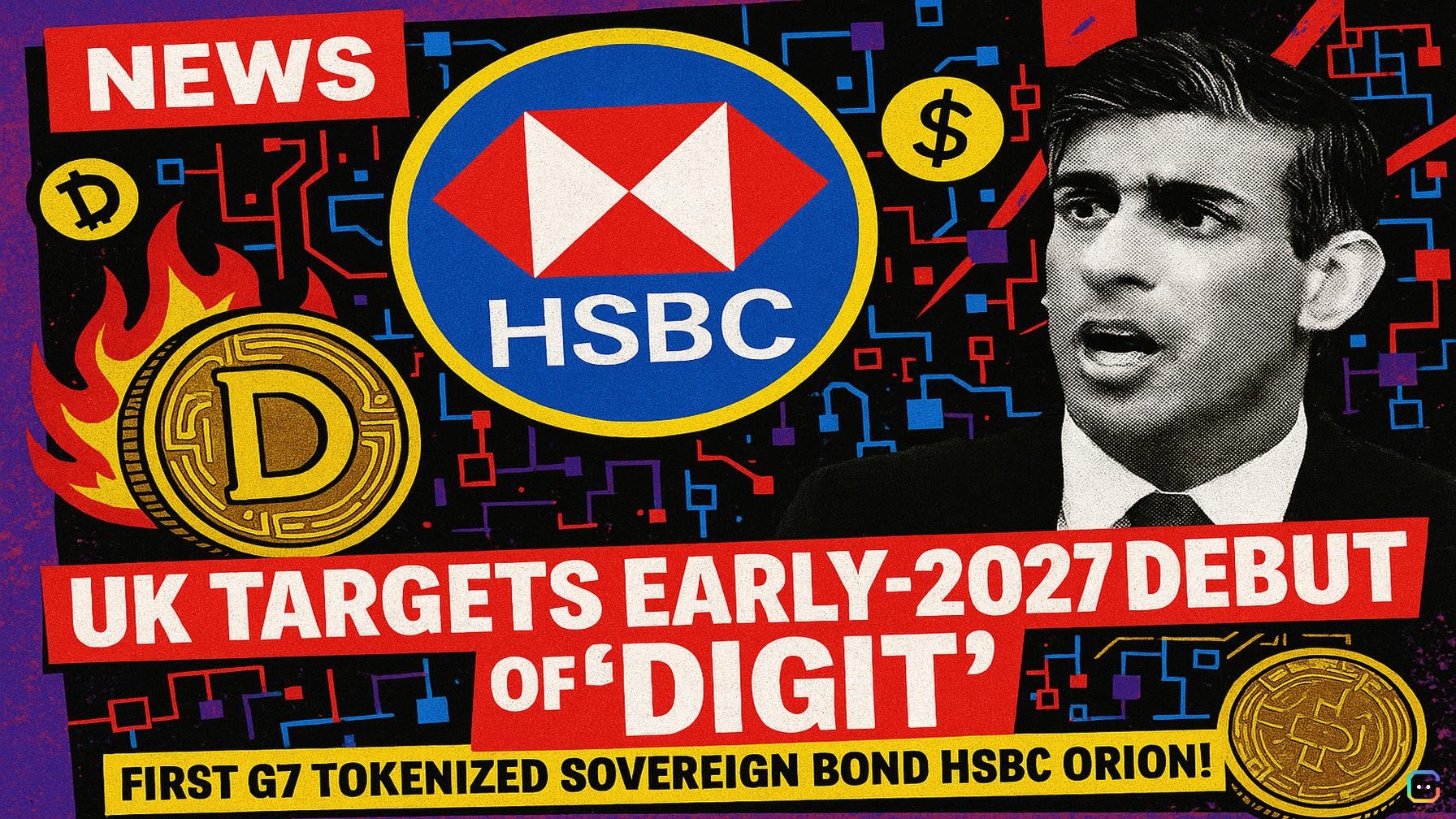
The UK has set a landmark target to issue its first tokenized sovereign bond in early 2027, stepping forward as the first G7 nation to put government debt onto distributed‑ledger infrastructure.
Chancellor Rachel Reeves announced the plan in her annual Mansion House speech, saying the initial digital gilt — branded the Digital Gilt Instrument (DIGIT) — will be sterling‑denominated and issued on HSBC’s Orion blockchain platform. The transaction will run inside the Bank of England and Financial Conduct Authority’s Digital Securities Sandbox, a regulatory testing environment designed to trial digital securities and market plumbing. If the pilot goes to plan, the government says it will follow the maiden issuance with further digital gilt sales.
Why this matters
- Tokenizing gilts aims to test whether distributed‑ledger technology can speed up settlement, cut reconciliation work and reduce operating costs across government debt markets — potential efficiency gains that could reshape parts of fixed‑income infrastructure.
- The move positions the UK as a frontrunner in tokenized sovereign issuance, a use case that market participants have long argued could unlock faster, lower‑cost secondary market activity and new forms of collateralization.
Platform and pilot background
HSBC won the mandate to operate the Orion platform in February after already issuing more than $3.5 billion of digital bonds through Orion — credentials the bank leveraged to secure the UK government assignment. The Treasury launched its digital gilt pilot in 2024 to evaluate the technology and market mechanics before committing to broader adoption.
Central bank support and collateral plans
Bank of England Governor Andrew Bailey told the same Mansion House audience the BoE will work toward making DIGIT eligible as collateral in its market operations. That step would enable tokenized repurchase agreements (repos) and allow banks to use DIGIT in central bank funding transactions — an important bridge between experimental tokenized securities and core liquidity facilities.
Unknowns and program scope
The Treasury has not disclosed specifics for the first DIGIT sale: the issue size, maturity, coupon, investor eligibility or what asset will be used for settlement remain undecided. Officials also said the initial issuance will sit outside the government’s conventional gilt financing program while the sandbox trial runs.
Bigger picture: UK‑US coordination on tokenized finance and stablecoins
The DIGIT announcement comes as the UK ramps up broader work on tokenized markets. Earlier this week the UK and US issued a joint statement under the Transatlantic Taskforce for Markets of the Future committing to closer cooperation on stablecoin regulation, cross‑border payments and tokenized finance.
Key points from that joint statement:
- The two governments will explore how regulated stablecoins issued in one country might access the other’s market while each keeps its own domestic rules.
- They will seek common approaches for tokenized securities settlement and study whether stablecoins or tokenized money‑market funds could be used as collateral in clearing markets.
- The statement sets out core principles for stablecoins presented as money: at least a one‑to‑one backing with high‑quality liquid assets, reserve assets kept separate from issuers’ corporate funds, timely redemptions for holders, and clear legal protections if an issuer fails.
The statement does not grant automatic market access or mutual recognition, but it provides a regulatory framework intended to reduce unnecessary cross‑border barriers while both countries finish their own rule‑making.
Bottom line
The UK’s DIGIT pilot and the transatlantic push on stablecoins mark a decisive move from isolated experiments to coordinated policy and market testing. If successful, tokenized gilts could open new plumbing for sovereign debt markets and accelerate integration between traditional central‑bank operations and emerging digital‑asset infrastructure.
Read more AI-generated news on: undefined/news