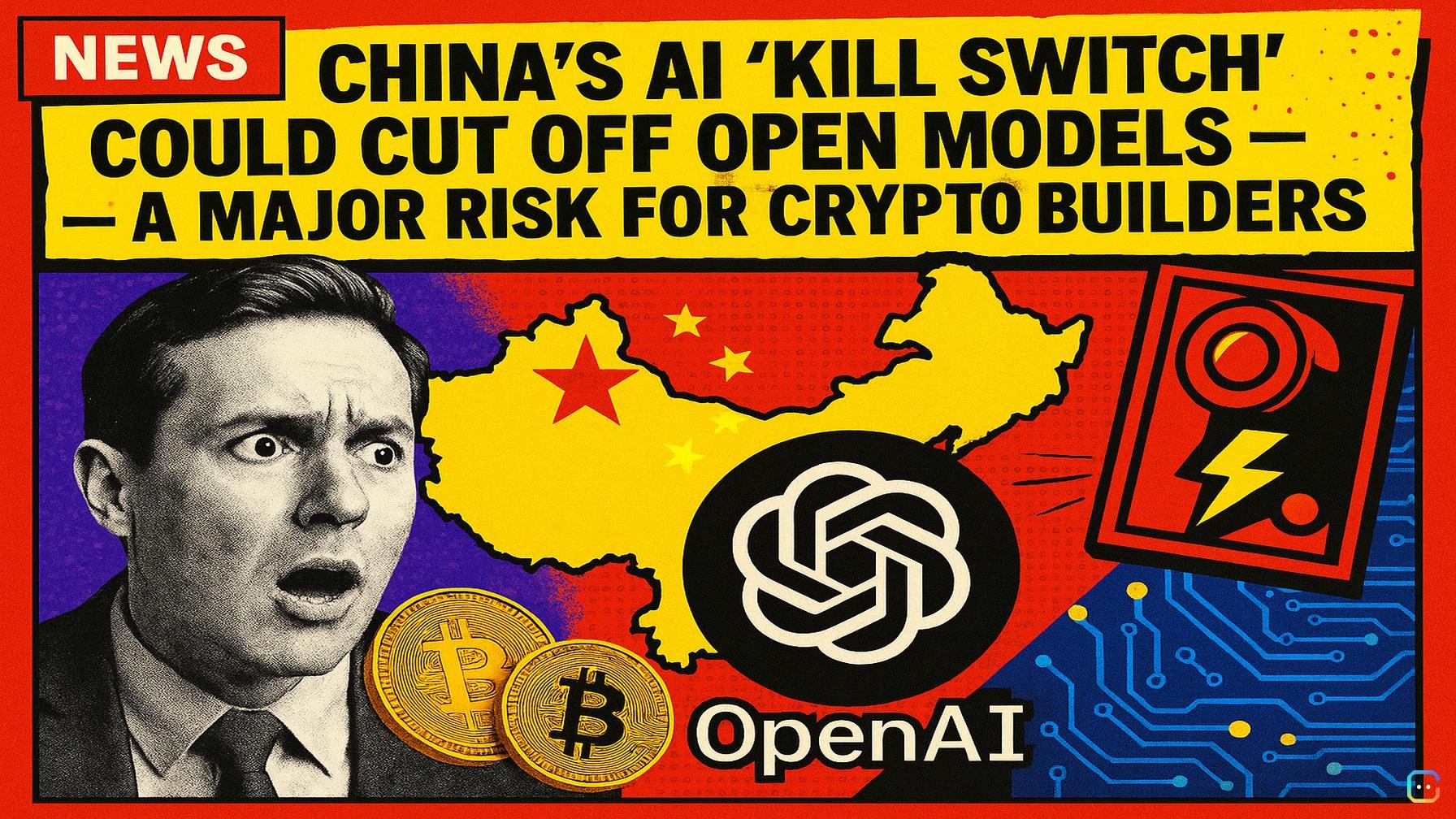
Headline: China May Be Quietly Building an AI “Kill Switch” — What That Means for Open Models and Crypto Builders
The U.S. pulled the emergency brake on advanced AI in June. Now Reuters reports Beijing may be quietly preparing its own version — and the move could reverberate through the open-source AI ecosystem that many crypto projects rely on.
What’s happening
- Reuters, citing three people familiar with the discussions, says China’s Ministry of Commerce has held private talks in recent weeks with major AI players — Alibaba, ByteDance and startup Z.ai — about restricting who can access China’s most advanced models, including some not yet released.
- Officials reportedly discussed limits on both closed-source models and “open-weight” models (the kinds developers can download, run locally and modify). They also floated making theft or unauthorized disclosure of proprietary AI tech a national-security offense.
- Participants considered tighter vetting of foreign investors in domestic AI startups. It’s unclear what, if anything, will be enacted: two sources told Reuters the rules might apply only to future models, not existing ones, and no timeline has been set.
A three-tier regulatory idea
- A May roundtable of Chinese legal experts — summarized in a Supreme People’s Court journal — proposed a three-tier regime for open-source AI:
1. Basic open-source tools would need a simple government filing.
2. More advanced tech would face security reviews before release.
3. The most sensitive “frontier” models would be barred from public release or restricted to domestic use.
- If adopted, that would be a sharp break from the openness that helped Chinese models gain global traction.
Why this matters now
- The U.S. already used an unprecedented export-control approach in June when the Commerce Department ordered Anthropic to suspend access to Claude Fable 5 and Mythos 5 for foreign nationals; Anthropic pulled those models globally and later restored them after retraining safety classifiers.
- OpenAI similarly limited initial rollout of new GPT-5.6 variants to vetted partners after consulting U.S. authorities. President Trump’s June 2 executive order asked developers to submit frontier models for federal cybersecurity review; a defining framework is due August 1.
China’s concerns and recent moves
- Reported Chinese worries include Anthropic’s Mythos being reverse-engineered to attack infrastructure and allegations that certain models may be tracking or leaking user information — claims that have stirred public alarm and calls for domestic defensive tools.
- Qihoo 360 founder Zhou Hongyi, at a Beijing AI event, called for China to build its own defensive AI agent and unveiled a tool called Tulong Feng.
- Beijing has already tightened rules around foreign tech and investment this year: it ordered Meta to unwind a $2 billion Manus deal in April and required government approval for certain funding rounds involving U.S. capital. An early-June regulatory package broadened scrutiny of cross-border tech and data deals.
The openness paradox
- Chinese AI’s global gains have largely come via openness. Alibaba’s Qwen models are popular on Hugging Face; ByteDance’s Doubao is a major Chinese product; and Z.ai’s GLM-5.2 has matched top U.S. models on some benchmarks while offering much cheaper API access.
- Open-weight Chinese models climbed from less than 2% of token usage on OpenRouter in late 2024 to roughly 61% by mid-2026 — a market shift driven partly by U.S. export controls that pushed users toward Chinese alternatives.
- If Beijing restricts overseas access to frontier models, that escape valve could close. Developers and businesses that turned to Chinese models for lower cost and fewer restrictions would face higher costs and reduced options.
Implications for crypto and decentralized builders
- The crypto ecosystem often depends on open models and permissionless infrastructure — from on-chain agents and oracles to AI-assisted smart contract auditing and dApp UX — many of which have relied on open-weight models from China because they’re affordable and flexible.
- Nationality- or location-based access controls are blunt tools: the U.S. experience shows such rules can also block the foreign-born engineers who contribute to model safety. China would face the reverse staffing and collaboration trade-offs.
- Tighter restrictions and investor vetting could reshape funding flows for AI startups, affect tokenized AI infrastructure projects, and push more work toward decentralized hosting and self-run models — but could also fragment standards and interoperability.
Bottom line
Beijing appears to be weighing China-style export and access controls for AI that mirror recent U.S. actions. For crypto builders and open-source communities that have benefited from cheap, open Chinese models, the stakes are real: a policy shift could raise costs, complicate cross-border collaboration, and accelerate interest in decentralized AI alternatives. At the same time, whether any measures are finalized — and how broadly they would apply — remains uncertain. Reuters’ reporting frames the discussions as active but undecided; watch for further regulatory moves after July 15 and the U.S. framework due August 1.
Read more AI-generated news on: undefined/news