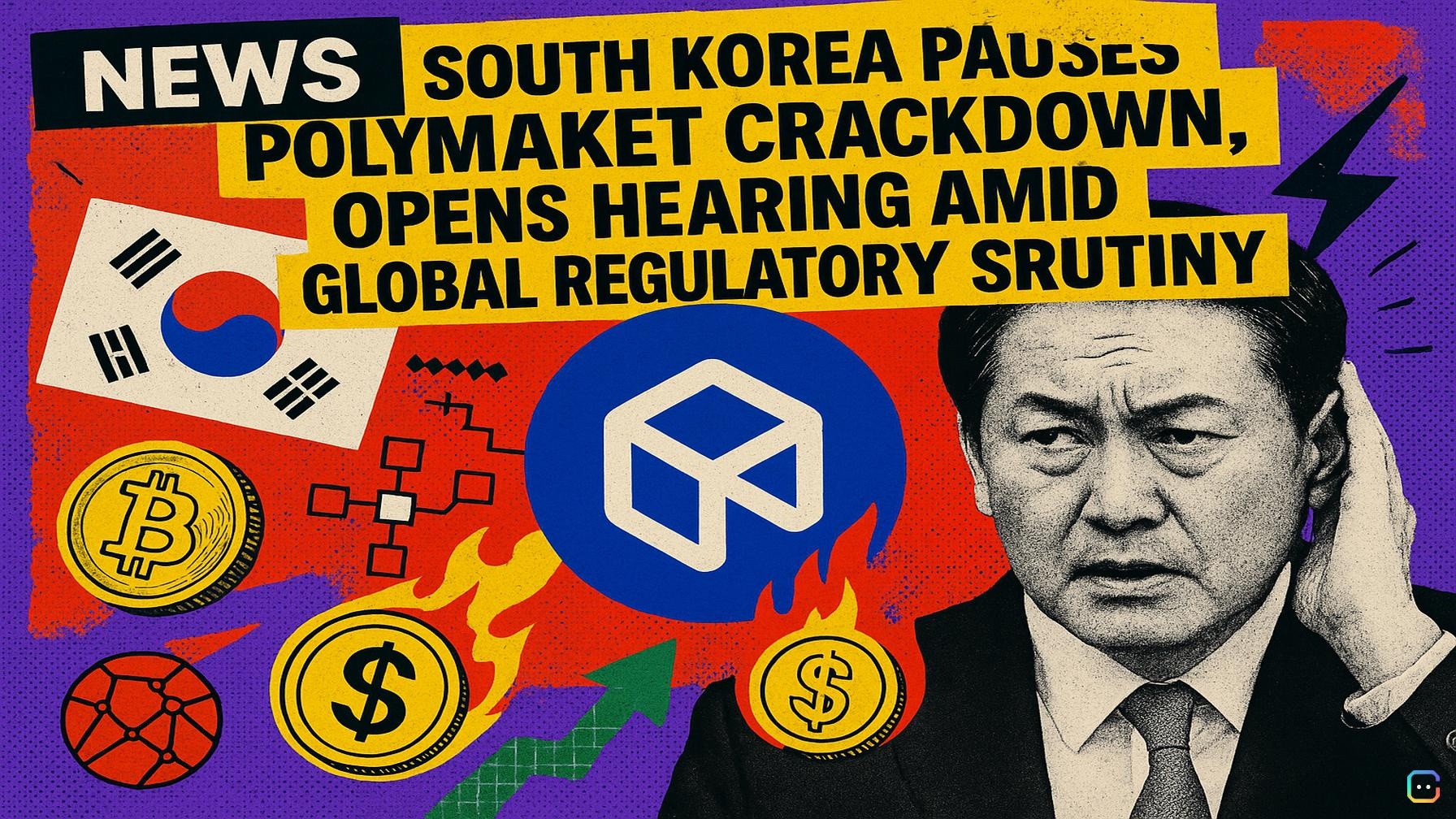
South Korea has paused plans to punish prediction market Polymarket and opened a formal hearing to let the platform respond to concerns that its service may amount to illegal gambling — a move that adds to mounting global regulatory pressure on event-based crypto markets.
What happened
- The Broadcasting, Media and Communications Review Committee said it will hear Polymarket’s position before deciding whether to issue a corrective order. The committee said the extra step is needed to verify both the legality of the service and how it operates.
- The review cites the National Gambling Control Commission Act, which treats online services that facilitate speculative gambling as illegal gaming and gives authorities powers to monitor and act against them.
Local probe and potential penalties
- The review follows a separate policing action: in early June, Gangwon Provincial Police launched what local media called South Korea’s first investigation into Polymarket users, focused on alleged illegal gambling tied to election-related prediction markets. The probe was reportedly requested by the National Police Agency.
- South Korea’s Criminal Act imposes fines up to 10 million won (about $6,500) for gambling offenses; habitual gambling can bring up to three years in prison or fines up to 20 million won. Running a gambling venue for profit can carry penalties up to five years in prison or a 30 million won fine.
Polymarket’s stance and access controls
- Polymarket says it enforces access restrictions to comply with sanctions, local financial rules, gambling and prediction market laws, anti-money-laundering requirements and KYC policies. The company blocks users from 33 countries — including the U.S., U.K., France, Germany, Brazil, Singapore, Japan and Australia — and also restricts access in certain regions within otherwise permitted countries (for example, some Canadian provinces and parts of eastern Ukraine).
How this fits into a broader regulatory squeeze
- South Korea’s review is the latest example of regulators scrutinizing prediction markets. In the EU, the European Securities and Markets Authority recently signalled that some event-based contracts could already fall under MiFID II as financial instruments — potentially exposing them to existing retail restrictions such as those on binary options.
- In the U.S., Bloomberg and CNBC reported that the Commodity Futures Trading Commission is conducting a broad investigation into Polymarket’s business, including its social media practices. That inquiry followed Wall Street Journal reporting that the platform had promoted simulated trading videos through paid content creators without proper disclosure; Polymarket told CNBC it has begun auditing promotional materials to ensure compliance.
On-chain activity raises enforcement questions
- On-chain research firm Allium found that U.S.-linked wallets traded roughly $571 million in political contracts on Polymarket over the past year, despite the platform’s user restrictions. Allium cautioned that its country attribution covered only a small share of wallets and is directional rather than exact, but the data underscore ongoing questions about how users access offshore prediction markets and how effectively geographic blocks and compliance controls work in practice.
Why it matters
- The South Korean hearing could set a meaningful precedent for how national regulators treat prediction markets that operate on decentralized or cross-border rails. Regulators are increasingly treating event-based crypto products as either gambling or financial instruments, and enforcement, disclosure and marketing practices are coming under scrutiny. For market operators and users, the trend raises legal and compliance risks — and highlights the practical challenges of enforcing national rules against permissionless or semi-permissioned platforms.
What’s next
- The Broadcasting, Media and Communications Review Committee will decide whether to issue corrective measures after hearing Polymarket’s response. Meanwhile, U.S. and EU regulatory probes continue to evolve, and on-chain monitoring will likely keep feeding enforcement and policy debates.
Read more AI-generated news on: undefined/news