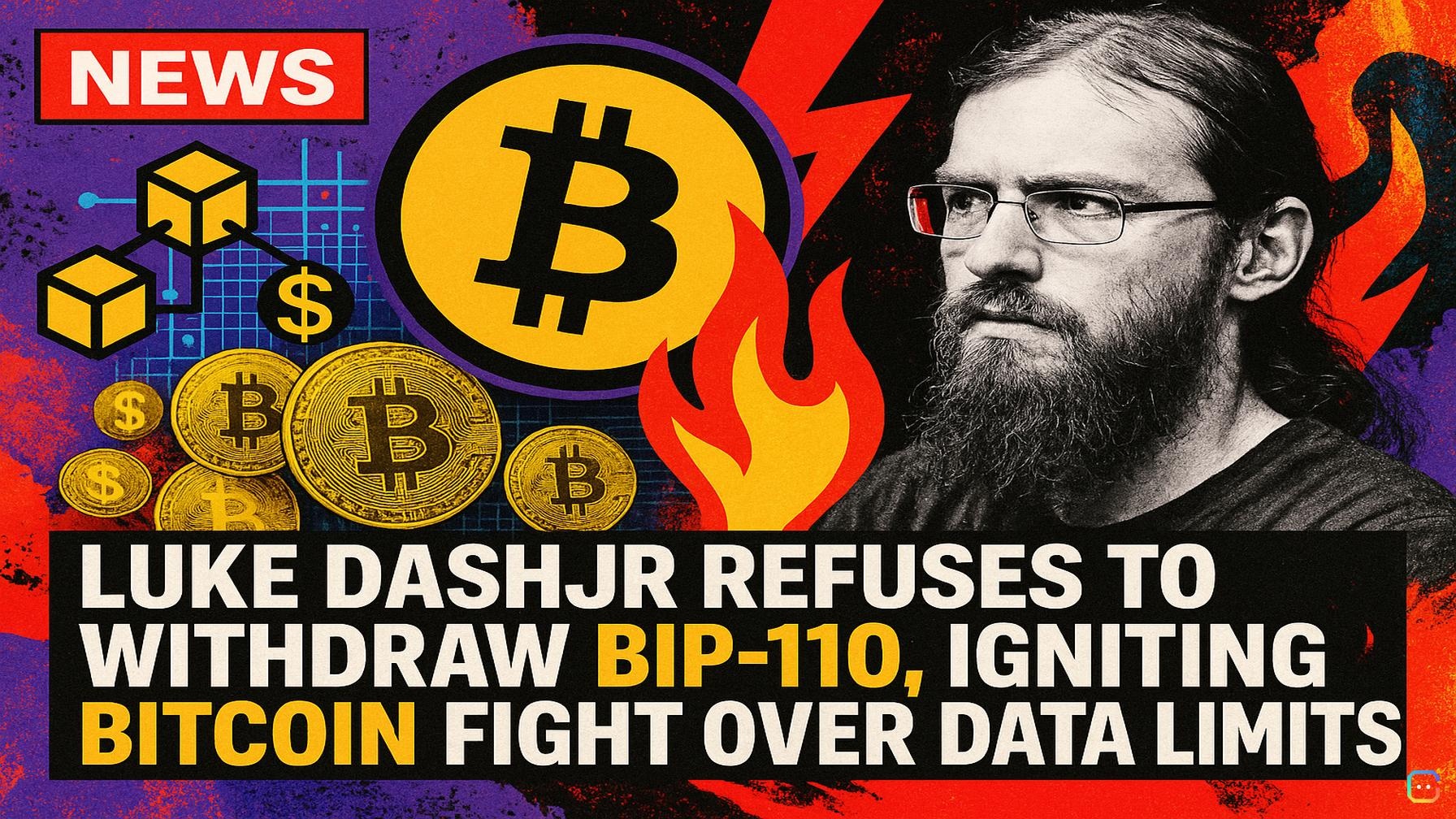
Headline: Bitcoin spam fight heats up as Luke Dashjr refuses to withdraw BIP-110
Bitcoin developer Luke Dashjr has rejected calls to pull BIP-110, a controversial proposal that would temporarily limit non-financial data in Bitcoin transactions — intensifying a growing debate over whether the protocol should be reserved solely for payments or remain open to data-heavy use cases like Ordinals and Runes.
“Saylor didn’t say anything about BIP110,” Dashjr wrote, adding bluntly, “And no, it’s too late to cancel BIP110.” His comments came after renewed discussion about Michael Saylor’s recent remarks that Bitcoin should “move slowly and not break,” a philosophy many interpret as support for a conservative approach to protocol changes. Saylor himself did not mention BIP-110 by name.
What BIP-110 proposes
- Officially titled the Reduced Data Temporary Softfork, BIP-110 would place temporary limits on certain forms of arbitrary data embedded in transactions.
- The proposal says the goal is to steer Bitcoin back toward “the world’s money” by rejecting data storage as a supported consensus-level use case.
- Importantly, the rules would apply only to UTXOs created at or after activation; existing UTXOs would be exempt to avoid freezing previously created coins.
- The BIP’s text frames the change as a way to invalidate some data-storage methods while preserving recognized monetary uses.
Why supporters back it
- Proponents say inscriptions, Runes and other data-heavy activity increase blockchain storage demands and shift resources away from peer-to-peer payments.
- Supporters present BIP-110 as a targeted, temporary measure to reduce spam and protect Bitcoin’s “core purpose” as money.
Why opponents object
- Critics argue block space should be open to any user who pays the fee, warning that restricting transaction content risks creating a subjective precedent and splitting the network.
- Runes and Ordinals, now integrated into Bitcoin’s fee market, are described by their advocates as Bitcoin-native digital commodities that can be engraved, minted and transferred via standard transactions — economic activity that some users believe should not be barred by consensus rules.
A broader context: governance and markets
- BIP-110 has become another stress test for Bitcoin’s decentralized governance model. There is no central authority to approve changes; developers can propose rules, but activation depends on the collective behavior of miners, node operators, businesses and users.
- Reports say miner support for BIP-110 remains weak, but the final outcome will hinge on signaling and user decisions during any activation window.
- The debate surfaces against a tense market backdrop: Bitcoin was trading near $64,000 as ETF outflows and macro headwinds pressured prices, and Michael Saylor’s company, Strategy, has faced scrutiny after the market value of its stock fell below its Bitcoin holdings — a broader story Crypto.news has previously covered.
Why it matters
BIP-110 is not just a technical tweak — it touches on competing visions of what Bitcoin should prioritize (pure money vs. multipurpose ledger), the limits of consensus-level rules, and how the ecosystem balances economic activity against network resource constraints. As signaling and conversations continue, the proposal will test how the community negotiates those trade-offs in practice.
Read more AI-generated news on: undefined/news