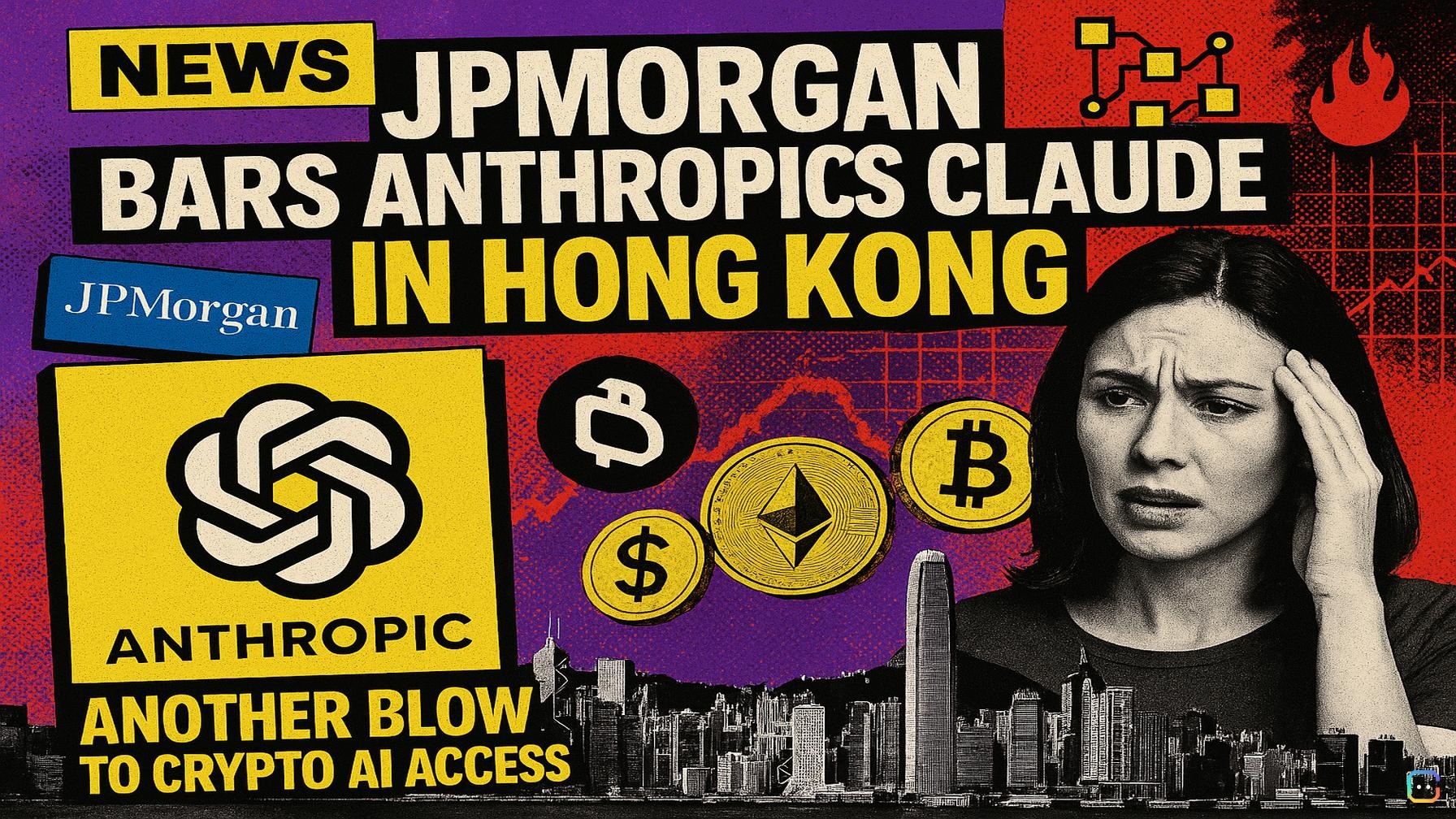
JPMorgan bars Hong Kong staff from using Anthropic’s Claude, echoing Goldman move
JPMorgan Chase has blocked employees in Hong Kong from selecting Anthropic’s Claude models from its internal list of approved large language models, the Financial Times reports. People familiar with the decision told the FT the restriction is rooted in language within Anthropic’s licensing terms — specifically clauses that limit where the models may be used. JPMorgan declined to comment; Anthropic has not issued a new statement but previously told the FT that Claude was never officially supported in Hong Kong.
This follows a similar ban by Goldman Sachs earlier this year, after Goldman concluded Anthropic’s terms exclude use across Greater China, including Hong Kong. The developments highlight how vendor licensing and U.S. policy are reshaping where banks and other institutions can deploy cutting-edge AI.
Why crypto and fintech audiences should care
- Trading desks, quant teams, smart-contract auditors and crypto research groups increasingly rely on generative AI to power code review, strategy development and data analysis. Restrictions like these can blunt productivity and raise costs for Hong Kong-based crypto firms and banks.
- They also feed a broader concern that Hong Kong — historically a more permissive gateway to frontier AI than mainland China — could lose an edge as advanced models become integral to software development, research and financial services workflows.
- For crypto infrastructure and DeFi teams operating across jurisdictions, the episode underscores the operational complexity of using cloud and AI services that carry geographic or export controls.
Broader context: export controls, model pauses and legal fights
Western AI companies routinely limit access to their most advanced models in mainland China due to company policy and local internet controls. But enterprise agreements and offshore infrastructure have allowed Hong Kong users more direct access — until now.
Anthropic recently faced two other major disruptions:
- On June 13, it disabled access to Fable 5 and Mythos 5 after receiving a U.S. government export-control directive. Authorities reportedly told Anthropic to block the models for all foreign nationals, including foreign-national employees in the U.S., over concerns a jailbreak technique could let the models identify or repair software vulnerabilities. Anthropic pushed back, suggesting the action may have stemmed from a misunderstanding and disputing the reported severity.
- Two days later, a proposed U.S. class-action suit (filed in the Northern District of California) accused Anthropic of shortchanging subscribers to its premium Claude tiers — alleging usage limits didn’t match the multipliers advertised. Plaintiff Karl Kahn seeks class status for customers who paid for Max 5x and Max 20x plans since April 2024.
Regulatory posture and Anthropic’s stance
Anthropic has been publicly urging stronger regulation for frontier AI. In its June 11 “Policy on the AI Exponential,” the company called for government testing requirements, independent evaluations, cybersecurity standards and enforcement mechanisms — arguing that frontier systems can create biological, cybersecurity and operational risks that warrant closer oversight.
What to watch
- Whether other global banks and crypto firms tighten access to Anthropic or similar vendors in Hong Kong and other jurisdictions.
- How U.S. export-control actions evolve and whether they prompt broader geo-fencing by AI providers.
- Potential follow-up legal or regulatory fallout for Anthropic and implications for enterprise AI licensing practices.
For crypto companies operating in Hong Kong or servicing Greater China, the episode is a reminder to map vendor terms and export risks into operational planning for AI-enabled workflows.
Read more AI-generated news on: undefined/news