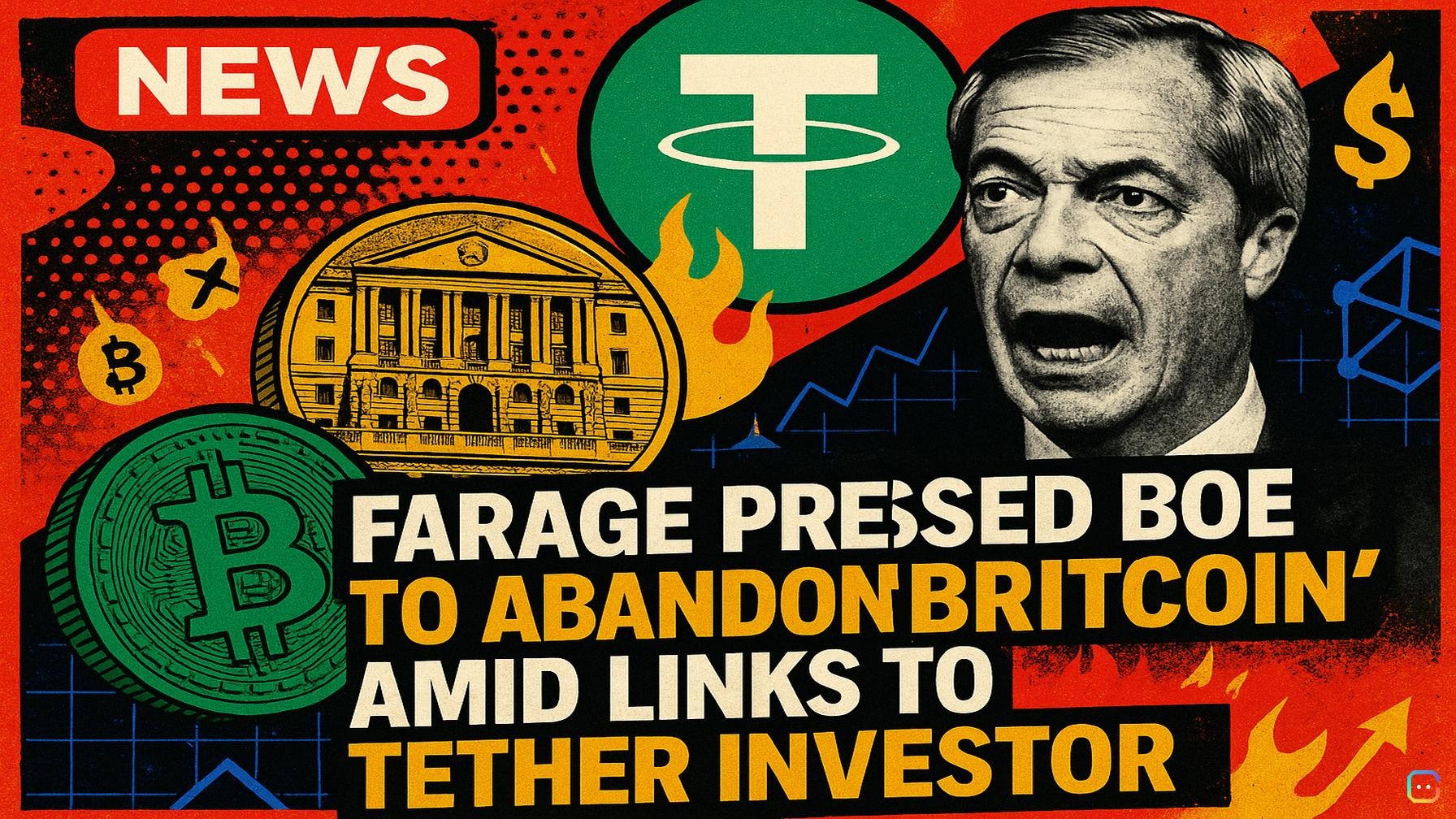
Nigel Farage has privately lobbied the Bank of England to abandon plans for a British central bank digital currency — a move that would also protect the financial interests of one of his biggest donors, industry documents and public records suggest.
What happened
- Last September Farage met Bank of England governor Andrew Bailey at Threadneedle Street and pressed him to drop plans for a state-backed digital pound, widely dubbed “Britcoin.” Farage later described the Bank’s proposals as “total and utter horror” and told a crypto audience he’d be “prepared to go to prison” to stop central bank digital currencies (CBDCs) if they were administered under a digital ID system.
- The Bank confirms the meeting was part of its engagement with political representatives and acknowledged Farage’s “differing view.” It has declined a freedom of information request for the meeting minutes, saying disclosure could inhibit frank advice.
Why this matters to crypto money players
- Christopher Harborne, a Thailand-based billionaire who has donated roughly £25m to Reform UK and is reported to have given a previously undeclared £5m personal gift to Farage, is a minority shareholder in Tether — the issuer of the world’s most widely traded stablecoin. Harborne’s donations account for about two-thirds of Reform’s funding, according to public records cited in reporting.
- Tether issues dollar-pegged “stablecoins,” tokens designed to let users move between crypto and fiat easily. An industry submission to the Bank warned that a government-issued digital pound could displace private stablecoins — cutting demand and potentially denting the profits of firms tied to that market. The Digital Currencies Governance Group (DCGG), an industry body that describes Tether as among its stakeholders, told UK authorities in 2021 there was a “significant risk” of users switching to a CBDC, “stifling growth and innovation.”
The business at stake
- Tether’s stablecoins play a central role in crypto markets and are widely used for peer-to-peer transfers and trading pairs. The company is registered in El Salvador with a small staff and has reported very large profits in recent years; media estimates have suggested those returns rival or exceed major corporate players. If Harborne’s reported 12% stake translated directly into profit share, the calculations imply very large annual gains — a figure widely cited in coverage, though Tether does not publish full audited accounts.
- Regulators and some industry voices worry a UK CBDC would reduce private stablecoin demand; DCGG urged the authorities instead to create a regulated market for private stablecoins.
Security, regulation and controversy
- Stablecoins have been linked in multiple investigations and prosecutions to money-laundering and fraud — used by some people evading sanctions, victims of “pig-butchering” romance scams, hackers, and organised-criminal networks — though companies like Tether say they work with law enforcement in dozens of jurisdictions.
- Farage frames his opposition to a digital pound chiefly as a liberty issue, warning about potential digital ID requirements and state surveillance. The Bank has not said a CBDC would require a digital ID system; many CBDC designs worldwide envisage a range of privacy and access models.
Lobbying and political ties
- Harborne’s name appears in EU lobbying records linked to DCGG in 2020–21. He has also hosted or attended high-profile political events where crypto policy was discussed. Harborne’s lawyers stress he is a minority shareholder, not an executive, and deny suggestions that his political donations were intended to influence policy on Tether’s behalf. They described recent reporting as containing “unsupported insinuations” and “conspiracy theories,” and declined further comment.
- Reform UK says Farage’s “only focus is on saving the country,” denying financial motives. Still, Farage’s public positions align with arguments made by stablecoin stakeholders: oppose a state digital currency and press for private stablecoin-friendly regulation.
What regulators are doing
- The Bank of England and Treasury say they are consulting widely — including industry, academia and public feedback — on CBDC policy and on how to address risks posed by stablecoins. Bank officials say options under consideration include possible caps or other measures for private stablecoin holdings after public consultation.
- Campaigners and transparency advocates have urged the Bank to publish more detail about high-level meetings with political figures while the UK designs its crypto regulatory framework.
Bottom line
Farage’s active opposition to a UK CBDC has become entangled with the interests of a major donor who holds a stake in one of the most influential stablecoin issuers. The episode highlights how political lobbying, donor influence and industry submissions intersect at a critical moment for UK crypto policy, as regulators weigh whether to build a state-backed digital currency, regulate private stablecoins more tightly, or pursue a hybrid approach.
Read more AI-generated news on: undefined/news